

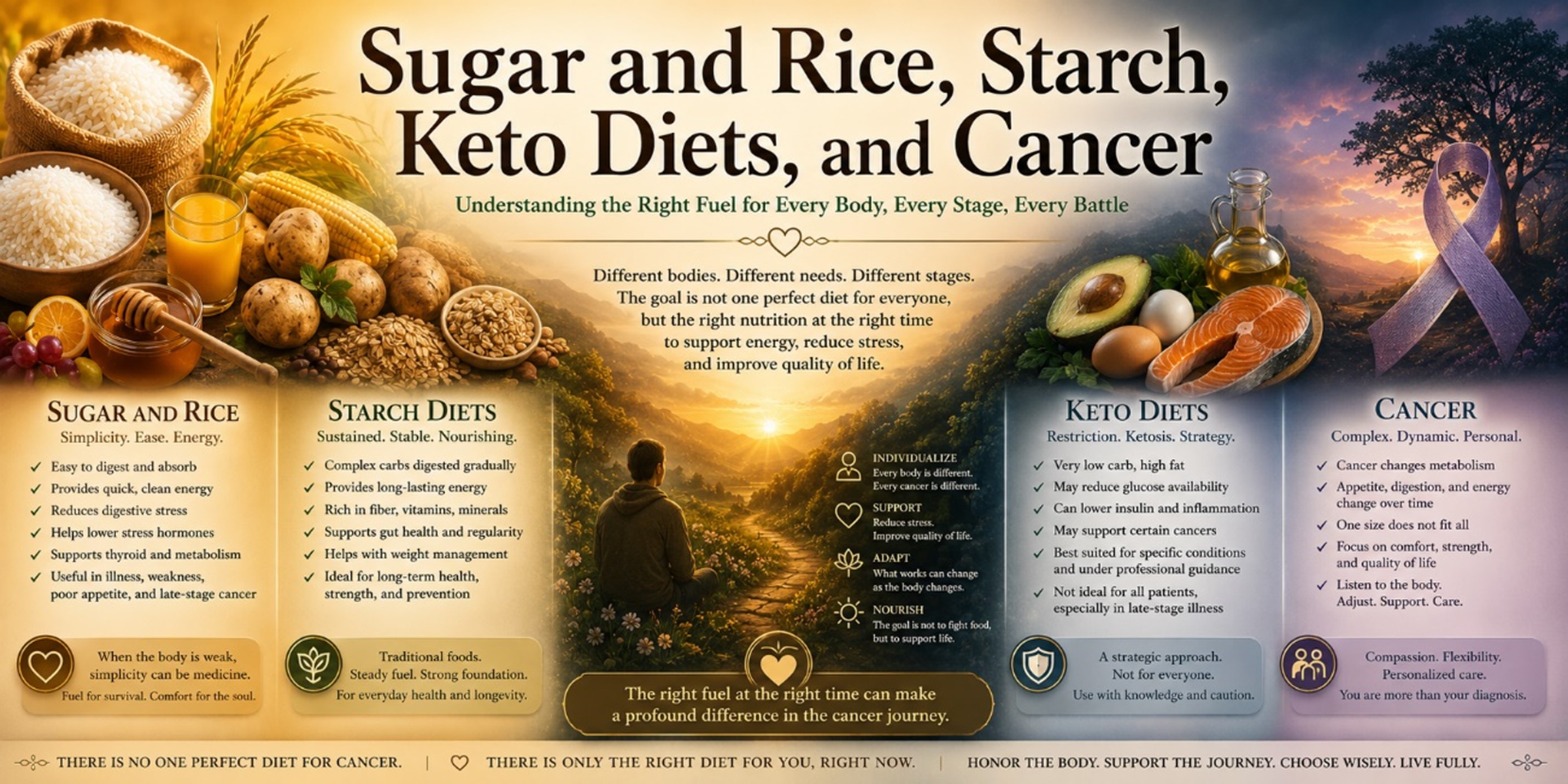
At first glance, the phrase “sugar and rice diet” sounds like a metabolic disaster—exactly the kind of thing the mainstream nutritional establishment would mock. But the fact that someone is reporting a reversal—presumably of a serious health condition—using such a diet points to something that the dietary orthodoxy refuses to grapple with.
For decades, physicians and nutritionists have passionately argued over the ideal human diet. Still, few debates are more interesting than the contrast between starch-based diets and simpler sugar-and-rice approaches. Both systems emerged from attempts to reduce disease, stabilize metabolism, and restore health, yet they arise from very different understandings of digestion, energy, and human physiology. Each approach has genuine strengths, and each reflects an important truth about the body. The real issue is not which side possesses absolute correctness, but rather what kind of body, under what conditions, needs to be nourished.
The sicker a person is, the closer to death, the more likely it is that the sugar and rice diet will shine, and there is quite a deep medical history to sustain that conclusion. Much of the discussion in this essay revolves around the critically ill, though the starch-based diet can easily meet most people’s needs, though not everyone’s.
The classic starch-centered diet has a long historical and clinical foundation. Doctors promoting a starch-based diet often emphasize potatoes, rice, oats, beans, corn, and other complex carbohydrates as humanity’s traditional fuel. Entire civilizations survived and even thrived on diets dominated by starches. Rural Asian populations historically relied heavily on rice. South American cultures centered around corn and potatoes. Many populations consuming starch-centered diets maintained low obesity and cardiovascular disease rates and relatively stable metabolic health before the introduction of modern processed foods.
One major advantage of starch-based diets is their satiety-promoting effects. Starches tend to digest more slowly, resulting in a steadier release of glucose into the bloodstream than simple sugars. This can help stabilize appetite and reduce overeating. Starch-heavy diets are also usually rich in fiber, which can support bowel regularity, beneficial gut bacteria, cholesterol reduction, and detoxification through improved elimination. Doctors who support starch-centered systems often see remarkable improvements in obesity, diabetes, blood pressure, and heart disease simply by removing processed fats, excess animal products, and ultra-processed foods while centering nutrition around whole starches.
There is also an economic and practical wisdom to starch diets. Potatoes, rice, oats, beans, and grains are inexpensive, accessible, and capable of feeding large populations efficiently. Many physicians who advocate starch-centered eating view it not merely as a nutritional intervention but as a sustainable public health strategy. From this perspective, starches represent safe, traditional, calorically stable foods that support long-term metabolic health when consumed in minimally processed forms.
The sugar-and-rice approach, however, comes from a very different understanding of illness and metabolism. Rather than focusing primarily on long-term population feeding, it often focuses on the stressed, weakened, inflamed, or metabolically compromised body. Advocates of simpler sugar-and-rice systems argue that many sick individuals no longer digest dense starches, fibers, legumes, and complex foods efficiently. They believe the digestive tract itself can become a major source of stress, inflammation, bacterial endotoxin production, fermentation, bloating, and metabolic burden.
Dr. Walter Kempner, a German physician at Duke University, famously used a diet of almost nothing but white rice, fruit, and sugar to reverse malignant hypertension and kidney failure in patients who had been given terminal diagnoses. His results were documented and published—and then largely buried by the medical establishment once pharmaceutical interventions for hypertension became the profit center.
The Kempner diet worked by being extremely low in protein and fat, effectively giving the kidneys and vascular system a metabolic “reset.” It was boring, restrictive, and required medical supervision—but it reversed conditions that were considered irreversible.
From this perspective, white rice and simple sugars are not viewed as “junk calories” but as highly efficient fuels requiring minimal digestive effort. White rice is almost pure glucose, with little fiber and minimal intestinal irritation. Simple sugars, fruit sugars, honey, or juices provide rapid energy that may help suppress stress hormones such as cortisol and adrenaline. In weakened patients, especially those suffering from chronic illness, cancer, wasting conditions, severe stress, poor appetite, or digestive collapse, the body may function better on foods that provide energy with the least physiological struggle. Spirulina, an extremely high-protein food rich in amino acids, comes to mind as I write this.
Special Note: White foods, white rice, though easy to digest, are stripped of minerals. So intravenous magnesium, magnesium bicarbonate water, magnesium chloride capsules, and even transdermal magnesium therapy need to be used to compensate not only for the lack of magnesium in these foods, but also for the fact that critically ill people are usually severely magnesium-deficient. The same could be said about iodine and selenium, both of which can be taken in liquid form for easy, non-stressful absorption.
This approach sees healing not merely as supplying nutrients but as reducing the burden. Sometimes the body does not need more complexity; it needs less friction. In this model, easily absorbed carbohydrates help spare protein breakdown, support thyroid function, stabilize energy production, and reduce the catabolic stress response that occurs when the body struggles to maintain glucose availability. Simplicity itself becomes therapeutic.
The disagreement between these two systems reflects a deeper divide in nutritional philosophy. Starch advocates often fear sugar because they associate it with obesity, insulin resistance, fatty liver disease, diabetes, and processed food culture. Sugar-and-rice advocates often fear stress physiology more than sugar itself. They argue that chronic elevation of stress hormones may damage metabolism more profoundly than moderate intake of easily digestible sugars, especially in already weakened individuals.
In truth, both systems contain important insights. The starch approach recognizes humanity’s long adaptation to complex carbohydrates and the benefits of stable, whole-food nutrition. The sugar-and-rice approach recognizes that illness changes physiology and that sick bodies often tolerate foods very differently from healthy bodies. A healthy laborer may thrive on potatoes, beans, oats, and whole grains, while a severely ill patient with gut inflammation, cachexia, exhaustion, or cancer may temporarily survive better on white rice, fruit sugars, juices, and simpler digestible foods.
The real mistake is ideological rigidity. Nutrition becomes dangerous when one philosophy attempts to explain every human condition equally. Human metabolism is dynamic, adaptive, and deeply influenced by stress, inflammation, age, disease state, digestive integrity, hormonal balance, and energy demands. What heals one person may burden another.
Perhaps the wisest conclusion is that both systems aim to solve the same problem from different angles: reducing suffering and restoring metabolic stability. One emphasizes the long-term strength of traditional starch-based nourishment. The other emphasizes simplicity, digestibility, and metabolic relief during states of physiological collapse. The body itself ultimately decides which language of nourishment it can receive at a given moment in life.
Starches Are Complex Carbs
The fact that starches are complex carbohydrates is the deeper point many people miss. Starches and sugars are often treated as opposites in nutrition wars, but physiologically, they are parallel systems far more than enemies. Both are fundamentally carbohydrate strategies. Both are attempts to provide glucose to cells. Both ultimately serve energy metabolism. The difference lies less in destination than in complexity, digestion speed, hormonal effects, and digestive workload.
A starch is essentially a long chain of glucose molecules linked together into complex carbohydrates. When you eat potatoes, rice, oats, bread, or beans, the digestive system breaks down those long carbohydrate chains into simpler sugars, primarily glucose, before they are absorbed. In other words, starches eventually become sugar anyway. The body cannot directly use “starch” at the cellular level. It must first convert it into usable glucose.
This is why the divide between starch-based systems and sugar-and-rice systems is often exaggerated. Both approaches recognize a critical fact: the body runs largely on carbohydrate energy. Both systems are, in their own way, anti-starvation strategies designed to stabilize metabolism and provide fuel for cellular respiration. They are not opposite universes. They are parallel metabolic philosophies emphasizing different forms of carbohydrate delivery.
Modern industrial diets are loaded with plant defense chemicals—lectins, oxalates, phytates, saponins—that many people cannot tolerate. White rice and sugar are among the few foods that contain virtually zero of these compounds. For someone with a compromised gut barrier, autoimmune reactivity, or chronic inflammation, stripping the diet down to the most chemically “clean” carbohydrates could allow the immune system to calm down and the gut to heal.
The starch-centered approach emphasizes gradual release. Complex carbohydrates digest more slowly, often producing steadier blood glucose curves, greater satiety, and longer-lasting energy. Fiber, resistant starches, and slower digestion create a buffering effect that can reduce rapid fluctuations in blood sugar. In healthy individuals with strong digestion and stable metabolism, this can work beautifully. The body receives a slower stream of glucose over time while also benefiting from minerals, fiber, and the physical fullness starches provide.
Likewise, starches are not automatically benign simply because they are complex. Some people digest starch poorly, leading to bloating, endotoxin formation, fermentation, gas, inflammation, and unstable blood sugar responses. Others thrive on them. Human metabolism is not uniform. Some people thrive and heal from carnivorous diets. For those with severe digestive or autoimmune issues, a meat-only diet can function as a powerful elimination diet and may provide significant symptom relief. A strict meat-based diet eliminates many foods that commonly cause problems in certain susceptible individuals.
The fascinating reality is that both approaches quietly acknowledge the same truth modern low-carbohydrate dogmas often resist: glucose is central to human metabolism. The disagreement is not whether carbohydrates matter. The disagreement is how best to deliver carbohydrate energy under different physiological conditions.
The starch doctor and the sugar-and-rice advocate are both fundamentally trying to support energy metabolism, preserve tissue integrity, reduce catabolism, and stabilize physiology. One chooses complexity and gradual digestion. The other chooses simplicity and rapid availability. But beneath the nutritional arguments, they are parallel roads leading toward the same biological destination: maintaining the body’s ability to generate energy and sustain life.
Cancer: Carbohydrates Vs Fats

The debate between ketogenic cancer diets and simpler carbohydrate-based approaches reveals one of the deepest conflicts in modern nutritional medicine: is the weakened body best served by restricting glucose or by protecting energy production at all costs? Both sides are trying to solve the same fundamental problem — the metabolic chaos of cancer — yet they approach the problem from almost opposite directions.
The ketogenic diet has gained enormous attention in cancer circles because it attempts to exploit one of cancer’s best-known metabolic characteristics: many tumors consume glucose aggressively. Inspired in part by Otto Warburg’s work, ketogenic advocates argue that reducing carbohydrate intake while increasing fat intake forces the body into ketosis, a state in which ketones and fats become the primary fuel sources rather than glucose. The theory is elegant. If cancer cells rely heavily on glucose fermentation while healthy cells retain greater metabolic flexibility, then reducing glucose availability may place metabolic stress on tumors while preserving normal tissues.
There are genuine strengths in this approach. Ketogenic diets can lower insulin levels, stabilize blood sugar, reduce obesity, improve metabolic syndrome, and, in some cases, reduce inflammation. Some cancer patients report temporary improvements in energy, mental clarity, appetite control, or symptom management. Researchers continue investigating whether ketosis may sensitize tumors to radiation or chemotherapy or reduce certain growth signals that cancers exploit. The ketogenic approach is neither irrational nor without scientific foundation.
But late-stage cancer is not simply a tumor problem. It is often a systemic collapse of the organism itself. This is where the conversation becomes far more complicated than simplistic slogans about “starving cancer with no sugar.” Too much sugar is a problem for everyone; at this point, it’s a civilizational problem that should never be underestimated.
However, advanced cancer frequently produces cachexia — one of the most devastating metabolic conditions in medicine. Cachexia is not ordinary weight loss. It is a hypercatabolic state in which the body progressively consumes its own muscle, fat, and other tissues despite adequate caloric intake. Stress hormones rise. Appetite disappears. Digestion weakens. Nausea increases. Energy production falters. The body enters survival physiology. In many patients, the cancer itself becomes only part of the crisis. The greater danger is the body’s progressive inability to sustain life.
Under these conditions, the idea of forcing a severely weakened patient into a rigid high-fat, low-carbohydrate metabolic state may not be therapeutic. Many advanced cancer patients struggle profoundly with fat digestion. Their appetite for fatty foods collapses. Bile production weakens. Pancreatic function deteriorates. Nausea intensifies. The digestive system itself may become exhausted. What looks elegant on paper can become physiologically overwhelming inside a failing organism.
This is where the sugar-and-rice philosophy emerges as a radically different but surprisingly coherent alternative. Rather than emphasizing carbohydrate restriction, this approach attempts to reduce digestive burden while preserving energy availability. White rice, fruit sugars, honey, juices, and other simple carbohydrates are viewed not as enemies but as readily available fuels that require minimal digestive effort. White rice itself occupies an interesting middle ground because it is technically a starch yet metabolically behaves more like a rapidly available carbohydrate due to its low fiber content and easy digestibility.
Advocates of simpler carbohydrate feeding argue that late-stage illness is often characterized less by “too much glucose” than by energy failure itself. The body is exhausted. Stress hormones like cortisol and adrenaline rise in response to unstable blood sugar and inadequate fuel availability. Protein breakdown accelerates. The organism begins cannibalizing itself. In this framework, easily digestible carbohydrates may reduce stress chemistry, spare muscle tissue, support thyroid function, and maintain caloric intake in patients who can no longer tolerate heavier foods.
The irony is that both ketogenic advocates and sugar-and-rice advocates are ultimately concerned with the same issue: mitochondrial energy metabolism. Both sides recognize that cancer involves profound metabolic dysfunction. The ketogenic diet attempts to deprive tumors of preferred fuels. The sugar-and-rice side attempts to preserve the organism’s remaining metabolic stability and prevent further collapse. One emphasizes metabolic restriction. The other emphasizes metabolic support.
The mistake occurs when either approach becomes ideological rather than clinical. Human physiology is dynamic, not dogmatic. A metabolically healthy overweight individual with early insulin resistance is not physiologically equivalent to a cachectic late-stage cancer patient barely maintaining or massively losing body weight. The body undergoes dramatic changes during severe illness. Digestive capacity changes. Hormonal signaling changes. Energy demands change. What may help one metabolic state may harm another.
Modern nutrition debates often descend into tribal warfare because people search for universal dietary laws that do not exist. Biology is adaptive. Context governs physiology. A body in collapse does not process food the same way as a body in strength. The question should never be whether carbohydrates or fats are morally superior. The real question is: what form of nourishment can this organism still utilize without increasing stress and deterioration?
Late-stage cancer exposes the limits of rigid nutritional ideology. Some patients may temporarily benefit from ketogenic strategies. Others may survive longer and suffer less by consuming simple, digestible carbohydrates that maintain energy and reduce digestive strain. The body itself ultimately determines which strategy it can tolerate.
Perhaps the deeper lesson is that cancer is not merely a disease of cells. It is a disease of the entire terrain of life — metabolism, digestion, stress physiology, inflammation, mitochondria, hormones, appetite, and the organism’s fading capacity to generate energy. Any nutritional approach that ignores this complexity risks becoming another theory imposed upon a suffering human being rather than a true response to the realities of illness.
Sugar and Sodium Bicarbonate
Perhaps this discussion is important for patients who use baking soda as a basic form of chemotherapy, answering whether to use something like blackstrap molasses or even honey with sodium bicarbonate. I have written extensively about using bicarbonates and carbon dioxide (two forms of the same thing) in the treatment of cancer.
Conclusion
None of this is an endorsement of running out and eating nothing but sugar and rice. Any extreme dietary intervention carries risks. There is no end to belief systems about diet, but food is beyond philosophy. In the end, the body must decide what is best for itself.
For most of the last 80 years, the Rice Diet has been a historical curiosity. That changed recently. In 2019, a team at Duke and the Hasso Plattner Institute in Germany began digitizing Kempner’s handwritten patient charts. They built a database of 17,487 patients, each with more than 110 health markers, plus 55,332 retinal photographs. Three peer-reviewed papers have emerged from this project so far: in BMJ Nutrition Prevention & Health (2024), in Hypertension (2026), and a long-term follow-up preprint (2026). The findings broadly confirm what Kempner reported. The healing was real.
What the diet actually looked like, Kempner published the original protocol in JAMA in 1944. It provided about 2,000 to 2,400 calories per day, roughly 95% of which came from carbohydrates. Protein was around 20 grams, mostly from the rice itself. Fat was almost nonexistent, at around 2-3% of calories. Sodium intake was kept below 150 mg per day, about a tenth of the amount most people consume. Fluid intake was capped at 700-1,000 ml. A multivitamin covered the B-vitamin gaps caused by eating polished white rice. (Spirulina is the best multivitamin.)
Sugar was given freely, with no upper limit. Most patients consumed around 100 grams a day, but some took in up to 500 grams to maintain their body weight. Underweight patients were fed more. The whole purpose was healing, not weight loss.
Dr.Sircus is a reader-supported publication. To receive new posts and support my work, consider becoming a free or paid subscriber.
Subscribe now

comments