

There is a principle in physics — the Heisenberg Uncertainty Principle — that warns us: the more narrowly you focus on one thing, the less you can see the whole. The Heisenberg Principle is one of the most profound and counterintuitive ideas in all of physics. It comes from quantum mechanics and was formulated by Werner Heisenberg in 1927. You cannot simultaneously know both the exact position and the exact momentum (speed + direction) of a particle. The more accurately you measure one, the less accurately you can know the other.
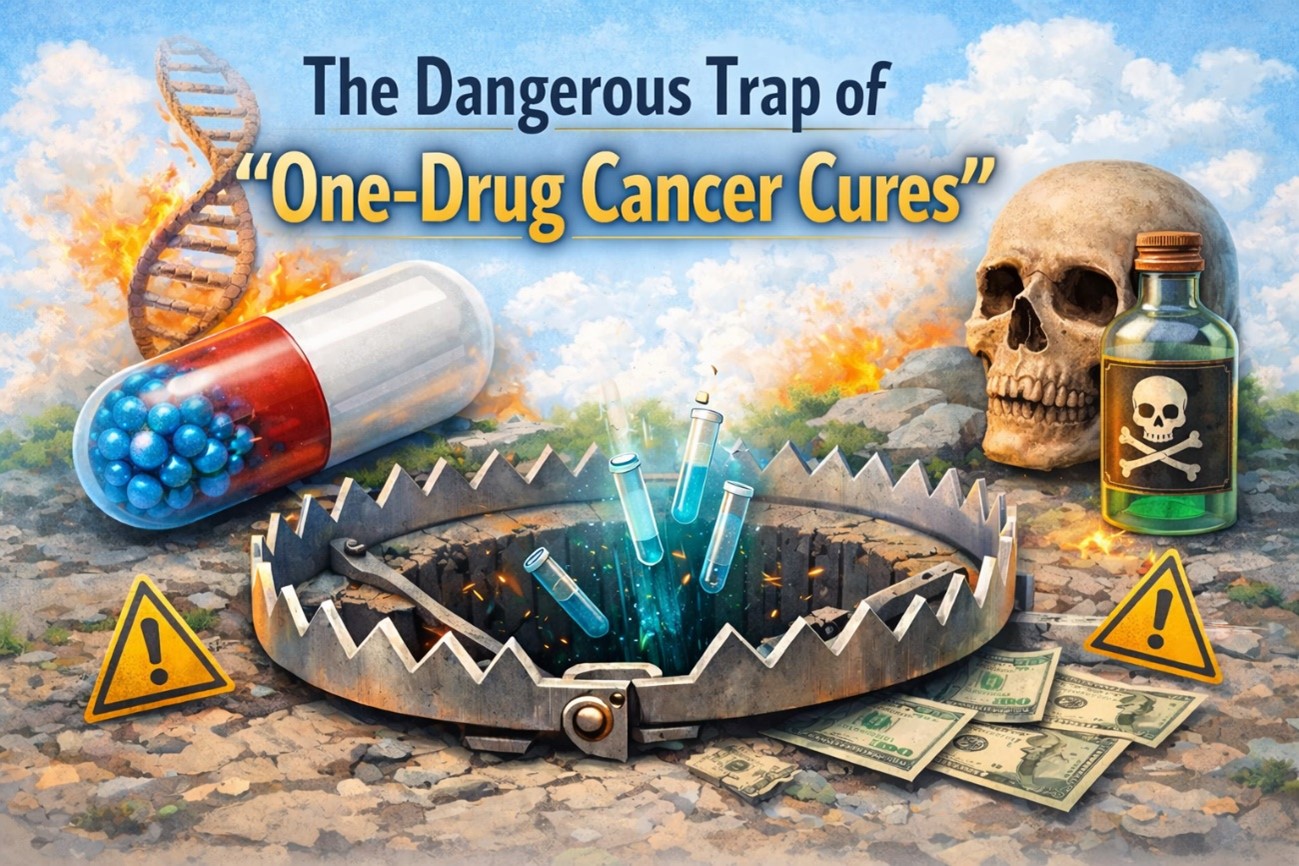
The Principle exposes a fatal flaw in modern thinking: the tighter you focus on one thing, the more blind you become to everything else. This is exactly what medicine has done with cancer—and now the same mistake is being repeated by those claiming to challenge it with alternative repurposed drugs. Ivermectin. Fenbendazole. The new “miracle cures.” Different molecules, same blindness.
Ivermectin and Fenbendazole have generated real excitement in some circles because laboratory studies and anecdotal reports suggest they can interfere with cancer cell metabolism, inhibit certain pathways, and trigger apoptosis in some tumor models. Some patients report remarkable responses when using them off-label. These observations deserve respectful investigation, not dismissal. However, turning them into miracle cures — promoted as the one thing you need while ignoring the rest of the terrain — repeats the same narrow-focus mistake that has failed patients for decades.
Yes, these drugs show activity. However, those who promote these repurposed drugs never talk about the dangers, the side effects. I have had a few patients on these drugs. One died. Another just on Ivermectin had side effects strong enough almost to kill him.
Cancer is not a target. It is a collapse. It is what happens when the terrain fails—when inflammation burns unchecked, when mitochondria lose their ability to produce energy, when oxygen can no longer be properly utilized, when the body acidifies, when magnesium disappears, when insulin signaling breaks down, when membranes oxidize, and communication between cells degrades.
And no drug—none—fixes that. Not chemotherapy. Not immunotherapy. Not Ivermectin. Not Fenbendazole. A molecule can interrupt a pathway. It cannot rebuild a system. Yet the obsession continues. Kill the cell. Block the receptor. Stop the signal. Always narrower. Always more precise. Always more blind to the whole and the natural medicines that target the terrain, target the whole.
Endocrinology has already proved where this leads. Doctors stare at blood sugar numbers, prescribe metformin, push statins, and call it treatment—while the patient continues to deteriorate underneath. Magnesium deficiency remains. Acidosis remains. Mitochondrial failure remains. The terrain continues to collapse. They are managing numbers, not restoring health.
Cancer care—both conventional and alternative—is walking the same path. Replacing chemotherapy with a different “magic bullet” is not a revolution. It is the same philosophy wearing a new disguise. Reductionism does not become wisdom just because the molecule changes. The body does not heal through isolated interventions. It heals through coherence to a vision that exposes the entire picture.
Magnesium. CO₂ and bicarbonate balance. Oxygen. Membrane repair. Mineral repletion. Metabolic stability. These are not optional. These are the foundations. Without them, every “cure” becomes another temporary interference in a system that remains fundamentally broken.
This is the uncomfortable truth no one wants to hear. There is no single cure because cancer is not a single problem. And the search for one—whether in a pharmaceutical lab or an alternative forum—is itself part of the reason so many fall to cancer. And of course, the whole situation is complicated because there are at least 100 treatment options or more to choose from.
The real danger is not the drugs. The real danger is the mindset that demands simplicity in an irreducibly complex system. The need for one answer, one solution, one savior molecule—that is the trap. The body heals as a system, or it does not heal at all. And cancer recedes not when we find the next headline drug—but when we restore the terrain so completely that cancer no longer has a reason to exist.
The real power lies in the whole. These repurposed agents may serve as useful tools within a comprehensive terrain-based approach, but they are not replacements for restoring the foundational essentials the body needs to heal. Narrow obsession with any single compound — whether a pharmaceutical, a repurposed drug, or even a natural substance — closes our eyes to the larger picture. True cancer reclamation requires seeing and addressing the entire metabolic collapse, not just hunting for the next “cure” headline. The body heals when the whole terrain is reclaimed, not when we fixate on one molecule and forget everything else.
Dr.Sircus is a reader-supported publication. To receive new posts and support my work, consider becoming a free or paid subscriber.
Subscribe now

comments