

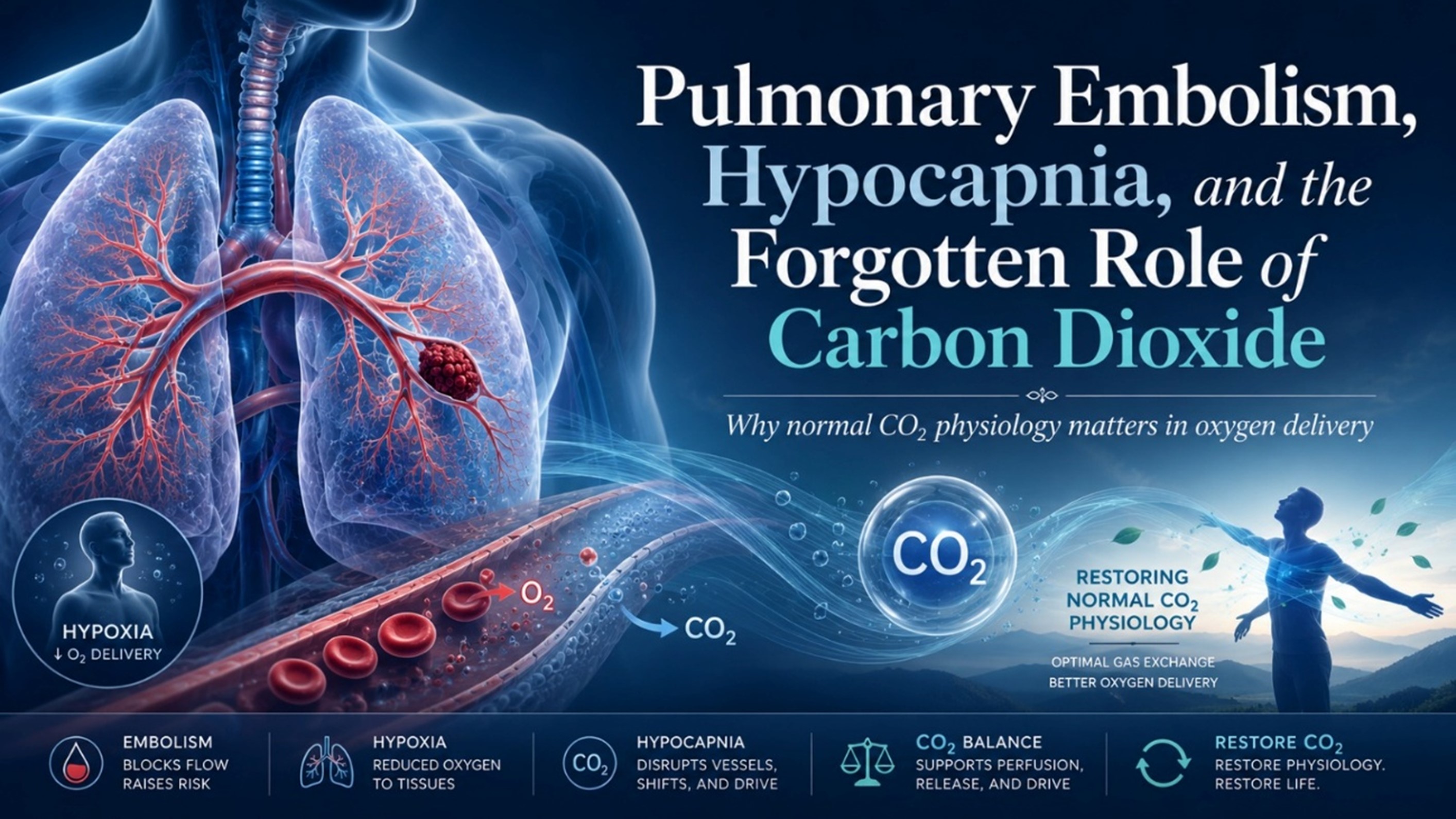
Pulmonary embolism is usually described as a disease of blood clots and oxygen deprivation. That is correct, but incomplete. A clot obstructs part of the pulmonary circulation; blood can no longer flow normally through sections of the lungs, pressure can suddenly rise in the pulmonary arteries, and the right side of the heart may be forced to work against an enormous new resistance. In severe cases, circulation collapses. This is why anticoagulation, thrombolysis, catheter intervention, or surgical clot removal can be lifesaving. Carbon dioxide does not dissolve a pulmonary embolus, and it should never be presented as a substitute for treatment directed at the obstruction itself.
Yet pulmonary embolism also profoundly disturbs respiratory physiology, and carbon dioxide sits at the center of it.
One characteristic finding in acute pulmonary embolism is hypocapnia—abnormally low arterial carbon dioxide. The embolus creates areas of physiological dead space: regions of the lung continue to receive air but receive little or no blood because the pulmonary vessels are blocked. The patient frequently responds by breathing faster and deeper. Hyperventilation increases, carbon dioxide is blown off, PaCO₂ falls, and respiratory alkalosis develops.
Thus, a patient, often a child, with compromised pulmonary circulation can simultaneously develop carbon dioxide deficiency. That should immediately attract our attention because carbon dioxide is not simply an exhaust gas waiting to be removed from the body. CO₂ is one of the great regulators of respiration, circulation, blood pH, vascular tone, and oxygen delivery. When carbon dioxide falls too far, physiology changes everywhere.
Low CO₂ shifts the oxyhemoglobin dissociation curve to the left. Hemoglobin becomes more reluctant to release the oxygen it carries. Oxygen may therefore be present in the bloodstream while delivery at the tissue level becomes less favorable. This is one of the central lessons of the Bohr effect: oxygen and carbon dioxide physiology cannot be intelligently separated.
Pulmonary embolism already compromises oxygen delivery because blood flow through parts of the lung has been obstructed. If the resulting hyperventilation then drives CO₂ downward, the body may face a second problem: the oxygen that does reach the blood can become more tightly bound to hemoglobin precisely when endangered tissues need oxygen released.
This makes pulmonary embolism a dramatic example of why oxygen saturation alone does not tell the whole story of oxygen physiology. You can put oxygen into the lungs, but if blood cannot reach a region of the lung because an artery is blocked, oxygen cannot correct that obstruction. Even where oxygen enters the circulation, severely reduced CO₂ can alter its delivery to tissues.
Hypocapnia also influences the circulation directly. Low carbon dioxide can produce vasoconstriction, particularly in cerebral blood vessels, reducing cerebral blood flow. It changes acid-base balance and affects cellular and nervous-system function. The combination of impaired pulmonary perfusion, reduced oxygen availability, hyperventilation, falling CO₂, and respiratory alkalosis creates a complex physiological crisis—not simply an oxygen shortage.
This leads to an important therapeutic question. If carbon dioxide has fallen significantly below normal, why should medicine automatically regard that as an irrelevant consequence of the disease rather than another physiological abnormality worth correcting? The objective would not be to produce hypercapnia. That distinction is essential.
Hypocapnia, Normocapnia, and Hypercapnia
There is an enormous physiological difference between hypocapnia, normocapnia, and hypercapnia. Carbon dioxide is not a substance for which more is always better. Like oxygen, glucose, temperature, sodium, pH, and countless other physiological variables, it exists within an optimal range.
Too little can be harmful. Too much can be harmful. The objective is physiological normality.
Studies showing that substantial elevations of carbon dioxide can increase pulmonary vascular resistance are important, particularly because pulmonary artery pressure may already be dangerously elevated during a major embolism. But those observations concern hypercapnia. They do not answer the separate question of whether restoring an abnormally low PaCO₂ toward normal could improve aspects of oxygen delivery and vascular physiology.
Suppose a pulmonary embolism patient has a PaCO₂ of 25 or 28 mmHg because of severe hyperventilation. Asking whether carefully bringing that value toward approximately normal physiology might be beneficial is fundamentally different from deliberately driving CO₂ to 50 or 60 mmHg. We should stop treating those situations as identical.
Hypocapnia is not normocapnia. Normocapnia is not hypercapnia. Medicine readily accepts this principle with almost every other physiological variable. If oxygen is abnormally low, physicians attempt to correct it. If blood glucose is dangerously low, they correct it. If potassium is deficient, physicians replace potassium. If body temperature becomes dangerously low, physicians warm the patient.
Yet carbon dioxide is still frequently thought of primarily as something the body must eliminate. That view is physiologically obsolete, meaning doctors are functionally back in the dark ages.
Carbon dioxide is intimately connected to oxygen release, blood pH, vascular tone, respiratory drive, and cellular metabolism. Consequently, pathological CO₂ deficiency deserves more attention than it generally receives from modern medicine.
This does not mean that inhaled carbon dioxide should suddenly become a do-it-yourself treatment for pulmonary embolism. Acute pulmonary embolism can be rapidly fatal, and the primary emergency remains restoration and protection of the circulation. Anticoagulation and, when indicated, reperfusion therapy remain central because the clot itself must be dealt with. A severely stressed right ventricle is also extremely sensitive to changes in pulmonary vascular resistance, blood pressure, ventilation, oxygenation, and acid-base status.
There is presently no established clinical protocol saying that pulmonary embolism patients with hypocapnia should routinely receive inhaled CO₂. That evidence would need to come from carefully designed clinical studies, but waiting for such research would cost lives.
The absence of an established treatment protocol should not close the physiological question. It should open it. The reality is clear; the treatment is logical. Restoring physiological CO₂ in appropriately selected hypocapnic patients would improve tissue oxygen unloading, stabilize acid-base physiology, reduce some consequences of excessive hyperventilation, or otherwise improve the patient’s condition. At the same time, conventional treatment addresses the embolus itself.
That is a completely different proposition from inducing hypercapnia. The distinction is everything. Doctors avoid even thinking about this issue because their minds default to hypercapnia.
Pulmonary embolism demonstrates one of the deepest principles in respiratory medicine: oxygen delivery is not an oxygen-only phenomenon. It depends upon ventilation, blood flow, hemoglobin, cardiac output, vascular tone, cellular metabolism—and carbon dioxide.
When a pulmonary artery becomes blocked, circulation and gas exchange are violently separated. Some alveoli receive oxygen without receiving blood. The body responds with hyperventilation. CO₂ falls. Blood becomes more alkaline. Hemoglobin’s affinity for oxygen increases. The entire oxygen-delivery system is disturbed.
What begins as a clot becomes a whole-body disturbance of respiratory physiology. That is why carbon dioxide belongs in the discussion. Not as a magical clot-busting agent. Not as a replacement for anticoagulants or emergency intervention. Not as an excuse to create dangerous hypercapnia.
But as a fundamental physiological variable whose deficiency may compound an already dangerous disturbance in oxygen delivery. Perhaps the most useful therapeutic principle is therefore surprisingly simple: Measure the carbon dioxide. If it is pathologically low, understand that restoring it toward physiological normality would help.
Dr.Sircus is a reader-supported publication. To receive new posts and support my work, consider becoming a free or paid subscriber.
Subscribe now

comments