

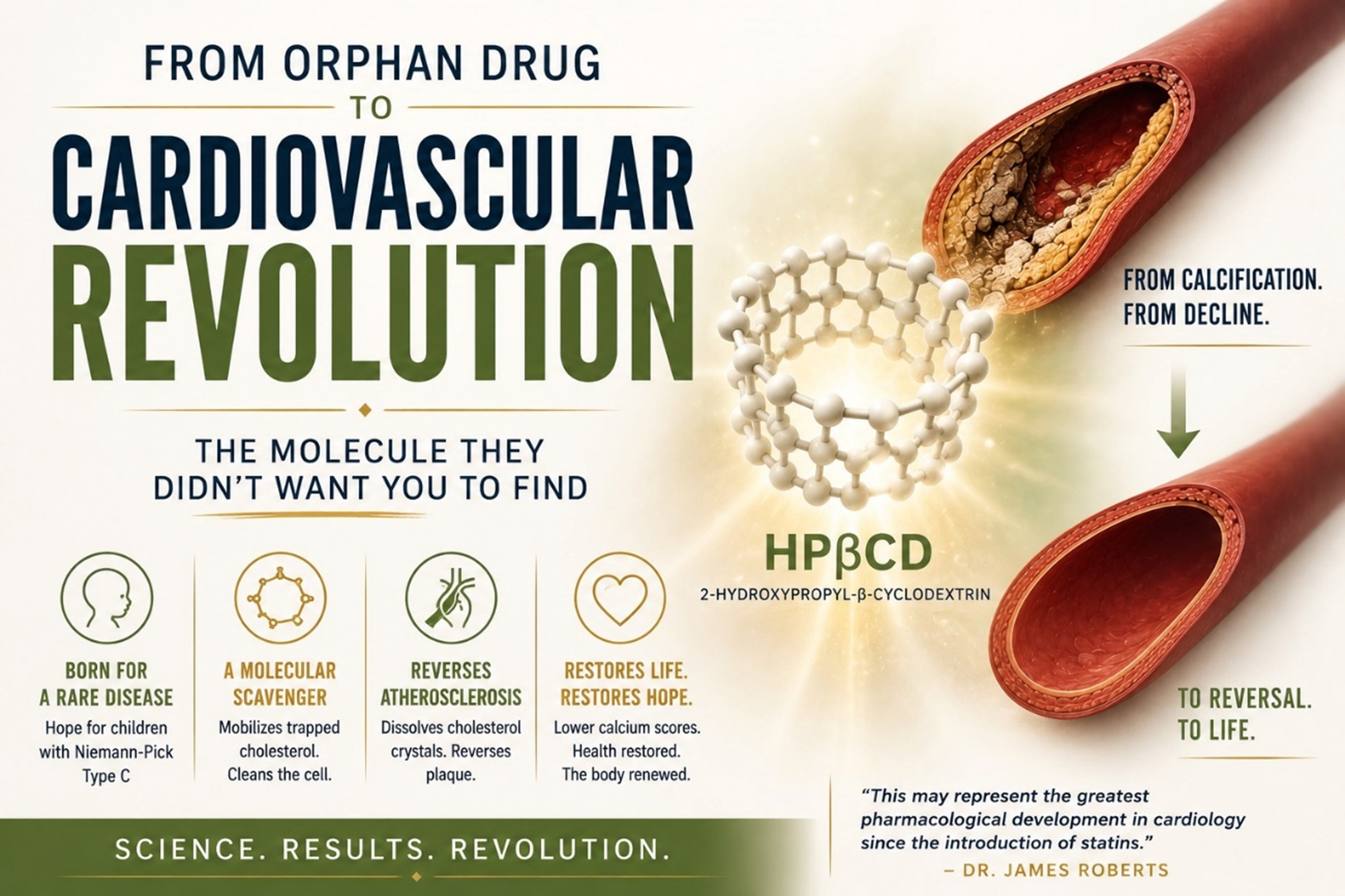
This essay shifts the focus from the “what” to the “why”—explaining how a molecule meant for a rare genetic disorder became the ultimate weapon against the world’s leading killer, and why the pharmaceutical industry is terrified of the implications.
In the world of drug development, there is a rigid hierarchy of value. At the top sit the “blockbusters”—patented, proprietary molecules that cost hundreds of thousands of dollars per patient and can move corporate stock prices. At the bottom sit the “orphan drugs”—compounds developed for rare, niche conditions where patient populations are small, and profit margins are slim.
But sometimes, a molecule escapes the box. Sometimes, a compound designed for a niche corner of medicine reveals itself to be a solution to the world’s greatest health crisis. This is the story of 2-hydroxypropyl-β-cyclodextrin (HPβCD).
The Niemann-Pick Origin Story
For years, HPβCD lived in the medical shadows. It was a tool used for Niemann-Pick Type C (NPC) disease, a devastating, rare, and fatal genetic disorder that prevents the body from properly transporting cholesterol within cells. Children with NPC suffer from a tragic accumulation of cholesterol in their tissues, leading to progressive neurological decline.
HPβCD didn’t “cure” the underlying genetic defect. Still, it performed a logistical miracle: it acted as a molecular “scavenger,” entering cells and solubilizing the trapped cholesterol so the body could finally move and excrete it. It was a lifeline for a small group of suffering families.
While the medical establishment focused on NPC, a few researchers were examining its broader implications. If this molecule could mobilize trapped cholesterol in a rare genetic disorder, what would happen if you applied it to the most common form of cholesterol-driven pathology on earth? Atherosclerosis!
The Jump to the Mainstream Killer
The leap from Niemann-Pick to cardiovascular disease is not just a change in target; it is a change in worldview.
In 2016, a landmark paper in Science Translational Medicine by Zimmer et al. blew the lid off the potential. They didn’t just show that HPβCD worked in a test tube; they showed it could dissolve cholesterol crystals, reprogram pro-inflammatory macrophages, and actually reverse arterial plaque in animal models—even in subjects forced to stay on a high-cholesterol diet.
This was the “Eureka” moment. It proved that atherosclerosis is not just a metabolic problem to be managed with statins that no one should be taking; it is a structural problem that can be actively reversed.
Why This Is a Threat to the “Profit-Driven Pipeline”

To understand why HPβCD isn’t the standard of care today, you have to understand how the “Profit-Driven Pipeline” functions.
The pharmaceutical industry does not invest in cures that you can buy for $92 a box. They invest in products they can patent, protect, and market as the only “evidence-based” option. HPβCD is off-patent. It is a simple, sugar-based cyclic oligosaccharide that has been FDA-approved for decades as an excipient—a “helper” ingredient used to carry other drugs.
You cannot build a $15 billion-a-year market on a compound that belongs to everyone and no one.
When a molecule like cyclodextrin comes along, it destroys the industry’s business model. It is:
- Off-patent: No monopoly pricing.
- Non-toxic: It bypasses the “side-effect management” revenue stream (where they sell you a drug for your heart and then another drug for the diabetes that the drug caused).
- Self-administrable: It doesn’t require a doctor to inject it or a hospital to monitor it. It can be injected, but for at-home use, the above is a liquid suppository.
This is why the jump from orphan drug to cardiovascular revolution has been blocked. It isn’t because the science failed. It is because the science succeeded too well. It provided a low-cost, high-efficacy solution in an industry that relies entirely on high-cost, low-efficacy management.
The Revolution Is Happening Anyway
Despite the institutional silence, the “orphan drug” is now fueling a revolution. Doctors like Dr. James Roberts and researchers at institutions like Griffith University are documenting what happens when you take a tool designed for cellular cleanup and apply it to the plumbing of the human heart.
They are seeing calcium (CAC) scores drop. They are seeing stenosed arteries open up. They are seeing patients who were told their condition was “incurable” return to life. I am one of the blessed who survived to tell this tale after suffering two almost totally blocked cardiac arteries. No sents, no heart attack. Now I dance in front of my computer and enjoy the good life.
We are watching a classic case of an “orphan” finding its true calling. HPβCD was designed to save a handful of children from a rare disease. It turns out, it was designed to save millions of adults from the slow, hardening death of arterial collapse.
The industry may ignore it. They may starve it of funding. They may pretend the clinical data doesn’t exist. But the molecule doesn’t care. It does what it was designed to do: it cleans the terrain. Strips cholesterol right out of the plaque and wastes no time doing so. Some patients with angina report relief after a few weeks to a month of daily, or as recommended for the first month, twice-a-day application.
And for those of us who have used it, the “orphan” is no longer a niche curiosity. It is the center of a new medical reality. Too bad cardiologists cannot even see their way to magnesium as the ultimate heart medicine. To 99.9% of cardiologists, HPβCD is on the far side of Pluto.

Dr. Mark Sircus is the author of Unclogging Your Arteries and can be seen on his site, Natural Cardiology. He is a reader-supported writer. To receive new posts and support this work, consider becoming a Substack paid subscriber.
Dr.Sircus is a reader-supported publication. To receive new posts and support my work, consider becoming a free or paid subscriber.
Subscribe now

comments