

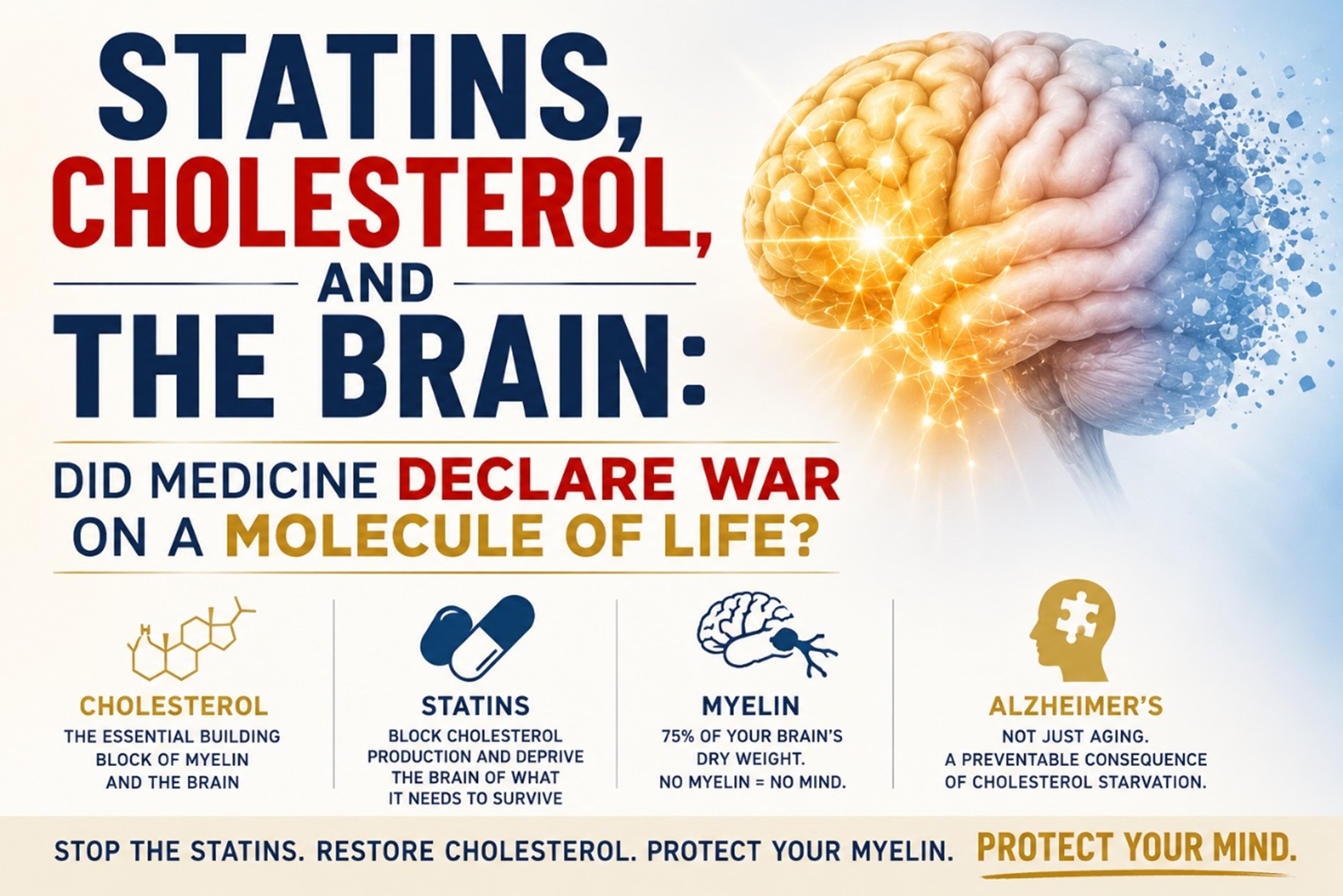
Dr. Joel Wallach makes a devastating accusation: “Alzheimer’s is a physician-caused disease.” His argument cuts straight through decades of cholesterol fear and forces medicine to confront a basic physiological question: What happens when doctors spend generations teaching people to fear one of the most essential molecules in the human brain?
Dr. Wallach’s statement cuts through decades of pharmaceutical propaganda with a single, brutal truth: Alzheimer’s is not a mystery; it is a predictable consequence of cholesterol starvation. We need to understand the biochemistry behind this, because once we see the mechanism, we can never unsee the crime.
Cholesterol forms a critical part of myelin—the fatty insulation surrounding nerve fibers that allows rapid electrical communication. Myelin is not a decorative material. It is the biological insulation of the nervous system that allows it to function. Destroy the insulation around an electrical wire, and the signal fails. Damage to myelin and the brain’s communication networks begins to break down.
The brain is not a bowl of jelly; it is a highly structured, electrical organ. 75% of its dry weight is myelin—the fatty, white insulation wrapped around every nerve fiber. Myelin is what allows electrical signals to travel at high speed, with precision, without short-circuiting.
Myelin is composed almost entirely of cholesterol. The brain contains roughly 25% of the body’s total cholesterol, despite being only 2% of body weight. It is the single most cholesterol-dense organ in existence. Cholesterol is not a “risk factor” for the brain; it is the primary structural material.
For half a century, cholesterol has been treated almost like a poison circulating through the bloodstream, something to suppress, block, and drive lower. Yet the same molecule condemned in cardiology offices is one of the most precious structural molecules in the nervous system. So, to answer the question, yes, modern medicine and our precious doctors did declare war on a most essential molecule of life.
The brain is the most cholesterol-rich organ in the body. Although it represents only about 2% of body weight, it contains roughly a quarter of the body’s cholesterol. Nature did not make a mistake. The brain concentrates cholesterol because it needs cholesterol.
Our memories, your movement, our personality, and our identity depend on the integrity of these biological circuits. The question that should have haunted medicine from the beginning is simple: How can a molecule essential for building the brain be treated only as an enemy?
Statin drugs work by inhibiting HMG-CoA reductase, a key enzyme in the mevalonate pathway. But this pathway does not produce only cholesterol. It is part of a deeper biological manufacturing system responsible for multiple compounds required for life. When this pathway is suppressed, the consequences cannot be judged solely by a cholesterol number on a blood test.
A starving neuron does not think better. A failing mitochondrion does not produce health. A damaged membrane does not create a stronger brain. The entire philosophy of forcing cholesterol lower and lower is pretty much insane. deserves examination because biology is built on balance, not elimination. Cholesterol participates in membrane structure, hormone production, vitamin D metabolism, bile acid production, and neurological function.
Medicine became obsessed with cholesterol as a cardiovascular risk marker while forgetting cholesterol as a molecule of life. Modern medicine seems almost suicidal in the long run because it is so into doing things wrong.
The explosion of Alzheimer’s disease and neurodegenerative disorders demands that we ask hard questions. Doctors cannot ignore the biological systems involved, but they do: cholesterol metabolism, myelin repair, mitochondrial decline, inflammation, oxidative stress, vascular health, insulin resistance, and nutrient deficiencies.
The brain can repair itself if given the right materials. The first step is the most obvious: stop the statins. The second step is to provide the essential nutrients that the statins depleted:
The medical establishment told a generation to fear cholesterol, to fear eggs, to fear butter, and to swallow a pill that would “protect” their hearts. They protected the heart by starving the brain. The result is millions of people losing their memory, their identity, and their dignity—suffering from a condition that is not a natural part of aging but a physician-caused disease.
Dr. Dwight Lundell, former Chief of Staff and Chief of Surgery at Banner Heart Hospital in Arizona, shocked many when he publicly challenged the cholesterol-centered model of heart disease. After decades as a cardiovascular surgeon, he wrote:
“We physicians, with all our training, knowledge, and authority, often acquire a rather large ego that tends to make it difficult to admit we are wrong. So, here it is. I freely admit to being wrong. As a heart surgeon with 25 years of experience, having performed over 5,000 open-heart surgeries, today is my day to right the wrong with medical and scientific facts.”
Dr. Lundell’s main argument was that modern cardiology had focused too narrowly on cholesterol while missing the deeper driver of arterial disease: chronic inflammation and injury to the arterial wall.
The scale of statin use is staggering. What began as a targeted pharmaceutical intervention for high-risk cardiovascular patients has expanded into one of the largest drug campaigns in history. Tens of millions of Americans now take statins, making them among the most commonly prescribed medications in the United States.
The pharmaceutical industry successfully transformed cholesterol into a public enemy and convinced generations of doctors and patients that driving cholesterol lower was the pathway to preventing future disease. The message was simple: cholesterol is dangerous, lower is better, and statins are protection.
One of the most uncomfortable observations in the cholesterol debate is that the relationship between cholesterol and survival is not as simple as “lower is always better.” Several large population studies have reported that people with very low cholesterol levels can have higher rates of death than those with moderate cholesterol levels.
Cholesterol Deficiency
The missing concept in modern cholesterol discussions is something seldom mentioned: cholesterol deficiency. A shortage of the materials required for maintenance and repair eventually has consequences. You cannot build a house without lumber. You cannot maintain electrical wiring without insulation. And you cannot maintain biological membranes without the molecules that build them.
Medicine has spent decades warning about the dangers of excess cholesterol, but it rarely asks the opposite question: What happens when cholesterol becomes too low for optimal biological function?
The brain exposes the weakness of the “lower is always better” philosophy. The nervous system is extraordinarily dependent on lipids. Cholesterol is a major structural component of myelin, the insulating sheath that allows neurons to communicate efficiently. The brain maintains its own tightly regulated cholesterol metabolism because proper cholesterol balance is essential for neurological function.
Statins are Poisonous for the Heart
A review published in Clinical Pharmacology suggests that statins may act as “mitochondrial toxins,” impairing heart and blood vessel muscle function by depleting coenzyme Q10 (CoQ10), an antioxidant used by cells for growth and maintenance. Multiple studies show that statins inhibit CoQ10 synthesis; thus, anyone following their cardiologist’s advice should supplement their diet with CoQ10.
CoQ10 is vital for producing ATP, the cell’s fundamental energy carrier. Insufficient CoQ10 inhibits ATP production, resulting in an energy deficit that could be a significant cause of heart muscle and coronary artery damage.
“We believe that many years of statin drug therapy result in the gradual accumulation of mitochondrial DNA damage,” according to the authors. A 2022 study published in the Biophysical Journal linked reduced ATP to heart failure. A 2008 study published in BioFactors reaffirms the statin–CoQ10 link. Researchers evaluated 50 statin patients for side effects like fatigue and muscle pain.
Cardiologists Disregard Cancer Implications of Statin Use
An old study in the Journal of Cancer Epidemiology, Biomarkers & Prevention reports that women who have used cholesterol-lowering statin drugs for more than ten years have double the risk of two common types of breast cancer: invasive ductal carcinoma and invasive lobular carcinoma.
Published in the Journal of the American Medical Association (JAMA), Dr. Thomas B. Newman and co-workers showed that all cholesterol-lowering drugs, both the early drugs known as fibrates (clofibrate, gemfibrozil) and the newer medications known as statins (Lipitor, Pravachol, Zocor), cause cancer in rodents at the equivalent doses used by humans.
Dr. Gloria Troendle, deputy director for the Division of Metabolism and Endocrine Drug Products for the FDA, noted that the cholesterol-lowering drug gemfibrozil belonged to a class of drugs that has repeatedly been shown to increase death rates among users. Moreover, Dr. Troendle stated that she does not believe the FDA has ever approved a drug for long-term use that was as cancer-causing at human doses as gemfibrozil.
Going After The Children
Many doctors were incredulous about the aggressive new recommendation from the American Academy of Pediatrics (AAP) for warding off heart disease in children, and for good reason. In 2008, the AAP recommended broader cholesterol screening for children and more aggressive use of cholesterol-lowering drugs starting as early as the age of 8 in hopes of preventing adult heart problems.
This aggressive new recommendation for warding off heart disease in some children has stirred a furious debate among pediatricians since the American Academy of Pediatrics issued it on Monday.
While some doctors applauded the idea, others were incredulous. In particular, these doctors called attention to a lack of evidence that the use of cholesterol-lowering drugs in children would prevent heart attacks later in life.
“What are the data that show this helps prevent heart attacks?” asked Dr. Darshak Sanghavi, a pediatric cardiologist and assistant professor at the University of Massachusetts Medical School. “How many heart attacks do we hope to prevent this way? There’s no data regarding that.”
“To be frank, I’m embarrassed for the A.A.P. today,” said Dr. Lawrence Rosen of Hackensack University Medical Center in New Jersey, vice chairman of an academy panel on traditional and alternative medicine. He added: “Treatment with medications in the absence of any clear data? I hope they’re ready for the public backlash.”
Under the old guidelines, children considered at high risk for heart disease could be given statins starting at age 10. The guidelines are always changing. Cardiologists would rather everyone be on Statins eventually.
Conclusion
Dr. Wallach is correct. Alzheimer’s is not a random tragedy. It is a predictable, biochemical injury inflicted on millions of people who trusted their doctors. Trusting your doctor is perhaps the biggest mistake one can make. The cure is not another drug. The cure is to stop assaulting the brain and to give it the raw materials it needs to rebuild the myelin sheath. Your myelin is your mind. Protect it. Run from your doctor who even mentions the word Statin.
Dr.Sircus is a reader-supported publication. To receive new posts and support my work, consider becoming a free or paid subscriber.
Subscribe now

comments