

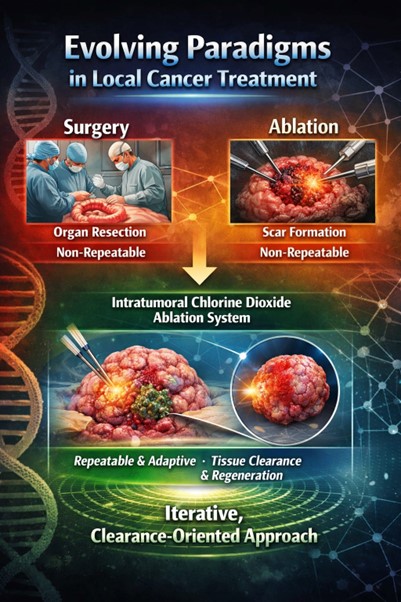
In 2011, Dr. Xuewu Liu began researching the medical potential of chlorine dioxide. At that time, this molecule was almost universally viewed through a single lens: disinfection. Its medical applications were either ignored, misunderstood, or dismissed as impractical or unsafe. There was no established regulatory pathway, no clinical precedent, and, indeed, no industrial framework that recognized chlorine dioxide as a legitimate therapeutic tool. In the mainstream halls of medicine, Liu and many others are changing that. Public water experts use it instead of chlorine, providing a strong basis for its usefulness, and dentists also use it legally, as do I, for sublingual absorption.
Though I never take any Cancer healing substance in isolation, there is a new treatment coming onto the cancer scene that deserves acknowledgement, and it’s as simple as injecting a specially prepared solution of chlorine dioxide directly into tumors, which tend to start dissolving immediately. Having been tested and used in Germany, a full-scale study is now or about to get underway in China, suggesting that chlorine dioxide has the potential to be an effective cancer treatment with minimal toxicity. After all, it is an oxidative agent like chemotherapy, but much safer to use.
The Intratumoral Chlorine Dioxide System is formally positioned in China as a Class III implantable/therapeutic medical device. Based on the current regulatory trajectory, this system may receive approval from the National Medical Products Administration (NMPA) by the end of next year and become a fully registered medical device.
According to Dr. Liu, the principal pioneer in this treatment, chlorine dioxide therapy has caused tumors shrink by more than 30% in just one hour.
- directly destroys tumors,
- shows immediate visual response,
- improves daily life, and
- does not weaken the body.
“This is not just a new technique; it represents a new philosophy for treating Cancer. The upcoming clinical trial in China will be the first large, systematic validation of this approach. If the data confirms what we already observe, it could pave the way for a new global standard in tumor therapy,” says Dr. Liu.
Liu continues saying, “With the maturing of our device system, stable ClO₂ formulation, procedural standards, and early human data, the treatment is now ready to enter the official regulatory pathway for Class III medical devices. Our therapy will now be tested under formal, transparent, reviewable medical-device standards. If the results confirm what we already observe, this treatment will move closer to official approval and broader patient access.”
Associated Therapy – Using Cold Instead of Chlorine Dioxide
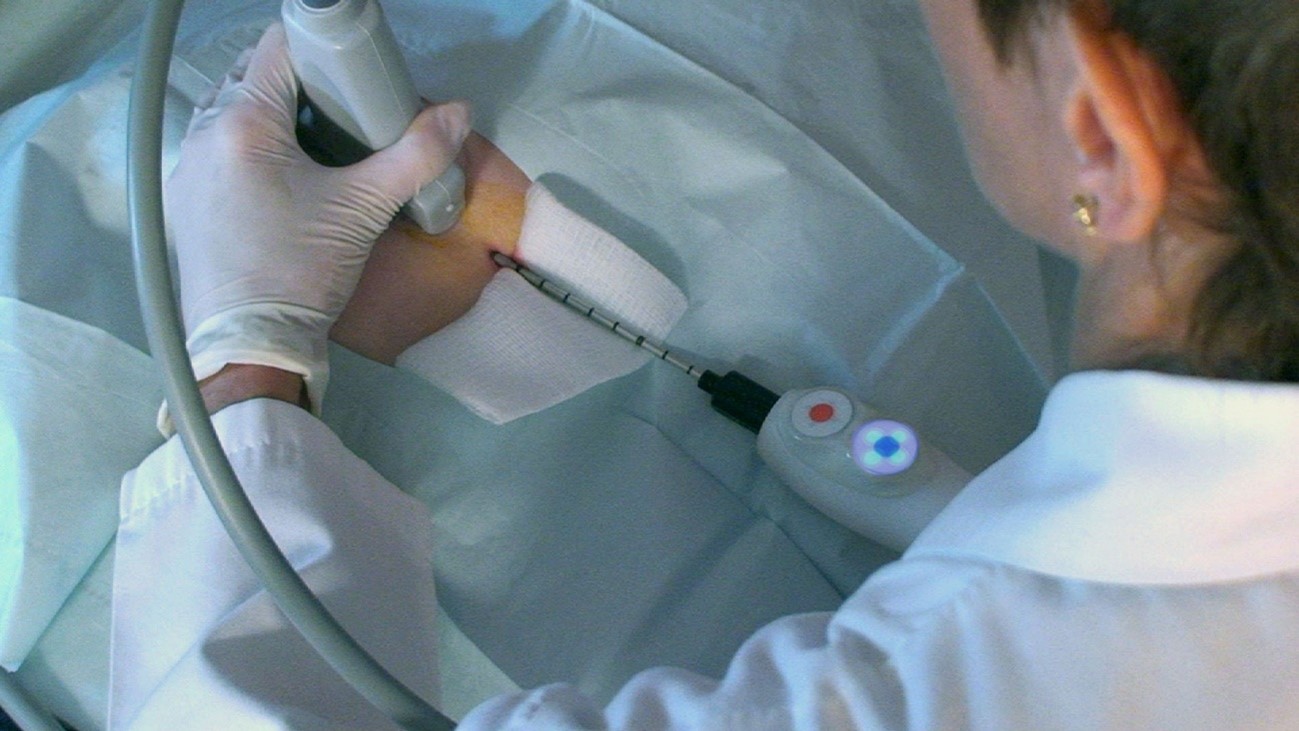
Cryosurgery is a proven medical technique that demonstrates what can be done for local tumors. A surgeon uses extreme cold (usually liquid nitrogen or argon gas) to directly freeze and destroy small tumors. It has been used for small breast tumors, prostate, liver, and kidney tumors, as well as skin cancers. Cryosurgery is one of the clearest examples that mechanical and physical methods, when used intelligently, can sometimes succeed where chemical warfare fails. Cryosurgery (often called cryoablation) uses the oldest destructive agent in the natural world — cold — as a scalpel.
Instead of using heat, radiation, or chemicals to kill diseased tissue, it relies on extreme cold—liquid nitrogen or pressurized argon gas—to freeze tumors from the inside out. Under imaging guidance, a probe is advanced into the tumor, and the temperature around its tip plunges to −150 °C (−238 °F). Ice crystals form within seconds, piercing cell membranes and halting every enzymatic reaction. When the tissue thaws, cells rupture, blood vessels collapse, and the tumor withers.
A New Category of Cancer Therapy: Visual, Immediate, and Precise
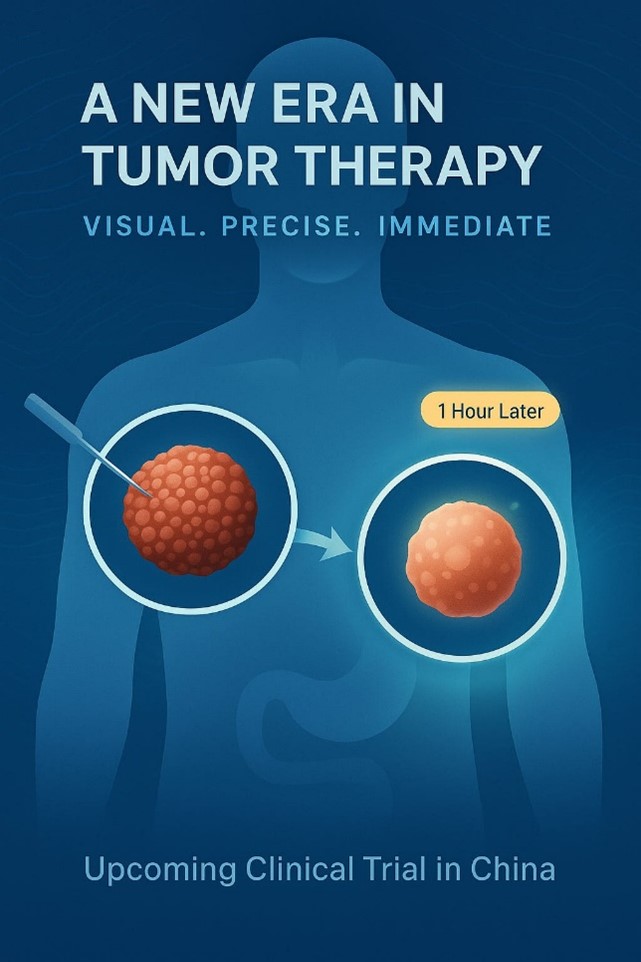
Most cancer treatments suffer from three significant limitations:
- The effects take months to evaluate.
- Patients cannot “see” whether the treatment is working.
- Side effects often overwhelm daily life.
The intratumoral chlorine dioxide ablation system is designed to destroy tumors from the inside, like Cryosurgery, with a reaction that is:
- Selective (targets tumor tissue rather than healthy cells)
- Rapid
- Visible in real time on ultrasound
- Free from systemic toxicity
Limited anecdotal/self-treatment cases (e.g., breast, liver, nasopharyngeal cancers in China/Germany), some veterinary examples. Liu has reportedly treated patients informally (including self-administration), often at $20,000/course, through clinics in Germany or direct contact. This approach represents an emerging, controversial frontier in oxidative cancer therapy. If the Chinese trial data emerges positively, it could shift perceptions—though rigorous, independent validation is essential given the history of ClO₂ controversies. Though chlorine dioxide is exceptionally inexpensive, this emerging therapy is not.
This therapy fits as a simple, oxidative, detoxification-oriented therapy—potentially synergistic with magnesium, iodine, or other protocols for inflammation/cancer support.
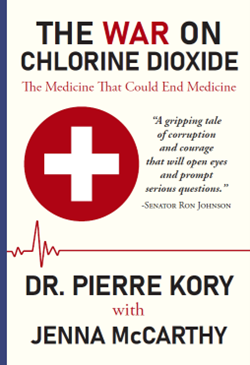
What if a simple molecule turned out to be one of the world’s most powerful medicines?
The War on Chlorine Dioxide exposes the shocking history of a simple molecule that kills pathogens, neutralizes toxins, and restores health at the cellular level—yet has been relentlessly smeared, censored, and suppressed.
In this bold new book, Dr. Pierre Kory uncovers how a humble water purifier became the target of a global disinformation campaign—precisely because it works. Backed by decades of medical experience and hundreds of studies, Dr. Kory explains the science, dismantles the propaganda, and reveals why governments panic at the idea of an unpatentable cure.
More than an exposé, The War on Chlorine Dioxide is a clear, evidence-based guide to understanding how this remarkable molecule works to treat everything from Cancer and malaria to autism and Covid, and why its safety and success threaten a system that profits from perpetual illness.
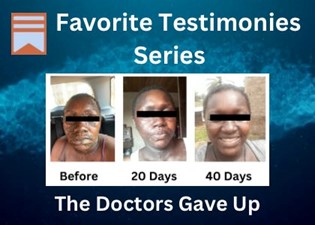
This particular testimony comes from a young woman in Africa who suffered from an unknown, incurable skin disease. Despite visiting several doctors, she found no relief. An acquaintance of hers, an underground practitioner, stepped in to help. Remarkably, she recovered completely in about 40 days.
Protocols used: Spray protocol and modified Protocol 1000
The practitioner explained that the patient followed both an oral and topical spray protocol involving activated MMS. Her regimen wasn’t precisely the same as the instructions in the links above, but it still worked. She began with 1 activated drop taken orally 4 times a day, gradually increasing over several days to 4 activated drops 4 times a day.
The exact concentration of the spray was unknown, though described as “weak,” suggesting an estimated range of 50–100 ppm. The spray was applied twice daily.
Day 0: Just before starting protocols
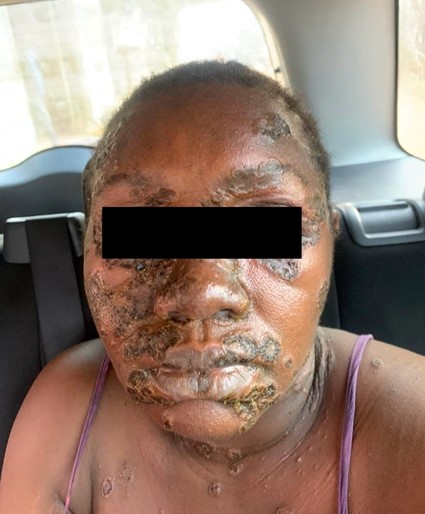
Day 20: image below
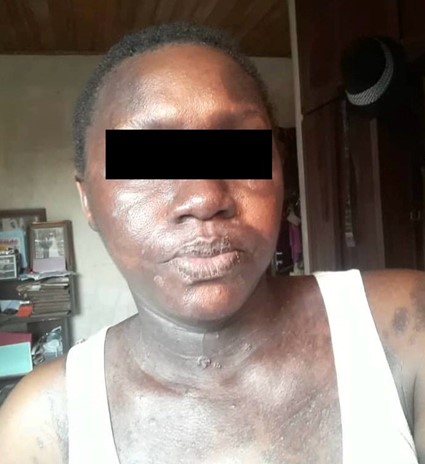
Day 40: She’s one happy girl!

Summary Report on Patient’s Recovery from Lady Windermere Syndrome
Note: Lady Windermere syndrome is a specific type of lung infection caused by Mycobacterium avium complex (MAC), a nontuberculous mycobacterium (NTM) found in soil and water. It typically affects elderly, thin, non-smoking women without prior lung disease or weakened immunity, often involving bronchiectasis (widened, damaged airways) and nodules primarily in the right middle lobe or lingula (part of the left upper lobe). This is a chlorine dioxide testimony of the mother of @margaretannaalice, a friend and author on Substack.
Before starting chlorine dioxide treatment, her mother was very sick and weak. She suffered from constant coughing fits—some so bad they left her exhausted and unable to sleep properly. Her oxygen levels were alarmingly low (around 86%), and she had lost a significant amount of weight. Her pulmonologist believed she had a Pseudomonas infection and advised her to take ciprofloxacin or go to the hospital for IV antibiotics. Because she had reacted badly to a similar drug before, her daughter sought a second opinion from a pulmonologist friend, who determined the problem was likely Lady Windermere syndrome. Under guidance, she began a slow and gentle treatment plan in January 2025 that included chlorine dioxide (also known as MMS) first taken orally in tiny amounts, then later through inhaling mist from a nebulizer and soaking in MMS baths and foot baths. In February 2025, she began incorporating DMSO into nebulizer treatments and baths to enhance MMS absorption, and she noticed further improvements after that.
Dr.Sircus is a reader-supported publication. To receive new posts and support my work, consider becoming a free or paid subscriber.
Subscribe now

comments