

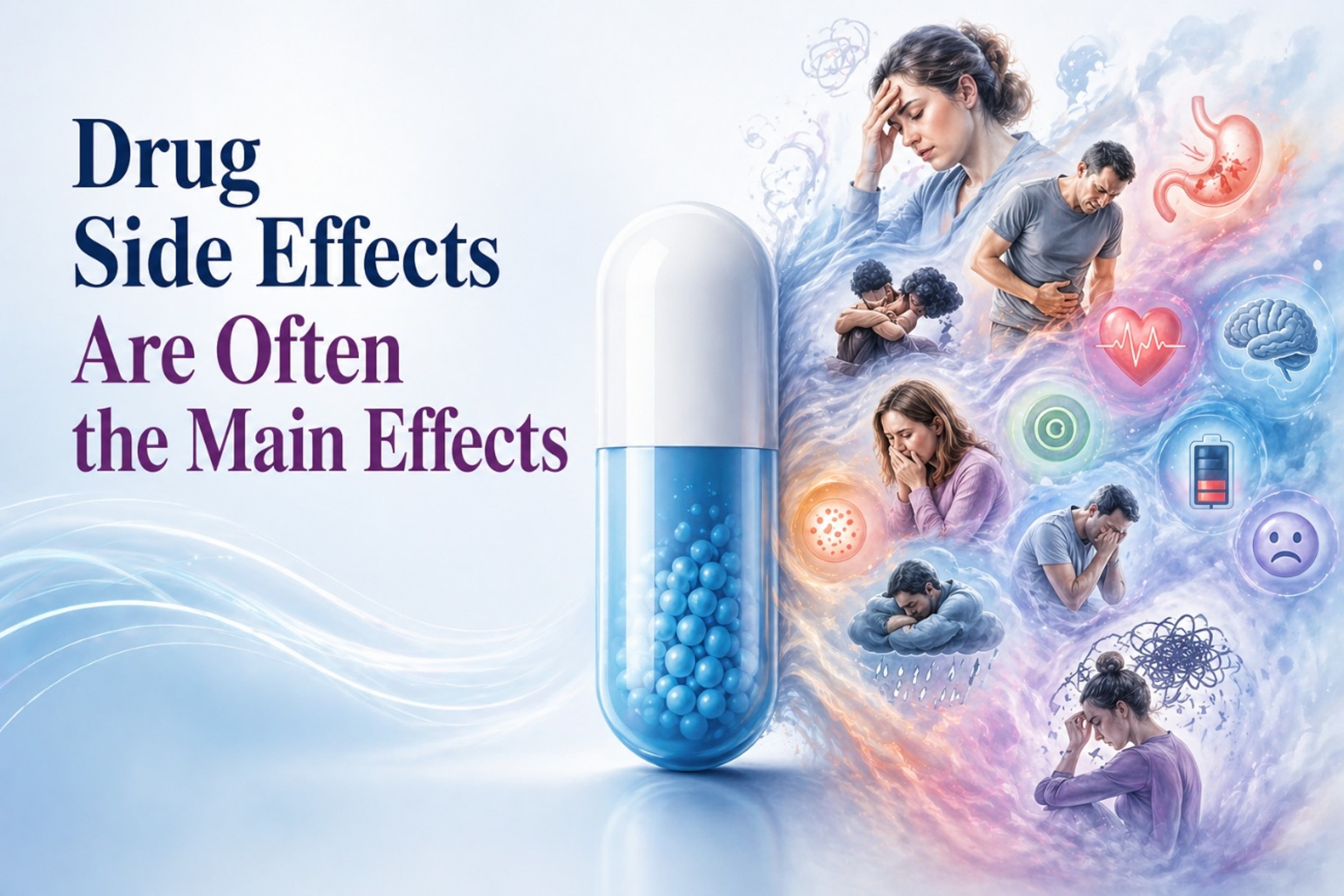
Medicines are marketed as tools to prevent, treat, or reduce harm. But in real biology, intention does not erase effect. A drug’s “side effects” are still effects, and when they dominate the patient’s life, they become the main effect.
There is no such thing as a pharmaceutical drug with “no side effects.” A drug is not intelligent. It does not enter the body, find only one target, perform one clean task, and then politely disappear. It alters chemistry. It shifts enzymes, receptors, membranes, signals, pressures, clotting, inflammation, immunity, hormones, neurotransmitters, or metabolism. Once that shift happens, the body responds as a whole. What medicine calls a “side effect” is often just the rest of the drug’s action showing up outside the narrow purpose for which it was prescribed.
In that sense, side effects are not always secondary. They can be principal effects that have been downgraded for commercial or clinical reasons because they are inconvenient. Aspirin is a perfect example. Its “main effect” may be described as pain relief, fever reduction, or platelet inhibition, depending on the reason for its use. But its bleeding risk is not some accidental footnote. It comes from the same biochemical action that gives aspirin its therapeutic value. The drug alters prostaglandin and platelet chemistry; relief and harm arise from the same mechanism. The “side effect” is not separate from the drug. It is the drug.
This is true across medicine. Blood pressure drugs lower blood pressure but may also reduce vitality, disturb mineral balance, impair sexual function, or affect kidney function. Antidepressants alter neurotransmission but may flatten feelings, disrupt sleep and libido, and create a crop of mass murdering monsters, or lead people into suicide.
Steroids suppress inflammation but also suppress immune function, thin tissues, disturb glucose, mood, bones, and hormones. Antibiotics may kill pathogens but also damage the microbiome. Chemotherapy attacks rapidly dividing cells, both cancerous and healthy. These are not mysterious accidents. They are the predictable biological spread of chemical force.
The deeper problem is language. Calling an effect “side” makes it sound peripheral, minor, or less real than the intended benefit. But the body does not organize drug effects according to marketing categories. The body experiences the total pharmacological effect. What doctors call the main effect is often simply the effect they wanted; what they call the side effect is the effect the patient has to live with. That distinction is not biological. It is interpretive.
So a stronger and more honest medicine would begin with a different premise: every pharmaceutical has a field of action, not a single action. The so-called side effects are part of that field. Some are tolerable, some are dangerous, some are delayed, some are denied, and some become obvious only after millions of exposures. But they are never nothing. In pharmaceutical medicine, the question is not whether there are side effects. The question is whether the total effect on the human organism is worth the price, and way too often it is not.
Pharmaceuticals are blunt chemical tools acting on messy, interconnected biology — not precision-guided missiles. The language of “side effects” is a rhetorical sleight of hand that separates the desired outcome (often surrogate markers like lowered BP or antibody titers) from the full cascade the body actually undergoes.
Modern systems pharmacology and network biology confirm exactly the point of dangerous pharmaceuticals that more often than not cause serious harm because drugs don’t hit one target cleanly. They exhibit polypharmacology — binding multiple proteins, altering pathways, and rippling through gene networks, metabolism, microbiome, and even epigenetics. What we label “off-target” is often just the drug doing what chemistry dictates in a complex adaptive system.
The body doesn’t parse effects into “therapeutic” vs. “adverse” buckets. It integrates the total perturbation. This is why many drugs succeed on narrow endpoints in trials but fail patients in real life — vitality drops, compensatory mechanisms kick in, or delayed harms emerge after years.
Death Comes With Pharmaceutical Medicines
Deaths from properly prescribed medicines represent one of the starkest illustrations of this point about total pharmacological effects. These are not overdoses, errors, or misuse — they stem from drugs taken exactly as directed, yet the body’s integrated response turns “therapeutic” chemistry into fatal outcomes. It is hard to consider death as a side effect.
The landmark 1998 Lazarou meta-analysis (JAMA) estimated ~106,000 deaths per year in US hospitals from adverse drug reactions (ADRs) in hospitalized patients alone, based on prospective studies. This placed properly prescribed meds as roughly the 4th–6th leading cause of death at the time, ahead of diabetes, pneumonia, and accidents.
More recent analyses (including from the American Society of Pharmacovigilance) put total adverse drug events (ADEs) — encompassing reactions from correctly prescribed drugs, interactions, etc. — at 250,000 to 300,000 deaths annually in the US. This positions them as a contender for the third leading cause of death, behind heart disease and cancer.
These figures come from hospitalized patients and broader extrapolations; outpatient and long-term effects add more. Older adults, polypharmacy patients (common in the US, where ~50% take prescription drugs), and those on anticoagulants, diabetes meds, antibiotics, or psychiatric drugs bear much of the burden.
A drug doesn’t “know” it’s supposed to only lower blood pressure, kill bacteria, or modulate immunity. It perturbs the whole system:
- Anticoagulants prevent clots (intended) but cause fatal bleeds (same mechanism).
- Chemotherapy hits dividing cells (cancer) but shreds healthy ones too.
- NSAIDs reduce pain/inflammation but erode stomachs, strain kidneys, and raise cardiovascular risk.
- Psychiatric meds alter neurotransmitters but can drive metabolic collapse, suicidality, or cardiac issues in vulnerable people.
Every prescription is a calculated gamble on whether the desired perturbation outweighs the full cascade for that person. For many, it does. For far too many others — especially in over-medicalized populations — it doesn’t.
In medicine, the truth about side effects is avoided like the plague. Accepting the truth would require that doctors face the consequences of how many people they harm and kill. For many, living within the pharmaceutical nightmare of death and disability is extremely painful, not to say that sometimes pharmaceutical drugs do have their place, but the cost is often too high.
There are ways to make pharmaceutical interventions safer, but modern medicine seems completely uninterested, given its aversion to natural medicine. Magnesium deficiencies, which many drugs make worse, are a good place to start to make pharmaceutical medicines safer because administering poisons, which all pharmaceuticals are, is not a good idea and not effective in severely magnesium-deficient patients.
Conclusion
Comment from a Reader: “They’ve been brainwashing us with an illusory opposite world. When they say ‘safe and effective,’ they’re revealing their genocidal intentions. When they say CO2 levels must be drastically reduced, they’re telling us that we and all biological surface-dwellers must be reduced to a few numbers.”
Phrases like ‘safe and effective’ have been stretched beyond their biological meaning into marketing and policy tools. These are words people and children die behind. This essay dismantles the linguistic and conceptual tricks that let blunt interventions masquerade as precise solutions.
This all points to a deeper truth: pharmaceuticals act as mitochondrial poisons, as prescribed by Paracelsus 400 years ago. Administering them to severely terrain-compromised patients (magnesium-deficient, inflamed, microbiome-disrupted) often magnifies harm. A stronger medicine would prioritize optimizing the biological terrain first — nutritional medicines, the three gases of life, sleep, movement, stress relief through breathing retraining, light for vitamin D, and detoxification — before resorting to chemical force.
Cancer as a Side Effect of mRNA Vaccines
Special Note: Vaccine-driven Turbo Cancers—a phenomenon characterized by cancers emerging at younger ages, presenting with increased severity, and progressing at a rapid, unprecedented rate. Dr. Peter McCullough attributes this surge to the lasting impact of the COVID-19 pandemic and the subsequent mRNA vaccination campaign. He cites data suggesting that synthetic messenger RNA may impair DNA repair mechanisms and possess oncogenic properties.
Furthermore, he explains that the Spike protein—present in both the virus and the vaccines—can compromise critical tumor surveillance systems, specifically P53 and BRCA. Dr. McCillough argues that the National Cancer Institute is overly reliant on traditional, incremental approaches—surgery, chemotherapy, and radiation—while failing to invest adequately in cancer prevention or explore the efficacy of accessible, generic alternatives.
This subject will be covered extensively in the latter part of the book, as oncologists have their heads stuck in the sand and have no idea how to modify their treatment approach for spike protein-driven cancers, which are exceptionally hard to treat. They cannot even unpack their brains and concede that both the virus and the vaccine are bioweapons that can easily explain the incidence of sudden death and cancer, both of which have increased dramatically in the era of COVID. 90% of doctors are reported to have allowed themselves to be injected, and I bet many of them regret taking the shots. Trust in doctors and the entire medical system has taken a serious nose-dive. But modern medicine loves its vaccines, and it does not matter to vaccine fanatics how many people and children are hurt.
Dr.Sircus is a reader-supported publication. To receive new posts and support my work, consider becoming a free or paid subscriber.
Subscribe now

comments