


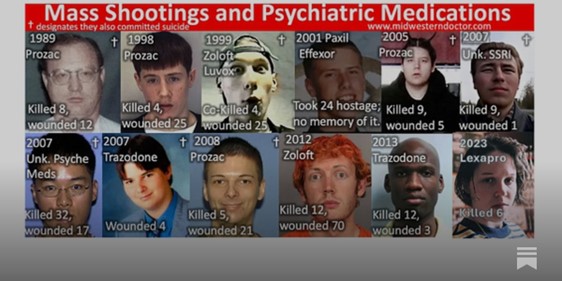
A shooting during a Rhode Island youth hockey game left three people dead, including the shooter, and three more hospitalized Monday night in critical condition, authorities said. When acts of mass violence erupt, the press reports every surface detail—guns, motive, ideology, social media posts—but rarely the psychiatric prescription record. Yet that’s the line of inquiry that often reveals how a chemically imbalanced mind reached the breaking point.
Since the 1990s, many high-profile shootings have involved individuals under treatment with SSRIs, SNRIs, benzodiazepines, or stimulants. Toxicology or medical record data occasionally surface later—often buried in court documents, but by the time they do, news coverage has moved on. Editors and pharmaceutical advertisers orbit the same; they avoid stories that could invite liability for trillion-dollar drug portfolios.
In Every Case of Mass Killings, Never Mentioned
Are the Pharma Drugs Shooters Are Taking
Most antidepressants don’t eliminate despair; they dampen inhibition. A small subset of users—especially adolescents and young men—experience akathisia, an inner agitation combining rage, panic, and dissociation. If you imagine a brain trapped between overstimulation and emotional anesthesia, you have the perfect neurochemical recipe for impulsive violence. Package inserts warn of “increased risk of suicidal or homicidal behavior,” but physicians seldom take that warning seriously.

Discussing medication history requires access to medical data protected by privacy law, so unless a family volunteers the information, reporters claim they “can’t verify.” The deeper reason: large newsrooms depend on pharmaceutical advertising. Criticizing the psychiatric‑drug industry would sever its lifeline. It’s less risky to blame the weapon, the ideology, or social media than to question FDA-approved psychotropics.
What Real Journalism Would Ask
Was the shooter taking or withdrawing from SSRIs, benzodiazepines, antipsychotics, or amphetamine‑based ADHD drugs? Had the dosage recently change Were there signs of akathisia or tunnel thinking noted by relatives? Was informed consent ever truly given about the aggression or detachment side effects? Those questions are absent from nearly every front page—and until they’re asked habitually, prevention is impossible.
More than 40 million Americans take psychiatric drugs chronically. Most will never commit violence, but millions report emotional blunting, insomnia, or sudden intrusive thoughts that dissolve once the medication is reduced under supervision. Suppressing that observation for corporate comfort keeps society blind to one of its authentic public‑safety issues.

Every shooting is tragic, but the refusal to trace biochemical triggers ensures repetition. When a medicated society refuses to audit its own mind chemistry, the gun becomes a convenient scapegoat for pharmaceutical silence.
Psychiatric medications can, in some individuals, produce serious psychological and behavioral side effects, including suicidal ideation, agitation, impulsivity, and rarely aggression. These reactions are not universal, but they are documented and recognized in regulatory warnings.

It took four days before the first elite-controlled media published one of the main reasons all these people in Vegas had to die. The killer was on massive dosages of Valium (diazepam). He was prescribed 50 10mg diazepam pills in June. Around a hundred thousand Americans die from properly prescribed medicines each year. However, it is freely admitted, and studies show that the majority of anti-anxiety drugs are not prescribed by psychiatrists who could expertly monitor the effects, meaning they are not properly prescribed, so the side-effect outcomes are even worse.
SIDE EFFECTS OF DIAZEPAM (VALIUM) include loss of balance, restlessness, irritability, thoughts about suicide or dying, new or worse anxiety, trouble sleeping (insomnia), acting on dangerous impulses, attempts to commit suicide, an extreme increase in activity and talking (mania), new or worse depression, panic attacks, acting aggressive, being angry, or violent, and other unusual changes in behavior or mood.
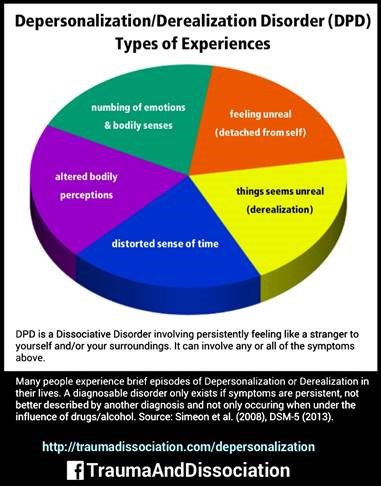
Depersonalization means we cannot fully engage and leads to a feeling of isolation. For some who experience this syndrome in its extreme, it leads to the feeling that we do not exist or our body is not our own. The Vegas shooter was described as a total loner on Valium.
Health Canada approved a new warning label for Paxil that read, in part: “A small number of patients taking drugs of this type may feel worse instead of better. For example, they may experience unusual feelings of agitation, hostility or anxiety, or have impulsive or disturbing thoughts, such as thoughts of self-harm or harm to others.
There were 39,000 adverse event reports submitted to the FDA’s Medwatch, according to award-winning investigative reporter, Robert Whitaker. And that number is said to represent only about 1% of the actual number of adverse events. “So, if we get 39,000 adverse event reports about Prozac,” Mr. Whitaker said in an interview for Street Spirit in August 2005, “the number of people who have actually suffered such problems is estimated to be 100 times as many, or roughly four million people.”
We have to admit, though, that the “1% rule” is a rough heuristic from older pharmacovigilance literature. It does not apply uniformly across all drug classes or eras. So multiplying raw report numbers by 100 to estimate true cases is speculative rather than epidemiologically rigorous.
Below is a focused overview by drug class, emphasizing behavioral and psychiatric risk signals rather than physical side effects.
Antidepressants (SSRIs, SNRIs, others)
Boxed Warning
All antidepressants in the U.S. carry an FDA boxed warning about increased risk of:
- Suicidal thoughts and behaviors
- Especially in children, adolescents, and young adults (up to age 24)
Documented Psychological Risks
- Agitation
- Akathisia (inner restlessness strongly linked to suicide risk)
- Emotional blunting
- Impulsivity
- Irritability
- Manic switching (triggering mania in bipolar patients)
- Rare reports of aggression or hostility
Risk is highest:
- Early in treatment
- During dose changes
- In undiagnosed bipolar disorder
Stimulants (ADHD medications)
Examples: methylphenidate, amphetamines
Possible behavioral risks:
- Irritability
- Agitation
- Paranoia
- Psychosis (rare but documented)
- Aggression
- Suicidal ideation (rare but reported)
Risk increases with:
- High doses
- Sleep deprivation
- Underlying mood instability
Antipsychotics
Used for schizophrenia, bipolar disorder, sometimes depression.
Behavioral concerns:
- Akathisia (strongly associated with self-harm risk)
- Emotional flattening
- Severe dysphoria in some patients
- Rare paradoxical agitation
Important distinction:
These medications are more often protective against violence in psychotic disorders than causative — but akathisia remains a serious risk factor.
Benzodiazepines
Examples: alprazolam, lorazepam
Behavioral risks:
- Disinhibition
- Impulsivity
- Aggression (paradoxical in some individuals)
- Depression worsening
- Withdrawal-induced suicidality
- Rebound anxiety
Dependence and abrupt withdrawal are major risk factors for psychological instability.
Mood Stabilizers
Lithium:
- Generally protective against suicide
- One of the few psychiatric drugs shown to reduce suicide risk
Valproate / carbamazepine:
- Carry warnings about suicidal thoughts (like most anticonvulsants)
Anticonvulsants (used for mood)
The FDA requires a warning that anticonvulsants may increase:
- Suicidal ideation
- Self-harm behavior
This risk is small but statistically detectable.
Mechanisms Behind Increased Suicidality
Several biological explanations are proposed:
- Energy before mood improves
– Patients regain drive before depressive hopelessness lifts. - Akathisia
– Intense inner agitation linked to impulsive self-harm. - Mania induction
– Bipolar activation increases risk-taking. - Emotional numbing
– Some report detachment leading to altered self-perception.
Important Perspective
- Most people do not become violent or suicidal from these medications.
- For some individuals, these medications reduce suicide risk dramatically.
- Risk is highly individual and often associated with:
- Age
- Dose changes
- Underlying bipolar disorder
- Polypharmacy
- Abrupt discontinuation
Conclusion – Core Clinical Reality
Psychiatric drugs alter neurotransmission, which means they can alter:
- Impulse control
- Mood regulation
- Aggression thresholds
- Perception
- Motivation
In susceptible individuals, this can destabilize rather than stabilize.
Conclusion
Thanks to modern medicine, we are watching the metabolic health, mental health, and resilience of young Americans decline in real time. We have record levels of anxiety, depression, obesity, drug dependency, and disengagement from the workforce.
Dr.Sircus is a reader-supported publication. To receive new posts and support my work, consider becoming a free or paid subscriber.
Subscribe now

comments