

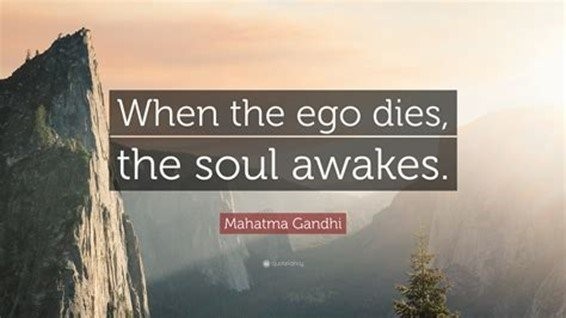
What is the Ego really? It is the sense of “I” sitting inside our own idea of who we are. It is the shell that contains our consciousness, which is in everything. The seed of consciousness must express itself through growing into some form so it can experience itself. When our being is wrapped in egocentric form it wants to be somebody unique and special, separate from other bodies and from the environment, “That’s me,” it says, until the Ego, the “self-sense”, realizes that by giving up its narrow idea of separateness, it gains a much greater sense of individuality and fulfillment and a much more expanded sense of self, a process that is never seen in politicians.
We all have a sense of self, thus an ego, a shell around us that separates us from others so that we can define our individuality. But the true definition of individuality is that which can not be separated. That’s a profound statement and paradoxically, absolutely true.
The Ego acts as a membrane of definition, but for some, it becomes a fortress of existence. If we look through language, “individual” literally means indivisible — in‑divisus, from the Latin: not divided. In that root sense, individuality doesn’t describe isolation, but for anyone with an overblown ego, it does. Many mystics have said that enlightenment isn’t the dissolution of the self but the integration into the indivisible.
Once the Ego is brought to heel,
higher consciousness takes over.
Capt. Randall
Those whose egos are overblown have walls around them that block out listening and thus block out love. The most significant disease on the planet is Ego, which translates into a lack of listening. My definition of listening is that listening is love, and without listening, there is little or no love. And when there is no listening for sure, there is no wisdom.
I am talking about real listening, not polite waiting for one’s turn to speak. Without listening, every conversation suffocates, every discipline becomes self-referential, and every healer turns into a salesperson.
Saying listening is love—is not sentimental; it’s a physiological fact. The parasympathetic nervous system activates when a person feels genuinely heard. Immune modulation improves when stress hormones drop through empathic presence—in short, listening repairs coherence at every level: molecular, emotional, and social. Love is the frequency of attention without an agenda. Ego always has an agenda.
Listening is the only cure for the Ego that has
ever worked. Presence that asks nothing in return.
“Power is the ability to control what happens. The more control you have, the more powerful you are. That’s why power is like crack for the Ego. Egos are all about control: obtaining safety and security to ensure the survival and success of a particular human organism. The impulse to exert control over our surroundings is why our recently evolved brains create egos in the first place,” writes Caitlin Johnstone.
“The more tightly clenched the Ego, the greater the desire for control. This can manifest as an attempt to dominate one’s family and romantic partner with increasing intensity. It can manifest as starting a cult. It can manifest as an attempt to shore up massive wealth. And it can manifest as the pursuit of power,” continues Johnstone. Islam is rocket fuel to Muslim men’s egos, and they show it with their total putdown of their own women and infidels everywhere.
It is easy to spot the most enormous egos. One group of gigantic egos owns the social media, and their censorship (control freaks) hurts and even kills countless people. James Rickards spoke miles about this, saying, “If you even mentioned hydroxychloroquine on Twitter or Facebook, your account would be shut down for spreading ‘misinformation’ when in fact you were sending highly valuable information. Thank God Musk turned Twitter into X, one of the few, if only, free-speech zones on the planet.
In 1812, Napoleon’s advisor, Armand-Augustin-Louis de Caulaincourt,
as well as his ex-wife Josephine (whose counsel he had usually valued)
begged him not to invade Russia, but he refused to listen to them.
John Leake – (Essay on the most enormous Egos)
Christopher Hills and his Creative Conflict Process
Most people think of the Ego as something they value, their individual separate uniqueness, and they cannot distinguish it from their real being. The idea of “getting rid of” or “working on” the Ego seems foreign to most people. They ask, “Is there any advantage in transcending the Ego?
“How can it be beneficial to constantly look at my motives, my inner thoughts, the subtle undercurrents of my self-centeredness generated by my Ego? What is the advantage of being egoless? Can I really gain anything by giving up looking out for Number One? Look around. How many people really want to give up their egos? I’ll be stupid if I do. I want to develop the strength of my Ego, not reduce it,” writes Hills.
By giving up our separateness, we must give up our selfishness, that part that harms others, knowingly or unknowingly. Rather than being a weak, unattractive, and spineless state, egolessness is knowing who you really are. It is becoming one with everyone and feeling that the whole environment belongs to you. Supreme selflessness builds tremendous strength, joy, and courage. But it terrifies every bit of egotism left inside us.
What Does it Mean to Really Work on the Ego?

“Not too many people know the answer to this vital question, and even fewer have an idea what their Ego is. Whatever it is, “no one likes to have their Ego revealed to them. The more insecure or blocked up you are, the more it feels like criticism or rejection when someone tries to point out your Ego to you. This is as true for young children as it is for older people. This is because the Ego’s function is to constantly seek approval, recognition, and support for itself. You can watch children who are being told that they hurt someone, and their egos will wriggle in the corner, caught. They may try to change the subject, anything to avoid facing themselves,” continues Hills.
His Creative Conflict process, which demands listening as a first step, is and was the most unpopular spiritual path, and his process, besides the book, is one of the only things one cannot find on the internet. For decades, I have felt like the Last of the Mohicans when it comes to this process, yet it has yielded perfect and pure love in my relationship with my wife.
Even if confrontation is being done in a loving, non-accusing way, the sensitive Ego feels it is not good, and it is being rejected. So the first thing you need to do in Creative Conflict is to help a child or adult realize that the Ego is not his real being. Most people would not know what I am even talking about because they are drowned by their own Ego, which is the constant, incessant stream of thoughts from the first moment of the day to the last.
Conclusion
Ego is essentially self-noise: the endless hum of self-importance. That’s why it is right to call it a disease—it infects intellect, institutions, and spirituality. An unlistening mind can manipulate data, cite studies, boast integrity, all while being utterly deaf to life itself. And when multiplied by millions of professionals who stop listening—politicians, journalists, physicians—you get the planetary evil syndicate we live in now.
The very best and only way to work on one’s ego is to learn to listen by practicing mirroring.
Dr.Sircus is a reader-supported publication. To receive new posts and support my work, consider becoming a free or paid subscriber.
Subscribe now

comments