

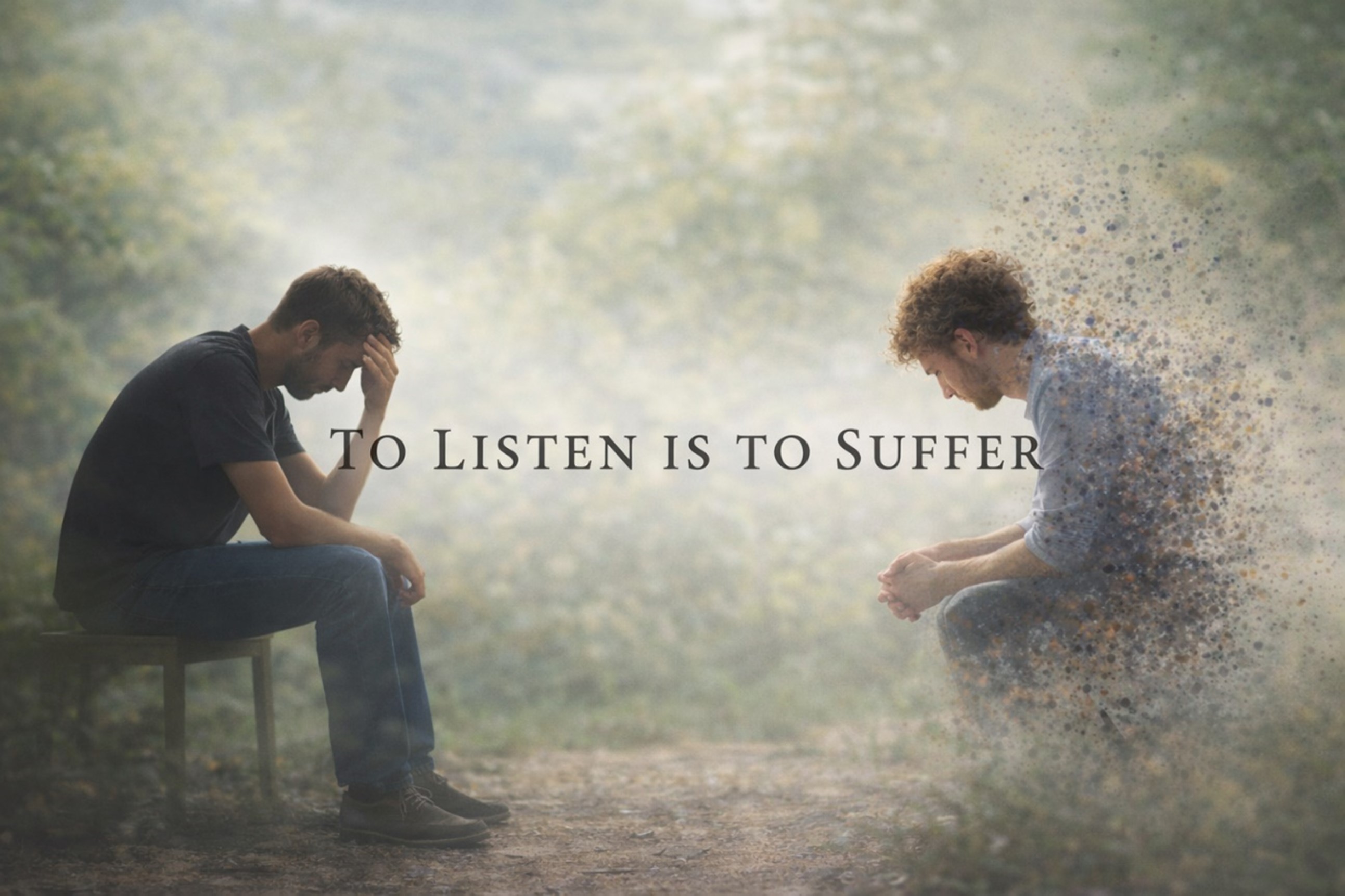
“To listen is to suffer, because we do not want to change.
To listen is to change.
We cannot change without listening.
Listening implies a change.
We need to change just to listen.”
This Zen-like observation on the deep resistance most people (and institutions) have to genuine listening captures why so many conversations about COVID origins, vaccine harms, metabolic damage, government legitimacy, and the unfolding collapse scenario from war, oil, gas, and fertilizer cutoffs are so difficult.
To listen is to suffer, because we do not want to change, explains institutional deafness. Health authorities cannot truly listen to evidence of lab origins or vaccine injuries because it would require admitting catastrophic failure—and then changing course (pulling products, investigating, offering real treatments, abandoning mandates). That change would be existentially painful for too many people: loss of power, prestige, funding, and self-image.
Individuals often cannot listen to the possibility that the injections were another layer of harm, or that modern medicine is largely impotent against neurological and metabolic diseases, because it would shatter the trust in the system they heavily rely on — and force personal change (detox protocols, lifestyle shifts, questioning authority). Listening threatens the comfort of mainstream narratives. Listening demands we confront uncomfortable truths.
The Necessity of Listening
Intelligence is directly proportional to listening.
Real listening is active and transformative. Meaningful listening requires humility, courage, and a willingness to let go of certainties. There is an uncompromising quality to these lines about listening, suffering, and change. They refuse comfort. They strip listening of its sentimental image and return it to what it actually is: an act of surrender.
It is a quiet truth most people spend their lives avoiding — that real listening is not passive. It is not agreement, nor politeness, nor waiting for one’s turn to speak. It is a form of internal disruption. Authentic listening is to allow something foreign to enter and rearrange us.
And that is where the suffering lies. Not in the words themselves, but in what they threaten:
- our identity
- our certainty
- our sense of being right
- our psychological stability
Most people do not resist listening because they are closed-minded in some moral sense. They resist because listening is destabilizing. It creates movement that challenges us to change. It introduces doubt where the ego wants structure and stability.
There may be no greater crisis today than the collapse of listening. It is the quiet root of violence, alienation, and the loneliness that now passes for normal life. We are a species addicted to talking, judging, and reacting.
We pretend to communicate, but we mainly broadcast. We imagine connection, yet we rarely allow another soul to enter our awareness fully. We scroll, perform, correct, and agree automatically—and call it communication. But listening? Authentic, deep, soul‑level listening? That is rare, too rare.
Intelligence is Directly Proportional to Listening.

To listen is to open space inside ourselves—not to fix, advise, or debate, but to allow. It is the act of receiving another being into our inner universe. Perfect listening creates perfect oneness, a mind‑blowing experience of empathy.
Listening becomes impossible when one person believes they know more, feel more, or are more important. Hierarchies kill presence, creating deaf people at the top.
Listening is the ecology of being; it opens the doorway to the heart. It creates trust between beings; it creates love. To listen is to surrender the inner noise that insists on being right. It requires what psychologists call bracketing: a temporary setting‑aside of one’s own obsessions, judgments, expectations, and even thought streams. To listen, we quiet the mind’s river until another’s river can flow into ours. Few people know how to do this. Real listening steps into another’s shoes and walks there until understanding arises.
Love Is Listening
Nothing shows the quality of our love more clearly than our listening. People who truly listen to each other inevitably grow closer, because deep listening is love in action. Wherever communication is impoverished, love is impoverished; where love is impoverished, deep listening has disappeared.
Listening is the art of paying attention, and attention is love in motion. The heart loves to pay attention—it is its nature. The most critical way we exercise love is by listening. Empathy is just that: the capacity to hear with our hearts. Romantic affection is easy compared to the discipline of true listening, which is the discipline of staying present without defense.
Nothing wounds the human soul more than having its feelings go unheard. Non‑listening destroys marriages, friendships, families, and nations. Happy relationships are sustained by people who show sincere interest in one another’s feelings and inner experience.
In conflicts, deep listening heals both parties—the speaker who is heard and the listener who opens. Carl Rogers, the father of humanistic psychology, observed:
“It is astonishing how elements that seem insoluble become soluble when someone listens. How confusions that seem irremediable turn into clear, flowing streams when one is heard.”
The price of non‑communication is conflict. The conflicts within our personal lives and throughout the world arise largely from misunderstanding born from shallow listening.
Real listening demands that we set aside reactive feelings and mental tapes that replay past pain or future worry. Only then can we hear exactly what the other person is saying. It’s not easy—but every time we suspend our noise long enough to hear another’s truth, the world becomes slightly more coherent.
Consequences
Science no longer listens to dissent; medicine no longer listens to the body; governments do not listen to the people; parents do not listen to children; friends do not listen to each other; and individuals do not listen to their own inner voice. We live amid a kind of spiritual deafness—a hyperverbal, low‑consciousness swarm of noise. Social media has made this deafness a daily sport, converting human communication into combat.
And yet, beneath the shouting, we still ache to be heard—deeply, quietly, reverently. Listening is not courtesy; it is transformation. When someone truly listens to you, your soul breathes. Your defenses dissolve. You feel your own truth more clearly. Even trauma begins to reorganize itself in that sacred silence. Deep listening is an act of non‑violence: it grants another being permission to exist.
Listening is love’s first task. If civilization is to heal, we must relearn its art—one conversation, one heartbeat at a time. Unfortunately, this is not happening, and that is why we have the world we have.
Dr.Sircus is a reader-supported publication. To receive new posts and support my work, consider becoming a free or paid subscriber.
Subscribe now

comments