

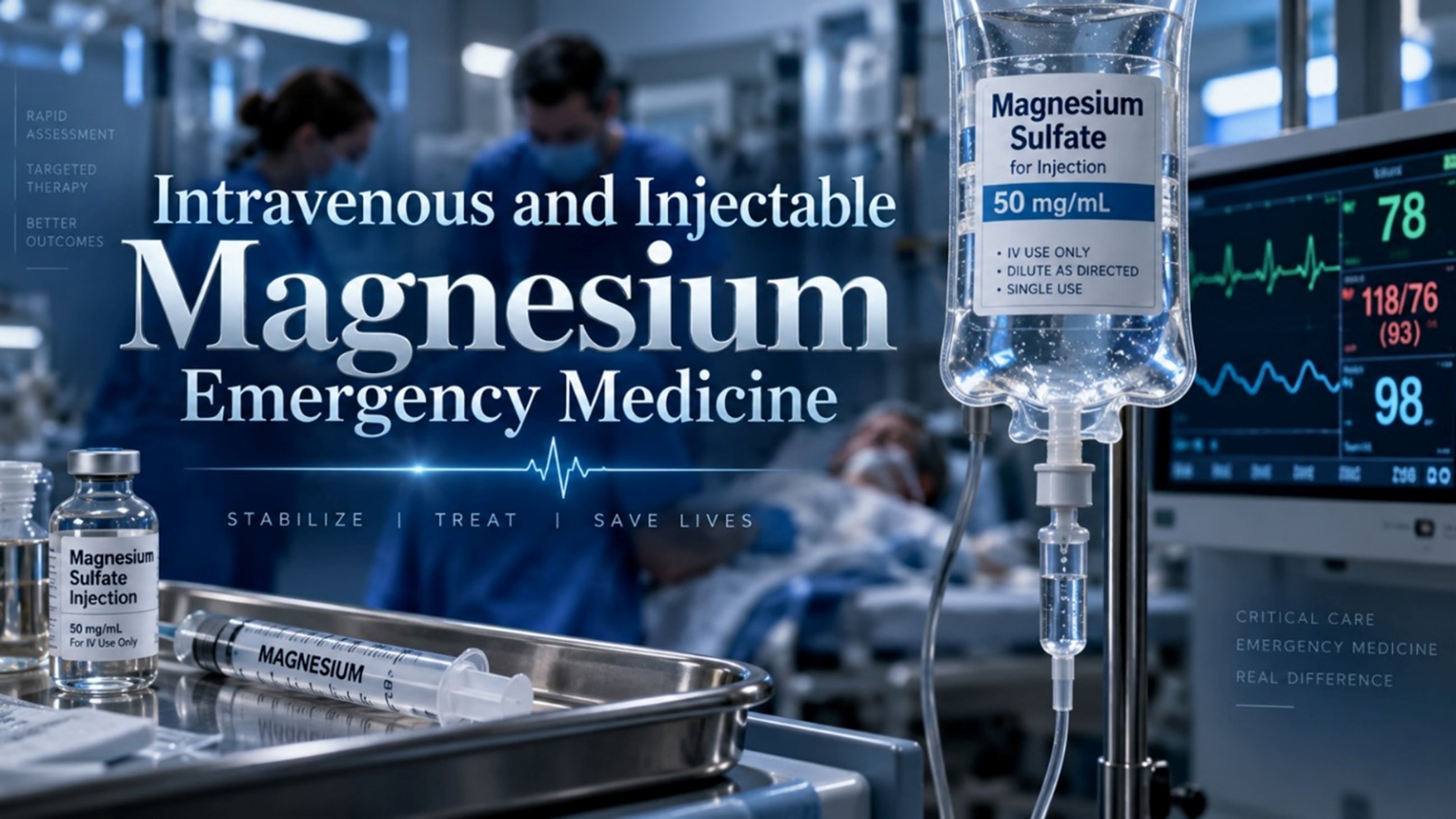
Magnesium injections are one of the clearest examples of magnesium behaving not merely as a nutrient but as a powerful physiological drug. When given intravenously or intramuscularly, magnesium bypasses the intestine, enters the circulation rapidly, and can affect vascular tone, neuromuscular transmission, cardiac electrical stability, blood pressure, the central nervous system, and enzyme systems within minutes. That is why injectable magnesium has a secure place in emergency medicine, obstetrics, intensive care, and electrolyte replacement.
The most common injectable form is magnesium sulfate. It is inexpensive, highly soluble, and has a long clinical history. Magnesium chloride injection also exists and is approved as an electrolyte replenisher for magnesium deficiency, but hospitals use sulfate much more widely.
Magnesium sulfate (MgSO4) in a 50% solution was injected initially
intramuscularly and later intravenously into patients with peripheral
vascular disease (including gangrene, claudication, leg ulcers and
thrombophlebitis), angina, acute myocardial infarction (AMI), non-hemorrhagic
cerebral vascular disease and congestive cardiac failure. This has been
going on since before most of us were born, but medicine has a short memory.
Journal of Nutritional Medicine (1994) 4, 169-177 Review 34 Years of Experience
One important distinction is between the weight of the magnesium compound and the amount of elemental magnesium. A gram of magnesium sulfate does not mean a gram of magnesium. One gram of magnesium sulfate heptahydrate provides only about 98 mg of elemental magnesium, approximately 4 mmol or 8 mEq of Mg²⁺. This matters enormously when comparing oral magnesium, IV magnesium, magnesium chloride, and different commercial concentrations. Confusing “grams of magnesium sulfate” with “grams of magnesium” can cause serious dosing errors.
Why Injections Can Work So Dramatically
Oral magnesium has to dissolve, survive gastrointestinal conditions, be absorbed through the intestinal wall, and then enter the bloodstream. Absorption varies by formulation, dose, intestinal health, and nutritional state. Parenteral magnesium avoids all of this. Once it enters the circulation, bioavailability is effectively complete. That makes it particularly valuable when someone has severe deficiency, seizures, dangerous arrhythmias, poor intestinal absorption, substantial gastrointestinal losses, or a situation requiring an immediate effect.
Yet there is an interesting paradox. Giving magnesium rapidly does not necessarily mean you retain more magnesium. A sharp rise in plasma magnesium tells the kidneys to excrete it, and a substantial fraction of a rapidly infused dose can appear in the urine. That is why, outside emergencies, slower IV replacement may actually replenish body stores better than a dramatic rapid bolus. The blood concentration rises before intracellular and tissue stores have necessarily been restored.
This also helps explain one of the great problems in magnesium medicine: serum magnesium is an imperfect measure of total magnesium status. Less than 1% of total body magnesium is present in serum; most resides in bone and soft tissue. Someone can therefore have a serum value within the laboratory reference interval while tissue stores are less satisfactory.
The major established medical uses
Injectable magnesium is standard treatment in several situations.
- Severe or symptomatic hypomagnesemia. IV magnesium sulfate is used when magnesium deficiency is substantial or accompanied by seizures, tetany, serious cardiac arrhythmias, severe weakness, or when intestinal absorption is poor. Mild asymptomatic deficiency is usually treated orally instead.
- Preeclampsia and eclampsia. Magnesium sulfate is the drug of choice for preventing and controlling eclamptic seizures. This is one of the strongest demonstrations in medicine of magnesium’s neurological importance. ACOG continues to recommend it in this setting.
- Torsades de pointes. IV magnesium can suppress recurrent polymorphic ventricular tachycardia associated with a prolonged QT interval, even when the serum magnesium is not obviously low. The AHA specifically distinguishes this from ordinary ventricular tachycardia with a normal QT, where routine magnesium has not shown benefit.
- Severe acute asthma. IV magnesium sulfate is not a routine asthma treatment. Still, GINA recommends considering it as an adjunct when a severe exacerbation has failed to respond adequately to initial therapy, particularly with persistent hypoxemia or very poor airflow.
- Fetal neuroprotection before anticipated very preterm birth. Obstetric protocols may use magnesium sulfate when early preterm delivery is imminent because evidence indicates a reduction in cerebral palsy among surviving infants.
Magnesium also has many other uses, including replacement during total parenteral nutrition and correction of magnesium depletion from diarrhea, alcoholism, certain diuretics, cisplatin, aminoglycosides, amphotericin B, and other causes of renal or gastrointestinal magnesium loss. Many pharmaceuticals and things like smoking and alcohol drive down magnesium levels. See here for a list of 20 magnesium muggers.
The Cardiovascular Effects are Particularly Interesting.
Magnesium is intimately involved in cardiac electrophysiology. It influences potassium and calcium movement across membranes, stabilizes excitable tissue, and participates in ATP-dependent ion pumps. Magnesium deficiency can therefore coexist with PVCs, atrial and ventricular arrhythmias, QT abnormalities, hypokalemia, and hypocalcemia. Correcting magnesium deficiency can sometimes make potassium deficiency easier to correct because persistent hypomagnesemia promotes renal potassium loss.
But magnesium is not a universal antiarrhythmic. The distinction matters. IV magnesium has a very clear role in torsades and in arrhythmias associated with genuine magnesium depletion; it should not automatically be assumed to cure atrial fibrillation, PVCs, PACs, or every tachyarrhythmia in a magnesium-replete patient. Current AHA guidance specifically states that routine magnesium is not useful for polymorphic VT when the QT interval is normal. Yet magnesium is always useful, as is breathing.
Its vascular effects are also real. Magnesium produces peripheral vasodilation. At lower parenteral doses, people may notice warmth, flushing, and sweating; at higher circulating concentrations, blood pressure can fall. That vasodilatory effect helps explain why an IV dose can feel immediately different from swallowing a capsule.
IV versus Intramuscular Magnesium (IM)
IV magnesium acts much faster. For anticonvulsant action, the onset is essentially immediate; IM magnesium takes roughly an hour and lasts longer. Historically, obstetric regimens sometimes combined an initial IV dose with large deep intramuscular injections. IM magnesium sulfate is still possible, but it can be painful, irritating, and less convenient than a controlled IV infusion, so modern hospital practice frequently favors IV delivery when vascular access is available.
For chronic replacement, there is rarely a compelling reason to repeatedly inject magnesium into muscle if the digestive tract works and oral or other replacement strategies are adequate. Injectable therapy becomes most attractive when speed, delivery certainty, severe depletion, or impaired absorption matters.
In the 90’s cardiovascular biologist Dr. Burton M. Altura of the State University of New York Health Science Center at Brooklyn witnessed a therapeutic benefit of magnesium in acute symptoms, such as headache pain. Altura administered a solution containing 1 gram of magnesium sulfate intravenously to 40 patients who visited a headache clinic in the throes of moderate to severe pain. They treated not only migraine sufferers but also persons with cluster headaches and chronic daily headaches.
Within 15 minutes, 32 of the men and women—80 percent—experienced relief. Though the headache may not have vanished, the pain lessened by at least 50 percent. In 18 of these individuals, the pain relief lasted at least 24 hours. Blood tests before treatment confirmed that all but four in this latter group had ionized magnesium concentrations lower than the average in a related group of pain-free individuals. “All nine patients with cluster headaches had their acute headache aborted by magnesium therapy.” Migraine sufferers who responded to the treatment experienced a complete alleviation of their current symptoms, including sensitivity to lights and sound. Subsequent studies of additional migraine patients have confirmed a common pattern, Altura says. “Those patients where ionized magnesium in the brain or blood is low will respond to intravenous magnesium very quickly and dramatically. “
Magnesium and the Nervous System
Magnesium reduces neuromuscular excitability and influences NMDA receptors, calcium entry, synaptic signaling, and acetylcholine release. At therapeutic concentrations, this can be anticonvulsant and calming; at excessive concentrations, the same physiology becomes neuromuscular weakness and respiratory depression.
This is why magnesium sulfate works in eclampsia without behaving like a conventional sedative anticonvulsant. It changes the excitability of the nervous and vascular systems rather than simply sedating the brain.
Magnesium also interacts importantly with anesthesia. Magnesium potentiates neuromuscular blockade and can add to the effects of narcotics, sedatives, anesthetics, and other CNS depressants. An anesthesiologist therefore needs to know when significant magnesium has been given.
Magnesium Sulfate versus Magnesium Chloride
Physiologically, the active therapeutic ion is Mg²⁺. The sulfate or chloride is the accompanying anion. Magnesium chloride is conceptually attractive because chloride is a normal major extracellular ion, and injectable magnesium chloride is marketed for magnesium replacement. Each milliliter of one U.S. product provides 1.97 mEq magnesium.
But magnesium sulfate has several practical advantages: a huge clinical experience base, standardized hospital protocols, high solubility, inexpensive production, and extensive obstetric, emergency, and critical-care research. For acute hospital medicine, sulfate therefore dominates.
It is not correct, however, to conclude that sulfate is intrinsically the “better magnesium” in every biological sense. It is simply the injectable magnesium salt with by far the deepest clinical infrastructure.
What I find particularly important about injections and magnesium deficiency
An injection reveals something that oral supplementation sometimes hides: a person can respond remarkably quickly when a real magnesium deficit is corrected. Neuromuscular irritability can settle, ectopy may improve when deficiency is contributing, tremor or tetany can diminish, potassium may become easier to correct, and severe deficiency-related neurological symptoms can improve.
But that dramatic response should not lead to the opposite mistake—that everyone who feels better after IV magnesium was severely magnesium deficient. Magnesium itself has acute pharmacological effects, including vasodilation and suppression of neuromuscular excitability. A response to an infusion is therefore not a diagnostic test for magnesium deficiency.
Magnesium injections are extraordinarily useful when there is a clear medical reason for parenteral magnesium. Severe deficiency, poor absorption, dangerous arrhythmia associated with magnesium deficiency or long-QT torsades, eclampsia, certain severe asthma attacks, and specific obstetric situations are excellent examples.

Modern emergency medicine already treats magnesium as something powerful enough to stop seizures, suppress a lethal arrhythmia, dilate blood vessels, and alter neuromuscular transmission within minutes. That alone should put to rest the idea that magnesium is merely a minor nutritional mineral. It is an essential mineral, an electrolyte, a metabolic cofactor, and under the right circumstances, a very potent medicine. However, doctors, even in ICUs and emergency rooms, do not reach for magnesium when they definitely should.
Cardiac arrhythmias and coronary artery vasospasm can be caused
by magnesium deficiency, and intravenous magnesium reduces the
risk of arrhythmia and death immediately after acute myocardial infarction.[i]
A study published in The Lancet reported the effects of a double-blind, randomized, placebo-controlled study in 2,316 patients with suspected myocardial infarction. The magnesium dose was high (about 8.7 grams given intravenously over a 24-hour period), but the results were remarkable: magnesium reduced cardiovascular mortality by 25 percent. Teo and colleagues, in an analysis of seven clinical studies, concluded that magnesium (in doses of 5-10 grams by intravenous infusion) reduced the odds of death by an astounding 55%. Two forms of Mg are available for infusion: Mg chloride and sulfate. Ten milliliters of a 10% Mg chloride (MgCl2) solution provide 1 g of Mg salts (= 118 mg Mg = 9 mEq = 4.5 mmol), and 10 mL of a 10% Mg sulfate (MgSO4) solution provide 1 g of Mg salts (= 98 mg Mg = 8.12 mEq = 4.06 mmol).
Although intravenous magnesium is the drug of choice at the
onset of a heart attack, it is not mentioned in the section on
arrhythmias in the 1989 Compendium of Drug Therapy.
Dr. H. Ray Evers

Dr. Sarah Myhill
Dr. Sarah Myhill has been using I.V. magnesium in her general practice for over 15 years for both acute and chronic problems. She uses it for all patients with acute chest pain (unless the blood pressure is very low), acute heart failure, pulmonary embolus, and acute asthma. Myhill says, “It is a potent vasodilator – i.e., it opens up all the blood vessels. Indeed, patients can feel their blood vessels dilating as I give them the magnesium – they warm up all over! This immediately reduces the heart’s workload and opens up collateral circulation. Most of the patients with acute heart attacks have their pain completely relieved by I.V. magnesium.”
“I then give them morphine as well (standard treatment) to relax them and take the stress out of the situation. (Anyone having a heart attack will naturally be in fear of their lives – the panic and adrenaline this creates puts even more stress on the heart). It is anti-dysrhythmic – most patients who die from a heart attack do so because the pacemaker is disturbed and the heart goes off into an abnormal beat. Magnesium is highly protective against this. It inhibits blood clotting and so reduces the likelihood of further clogging of the blocked artery.”
Myhill continues, “It protects against ‘stunning’ or reperfusion injury. After an acute heart attack, the muscle dies and becomes the infarcted area. As it recovers, the damaged area may receive renewed blood supply. The damaged heart muscle may not be able to cope with the renewed oxygen supply and suffer stunning – an acute loss of its contractile ability. This may explain deaths which occur a few hours or days after the initial infarction. In the many patients where I have injected magnesium before admission to the hospital, I have never had a patient die subsequently. Indeed, I can relieve pain quickly and send them on, greatly reassured that all will be well. Dr. Sam Browne taught me this technique and documented his cases (Journal of Nutritional Medicine 1994, 169-177).
Doctors have used magnesium safely for almost a century. Magnesium’s powerful vasodilatory action became apparent immediately, with its potency increasing as initial blood concentrations rose. After magnesium infusions, cardiac output increases significantly, and the cardiac index remains higher than in control groups during anesthesia induction and endotracheal intubation.[ii]
The common procedure of invasive cardiac intervention and intravenous magnesium administration before reperfusion should without question become the gold standard in treatment of acute myocardial infarction.[iii] Two meta-analyses studied the impact of magnesium treatment on reduction of the death rate and rhythm disorders in the acute phase of myocardial infarction before initiation of reperfusion treatments. Both reports found a 54% reduction in the death rate, and one noted a decreased incidence (49% less) of ventricular fibrillation or tachycardia in the population treated with magnesium.[iv] The most important action of MgSO4 in Acute Myocardial Infarction (AMI) is to open collateral circulation and relieve ischemia, reducing infarct size and mortality.[v]
In the emergency treatment of tetanus, magnesium infused at doses
providing serum concentrations of 2 to 4 mmol•L-1 allowed good
control of spasms and muscle rigidity. Intubation and ventilation were
only required for 43% of patients, and the overall death rate was 12%.[vi]
Studies looking at the beneficial effects of magnesium administration to critically ill patients in the ICU with a wide range of diagnoses showed that after infusion of 5 gm of magnesium in D5W over 6 hours:
- Heart rate decreased within an average of 45 min, and rhythm improved from irregular to regular with good volume.
- Urine output increased from almost oliguria to 30–40 ml/hour. Creatinine decreased or did not rise any further.
- Pulmonary edema resolved in 24 hours.
- Lactic acidosis disappeared within 4–5 hours.[vii]
A total of 126 patients with proven angina have been treated with IV MgSO4, and 116 have either been completely relieved of pain or markedly improved.[viii] Most patients received six IV injections of MgSO4, for a total dose of 24 to 48 mmol of Mg. If the patient is quite happy, the dose is often increased to 8 mmol, given on five further occasions, either daily or weekly, as is convenient.
In Acute Myocardial Infarction, I give 7 mmol MgSO4 with 5000 units of heparin in about 15 seconds after an initial 1 mmol has been given more slowly. Then, give MgSO4 (8 mmol) daily for 2-3 days, or longer if chest pain recurs. Give a further course of three doses of 8 mmol after 2-3 weeks. In AMI, reduce the dose to 1 mmol or less and repeat at 15-min intervals if blood pressure falls unduly.
In some patients with AMI, IV MgSO4 can produce a fall in blood pressure which, if not excessive, may be more beneficial than harmful. In severe cardiogenic shock, the Mg dose has been reduced from 8 mmol to 1 mmol or even 0.20 mmol, repeated at 15-min intervals with blood pressure monitoring until 4 mmol have been given.[ix] Singh has reported dramatic improvement in severe shock using an IV vasodilator.[x]
The treatment to fully replete magnesium levels becomes even more urgent when pharmaceutical medications are used because most drugs drive down magnesium levels further. Most therapeutic drugs (diuretics, chemotherapeutics, immunosuppressive agents, antibiotics) cause hypomagnesemia by increasing urinary loss.
Magnesium deficiency is routinely made worse by the very drugs meant to help heart problems. “Few doctors know that diuretics help flush magnesium as well as potassium from the body. The resulting magnesium deficiency hinders the cells’ use of potassium. “Magnesium deficiency keeps people from replenishing potassium,” says hypertension expert Dr. Chris Mende.
Why magnesium can become dangerous
The same reason injections are powerful is the reason they require respect: you bypass the body’s intestinal safety valve. Oral magnesium tends to produce diarrhea well before most healthy people develop severe magnesium toxicity. IV or IM magnesium can raise blood levels much more rapidly. The kidneys are the main route of magnesium elimination, so impaired renal function is a danger. A dose easily handled by healthy kidneys may accumulate in someone with renal failure.
As circulating magnesium rises, the progression is recognizable. Warmth, flushing, nausea, lethargy, and muscle weakness may appear first. Deep tendon reflexes then diminish. With greater toxicity, there can be profound hypotension, loss of reflexes, respiratory depression or paralysis, bradycardia, conduction block, coma, and ultimately cardiac arrest. The prescribing information notes that reflexes begin to diminish at elevated serum concentrations and that very high concentrations can be fatal.
This is why hospital magnesium infusion is accompanied by monitoring of blood pressure, breathing, neurological reflexes, renal function, urine output, serum magnesium, potassium, and calcium, and sometimes continuous ECG monitoring, depending on the indication and dose. In severe magnesium toxicity, IV calcium is used to antagonize magnesium’s effects, and dialysis may be required when renal clearance is inadequate.
[i] Eisenberg MJ, Magnesium deficiency and sudden death (editorial), AM Heart J 1992 Aug; 124(2):544-9
[ii] The Effect of Magnesium Sulphate on Hemodynamics and Its Efficacy in Attenuating the Response to Endotracheal Intubation in Patients with Coronary Artery Disease G. D. Puri, MD, PhD*, K. S. Marudhachalam, MD, DA, DNB*, Pramila Chari, MD, FAMS, MAMS, DA?, and R. K. Suri, MS, FAMst Departments of *Anaesthesia and Intensive Care and tcardiothoracic and Vascular Surgery, Postgraduate Institute of Medical Education & Research, Chandigarh, India http://www.anesthesia-analgesia.org/cgi/reprint/87/4/808.pdf
[iii] Smetana, R. Wink, K. Magnesium, acute myocardial infarction and reperfusion injury. Medicine and Konrad Wink, University Clinic Internal Medicine IV (Vienna, Austria). Clin Calcium. 2005 Feb;15(2):261-4
[iv] http://www.cja-jca.org/cgi/content/full/50/7/732?view=long&pmid=12944451#R93#R93
[v] The Case for Intravenous Magnesium Treatment of Arterial Disease in General Practice: Review of 34 Years of Experience S. E. BROWNE MB BCH
[vi] Attygalle D, Rodrigo N. Magnesium as first line therapy in the management of tetanus: a prospective study of 40 patients. Anaesthesia 2002; 57: 778–817.[Medline]
[vii] Magnesium in the intensive care unit; from 21st International Symposium on Intensive Care and Emergency Medicine Brussels, Belgium. 20–23 March 2001; Critical Care 2001, 5(Suppl 1):P207 http://ccforum.com/content/5/S1/P207
[viii] http://www.mgwater.com/browne01.shtml
[ix] Browne SE. Intravenous magnesium sulfate in arterial disease. The Practitioner 1969; 202: 562-4.
[x] Singh SP. Use of vasodilator drug in shock (letter). Br Med J 1966; 2: 765.
Dr.Sircus is a reader-supported publication. To receive new posts and support my work, consider becoming a free or paid subscriber.
Subscribe now

comments