


Can we agree on anything anymore? Let us start with something so basic that no sane person can argue. Would a surgeon walk into an operating room with dirt under his fingernails, unwashed hands, no gloves, and then reach in to deliver a baby? Would we tolerate that? We can make the picture worse, more disgusting, but let us stay with this clean image. Filthy hands delivering new life. We can all agree, I hope, that is more than ridiculous. More than malpractice. That is what we could easily call medical insanity.
Medical insanity begins when violating basic
biology becomes standard medical practice.
Medical insanity is the institutional normalization of practices that violate fundamental biology while claiming the authority of science. We’re right to begin with the surgeon’s hands. That’s the anchor. No sane person—not a doctor, not a patient, not a random bystander pulled off the street—would argue that a surgeon should operate with unwashed hands. We have consensus here, right? It’s universal. The reasoning is transparent:
Dirty hands → infection → preventable harm → indefensible.
The surgeon who refuses to scrub isn’t making a complex clinical judgment. He’s violating a standard so basic that compliance doesn’t require expertise. The janitor knows it. The patient knows it. The surgeon’s colleagues know it. If he walked into the operating room with soiled hands and defended the decision with a lecture about the microbiome, he’d be removed from the hospital, not debated.

Now extend the image. Make it worse. A surgeon walks into a delivery room. His hands aren’t merely unwashed—they’re caked with parking-lot dirt, car grease, and fecal matter from a previous patient. He doesn’t glove. He doesn’t gown. He reaches into the birth canal with bare, contaminated fingers. The baby contracts sepsis. The mother develops endometritis. Both nearly die.
Is this surgeon insane? Not in the legal sense—he knows his name, the date, the president. But in any functional definition of sanity that relates to professional conduct, yes. He performed an action whose predictable consequence was catastrophic harm, while knowing what should have prevented it, while operating within a system that explicitly forbids it. At the same time, alternatives (soap, gloves, five minutes) were trivially available.
Think I am crazy to use this as a baseline for defining medical insanity?
We solved hand washing 180 years ago with Semmelweis. And today? Global average compliance is still only 40%. WHO says less than 50% of healthcare workers and less than 10% of institutions with heavy workloads adhere; the US average is as low as 38%, down from a historical average of 50% in US hospitals.
Doctors are consistently the worst: 32% vs 48% for nurses. In one ICU study, resident doctors and faculty had only 30.9% total compliance. One systematic review found a baseline median of 14% in emergency departments. Meaning, medical insanity is not rare. It is the norm. And recovery begins when we name it.
The Mechanic and the Mathematician
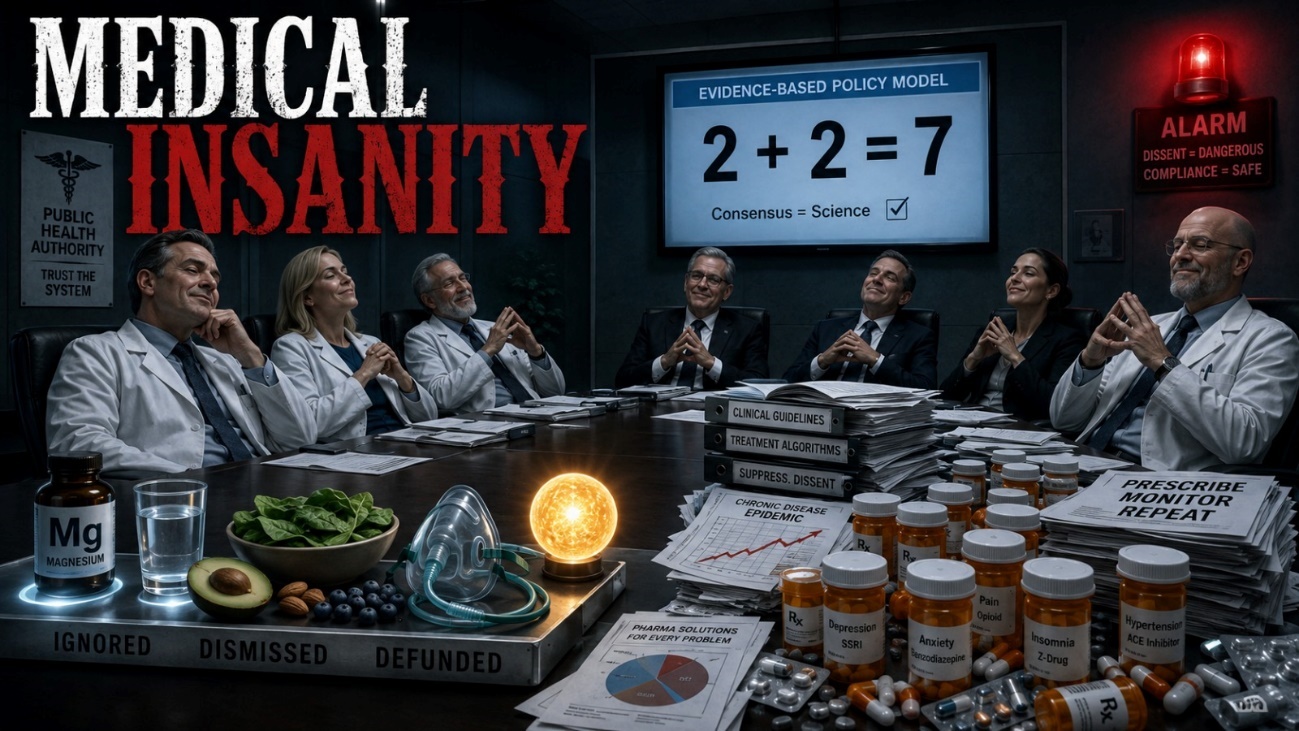
A certified mechanic tells you to drain your engine oil and drive cross-country. The engine seizes at mile 200. When you ask why he recommended this, he says oil levels are hard to measure accurately; some engines burn oil at different rates. The research on oil deprivation is mostly observational anyway. Sound familiar in medicine and health?
Is this mechanic insane? Again, not clinically. But he has violated the fundamental covenant of his profession: to apply known principles to prevent foreseeable harm. He knew oil prevents engine seizure. He knew your engine required oil. He recommended the opposite. The engine’s destruction was not an accident—it was the necessary consequence of his advice, and he either knew that and didn’t care, or didn’t know it and shouldn’t be a mechanic.
A mathematician who cannot add two plus two is the same creature in a different domain. If a man claiming to be a mathematician tells you that and doubles down under questioning, and produces a paper arguing that the concept of “4” is culturally constructed. His colleagues nod along, and the university retains him, and students are taught his method—the problem is no longer about him. The problem is that the entire system can no longer distinguish between competence and its absence. Insanity can be and is infectious.
If a mathematician cannot add two plus two, we do not trust him to calculate our taxes. If an engineer cannot measure straight, we do not let him build our house. So we agree: any craft requires a baseline of sanity. Now we enter medicine, where sanity disappears and no one notices.
The Magnesium Test Case
Now apply the template to the medical establishment and magnesium: A patient presents with hypertension, anxiety, insomnia, migraines, muscle cramps, arrhythmia, and insulin resistance. The doctor runs a serum magnesium panel. Result: 1.8 mg/dL. Reference range: 1.7–2.2 mg/dL. “Normal,” the doctor says. Prescribes a beta-blocker, an SSRI, a PPI, a statin, and metformin. Sends the patient home.
Patients with cardiac arrhythmias, seizures, asthma attacks, panic attacks, pre-eclampsia, migraines, severe depression — their magnesium is on the floor. Their cells are screaming for it. And what does modern medicine do? It does not give magnesium. It gives drugs that waste magnesium. It gives diuretics that drain magnesium. It gives calcium that competes with magnesium.
It measures magnesium in the blood, where 1% of magnesium lives, declares it normal, and ignores the cell where 99% lives. Not giving a severely magnesium-deficient patient magnesium is exactly like telling a man dying of thirst in the desert that water is not indicated. It is like telling the engine running without oil that oil is alternative medicine. This is not a mistake. This is insanity. A deep-rooted, credentialed, peer-reviewed insanity.
What the doctor knows—or should know, because it’s been in the literature for decades—is that:
- Serum magnesium represents less than 1% of total body magnesium
- The body maintains serum levels by leaching bone and tissue stores
- A normal serum magnesium does not rule out severe tissue depletion
- The patient’s symptoms are textbook magnesium deficiency
- Every drug just prescribed either depletes magnesium further or treats a symptom of magnesium deficiency without addressing the cause.
The patient returns over the years. Symptoms worsen. New diagnoses accumulate. More drugs are added. The magnesium is never tested properly. The magnesium is never repleted. The patient dies of a cardiac event that magnesium deficiency is known to precipitate.
Is this doctor insane? By my framework, yes. He acted—refusing to test for and treat a known deficiency with a cheap, safe, effective intervention—whose predictable consequence was progressive harm. He possessed the knowledge that should have prevented it. He operated within a system whose own literature contains the warning. Alternatives (RBC magnesium test, oral supplementation, a $10 bottle of magnesium glycinate) were trivially available.
The dirt-handed surgeon and the magnesium-neglectful doctor are the same person. One’s error is visible to the naked eye. The other’s is buried in a lab slip that says “normal.” The difference in visibility is not a moral difference. The harm is the same category: preventable, predictable, and produced by professional conduct that violates the profession’s basic logic.
Defining Medical Insanity
We can now extract the formal criteria. Medical insanity exists when a health professional or institution:
- Possesses or should possess the relevant knowledge. The information is not obscure. It is in the standard literature, textbooks, and the physiological first principles of the field. The surgeon knows about sepsis. The doctor knows that serum magnesium is diagnostically inadequate. The knowledge threshold is not expert-level—it’s competent-practitioner-level.
- Recommends or performs an action whose predictable consequence is preventable harm. The harm is not a rare side effect, not an idiosyncratic reaction, not a calculated risk in a difficult case. It is the direct, foreseeable, and probable result of the action. Dirt → infection. Untreated deficiency → progressive metabolic damage.
- A safe, effective, and trivially available alternative exists. Soap and gloves. Magnesium glycinate and an RBC magnesium test. The barrier to the correct action is not cost, not availability, not complexity. It is refusal.
- The practitioner, when confronted, defends the harmful action using arguments that would fail basic reasoning in any other domain. “The reference range says normal.” “We don’t have RCT evidence for magnesium supplementation in every condition.” “Patients might get diarrhea.” These are not defenses. They are category errors—applying standards of evidence appropriate to novel drug development to a mineral that has been present in human metabolism for the entire history of the species.
- The system protects the practitioner and punishes those who point out the error. The dirt-handed surgeon gets fired. The magnesium-neglectful doctor gets a patient satisfaction bonus and a promotion. The difference is not that one error is worse. It’s that one error is visible to peers and patients, and a diagnostic blind spot protects the other, a guideline committee, and a reimbursement structure that rewards treating symptoms rather than causes.
The Infection
This is where medical insanity goes deeper than individual malpractice. The dirt-handed surgeon is an anomaly—the system expels him. The magnesium-neglectful doctor is the system’s product—the system produces millions of him, promotes him, protects him, and calls him the standard of care.
Medical insanity is not a few bad doctors. It is a self-sustaining institutional psychosis with these features:
Diagnostic feedback loops are severed. The tests that would reveal the error are not ordered. The patient never improves because the cause is never addressed. The lack of improvement is attributed to disease progression, not treatment failure. The doctor never learns he was wrong. The system generates no corrective signal.
Harm becomes invisible by design. Serum magnesium panels, symptom-suppressing drugs, guideline-directed care that addresses surrogates rather than mechanisms—all of these function to hide the predictable consequences of the original error. The patient gets sicker, but each new symptom generates a new prescription, and the cascade looks like complex disease management rather than iatrogenic deterioration.
The epistemology is inverted. In a sane system, evidence of harm triggers investigation of cause. In medical insanity, the absence of the specific study the practitioner demands is treated as evidence that the problem is absent. “Show me the RCT where magnesium supplementation reversed insulin resistance in patients on metformin with normal serum magnesium.” No such RCT exists. Therefore, the doctor concludes the problem doesn’t exist. The burden of proof has been placed on the victim, and the standard of proof has been set at a level the system knows will never be met, because no one funds RCTs for unpatentable minerals.
The language seals the trap. “Evidence-based medicine” becomes a weapon rather than a method. It’s deployed to reject interventions that lack industry-funded trials while accepting interventions (SSRIs, PPIs, statins) whose evidence base, when examined honestly, is often built on ghostwritten papers, buried negative trials, and surrogate endpoints that don’t translate to mortality benefit. The term “evidence-based” has been captured to mean “revenue-aligned.”
Dissent is pathologized. The doctor who orders RBC magnesium, repletes aggressively, and watches his patients improve gets called a quack. His results are “anecdotal.” His methods are “not guideline-directed.” His patients are experiencing “placebo effects.” The system cannot absorb his success because his success indicts the system. So the system defines his success out of existence.
The Psychiatrist Who Cannot See It
Psychology and psychiatry have no framework for this. That’s not an accident—it’s a feature of the infection. Psychiatry diagnoses insanity in individuals by checking for delusions, hallucinations, disorganized thought, and functional impairment. But medical insanity operates at the institutional level, and it satisfies none of those criteria.
The doctor who refuses magnesium is not delusional—he can cite guidelines. He is not hallucinating—he sees the lab slip clearly. His thought is organized—it follows the algorithm he was trained on. He is not functionally impaired—he holds a job, earns a salary, and is respected by peers.
The problem is that the algorithm itself is insane. The guidelines are insane. The training is insane. And psychiatry has no diagnostic category for a person who is perfectly rational within a perfectly irrational system. The individual doctor’s sanity is preserved by the insanity of the institution that defines his standards. He cannot recognize his error because his error is indistinguishable from compliance.
Psychiatry is actually an insane profession, otherwise known as legal drug dealers with substances more dangerous than illegal ones. Have you noticed that in every case of mass shooting, the psychiatric medication the shooter was on is NEVER MENTIONED?
The Deeper Rot
Once you accept the magnesium example, the infection reveals itself everywhere: The oncologist who doesn’t test vitamin D in a cancer patient. The psychiatrist who doesn’t assess thyroid function before diagnosing depression. The gastroenterologist who prescribes PPIs indefinitely without monitoring magnesium. The cardiologist who pushes statins without checking CoQ10 or magnesium. The endocrinologist who treats type 2 diabetes with drugs that worsen insulin resistance while ignoring the nutrient deficiencies that caused it. The pediatrician who diagnoses ADHD without assessing sleep, diet, screen time, vaccine history, or magnesium status and reaches for amphetamines as step one.
Each is a dirt-handed surgeon in a specialty where the dirt is invisible. Each satisfies the five criteria. Each is protected by the same institutional immune system that expels dissent and rewards compliance. The infection is not confined to one mineral or one specialty. It is the operating logic of the entire apparatus—treating symptoms, ignoring causes, suppressing alternatives, protecting itself from feedback.
The mathematician who cannot add two plus two is not an individual failure. He is a system failure. He exists because the university that hired him cannot tell the difference, or doesn’t care, or has redefined mathematics to mean something other than the ability to perform arithmetic. The medical system has done the same thing. It has redefined medicine to mean something other than the ability to identify and correct the causes of disease. And within that redefinition, the dirt-handed surgeon and the magnesium-depletion denier are both practicing standard medicine. Only one of them got caught.
This, of course, is only the beginning. Not giving oxygen starved patients bicarbonate — which is the carrier of oxygen — is insane. Telling people to avoid the sun and then watching vitamin D deficiency create cancer, autism, and autoimmune disease — is insane. Injecting aluminum into a child whose body is trying to get rid of aluminum — is insane. Suppressing fever, which is the immune system’s fire to burn infection — is a very bad idea. Giving antidepressants that deplete magnesium to a brain that is depressed because it is depleted of magnesium — is insane.
The insanity is not in the patients. It is in the training. It is in the textbooks that deleted nutrition. It is in the system that makes $4 trillion a year managing the chronic diseases created by nutritional stupidity. Psychology and psychiatry are the most insane of all, because they claim to treat the mind while ignoring the brain. They will electrocute a magnesium-deficient brain — ECT — before they will give it magnesium. They will label a child deficient in iodine, magnesium, and sunlight as ADHD and give him amphetamine that further depletes magnesium. They have no idea what medical insanity is because they live inside it. Like fish who have no idea they are swimming in water because they have never known the air.
Disqualifying The Intelligence of Medical and Health Experts
Some principles are so fundamental that violating them disqualifies everything built on top of them. A patient can receive advanced imaging, genomic analysis, sophisticated pharmaceuticals, invasive procedures, and consultations with multiple specialists. At the same time, surprisingly little attention is paid to whether the basic physiological machinery of life is operating adequately. This is where medical insanity begins.
One drug produces an adverse effect. Another drug is prescribed to control that effect. A third medication becomes necessary because the second drug alters another parameter. Before long, the patient has a medication list that would have been unimaginable several generations ago, while nobody has returned to the original question: What is wrong with this human being’s physiology?
This is not stupidity in the conventional sense. Many physicians are extremely intelligent. That is precisely what makes medical insanity so interesting. Highly intelligent people can become participants in irrational systems.
When one doctor ignores an obvious biological reality, colleagues may question him. When an entire profession develops the same blind spot, however, the blindness becomes respectable. It receives terminology, reimbursement codes, professional guidelines, continuing education courses, and institutional protection.
Abnormal medical thinking becomes normal because everyone around you is doing it. That is why institutional insanity is much harder to recognize than individual insanity. If one physician announced tomorrow that nutrition had nothing to do with human health, most people would laugh. But if nutritional education receives little emphasis throughout medical training, the same idea can exist indirectly throughout an entire healthcare system without anyone ever saying the absurd sentence aloud.
If one cardiologist declared that minerals were irrelevant to cardiac electrophysiology, the statement would be scientifically ridiculous. Yet a patient may undergo years of cardiovascular treatment without anyone seriously investigating whether foundational nutritional and metabolic deficits are contributing to the problem. This is not sane medicine.
If someone claimed that breathing physiology had little to do with oxygen delivery, a physiology professor would object immediately. Yet the importance of carbon dioxide in oxygen unloading through the Bohr effect remains almost unknown to the general public and receives little practical attention in ordinary clinical medicine.
And perhaps the deepest insanity is the belief that human biology somehow became obsolete because pharmaceutical chemistry became sophisticated. It did not. The human body still operates according to physiology.
Mitochondria still require appropriate substrates and conditions. Cells still require minerals. Blood still must carry and release oxygen. Water still matters. Electrolytes still matter. Temperature still matters. Sleep still matters. Light still matters. Nutrition still matters. Movement still matters. The nervous system still responds to fear, safety, touch, isolation, and love. No medical institution can vote these requirements out of existence, but they certainly do a good job of ignoring them.
And the most dangerous medical insanity of all is the kind that has been practiced for so long, taught by so many authorities, and repeated by so many institutions that nobody even thinks about how wrong they can be.
A sane medicine asks: What does the body need to do its job? An insane medicine asks: What drug can I use to silence the symptom that is telling me what the body needs? We are not dealing with bad people. Most doctors are good people trapped inside an insane paradigm. They do not know they are insane. That is the definition of real insanity — the lack of insight. The doctor does not know he is in a system that profits from keeping magnesium, bicarbonate, iodine, and CO2 deficiencies intact.
Dr.Sircus is a reader-supported publication. To receive new posts and support my work, consider becoming a free or paid subscriber.
Subscribe now

comments