

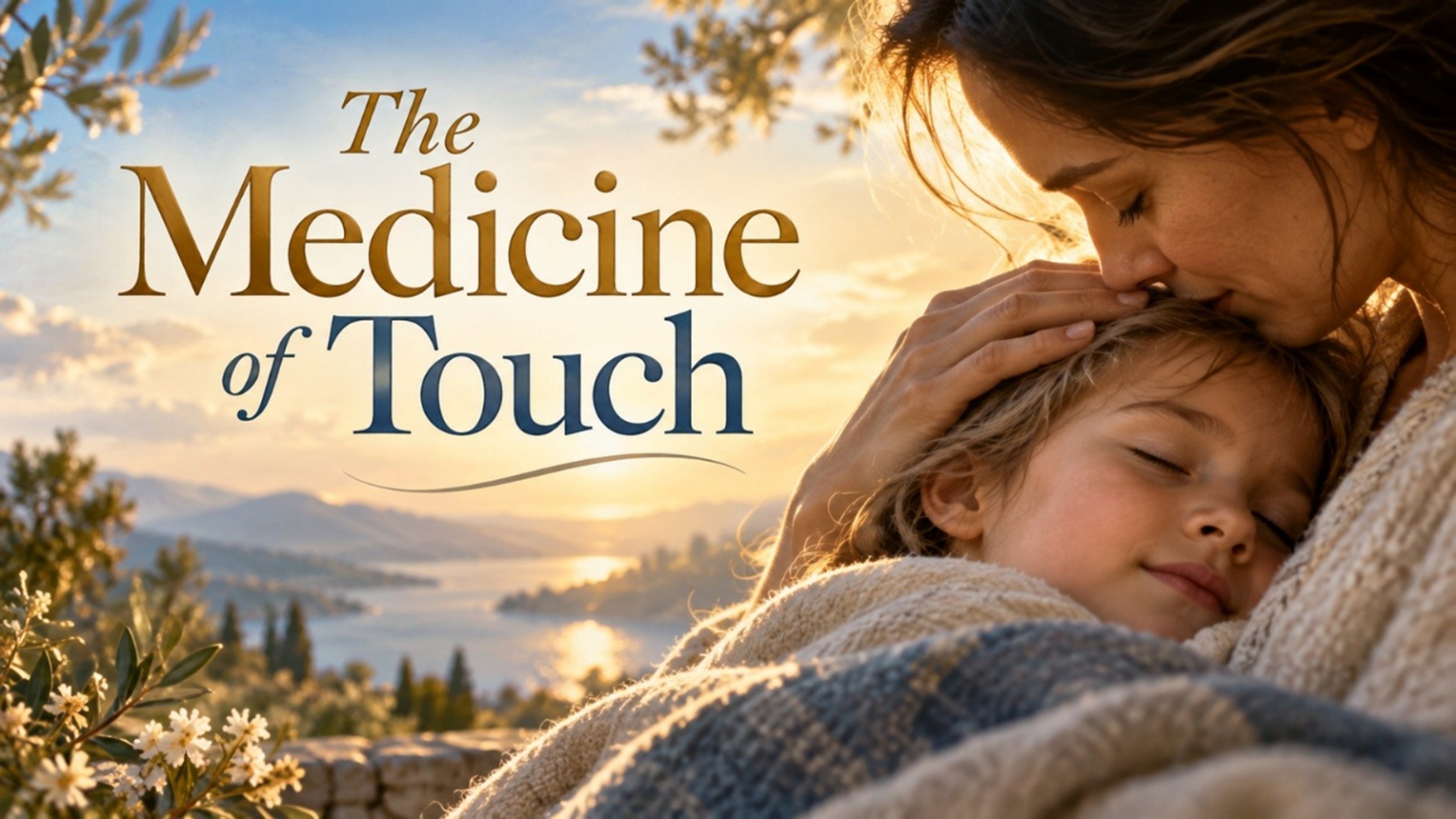
There are forms of medicine so simple that modern medicine almost ceases to recognize them as medicine: a hand on a frightened child’s back, a baby resting against the warmth of a mother’s chest, a father holding a feverish child through the night, a hug after fear, a gentle hand on the forehead, the quiet reassurance of physical presence.
None of these comes in a bottle. None requires a patent. None can be billed as a procedure, yet Reiki, which I define as healing pure touch, is used in more hospitals. Touch enters the nervous system immediately. One of the strongest lines in Humane Pediatrics was simply, “To touch is to be human.”
Biological touch hunger is real. Infants need more than food and cleanliness; they need holding, warmth, eye contact, soothing, and responsive human contact for normal development. Historical orphanage observations were horrifying: in the early 1900s, some institutions with adequate feeding and hygiene still saw extraordinarily high infant mortality when children received minimal physical and emotional contact. René Spitz later documented the profound developmental collapse he called hospitalism in institutionalized children deprived of consistent nurturing.
The biological lesson, however, is powerful: touch is not a luxury for an infant. It is part of the developmental environment the nervous system expects to grow. Harry Harlow’s primate work reinforced the same principle by showing the extraordinary importance of contact comfort to infant attachment and development. Harlow was an American psychologist at the University of Wisconsin who became famous in the 1950s and 1960s for experiments on infant rhesus monkeys.
Touch is medicine only when it is safe, welcome, and appropriate. Forced affection is not affection, and touch that ignores the child is not humane touch. The first act of healing is still listening. Sometimes we listen with our ears, and sometimes we listen with our hands.
A newborn enters the world through touch. Before language, before philosophy, before conscious reasoning, there is warmth, pressure, movement, heartbeat, voice, smell, and skin. Touch is among the earliest ways a baby discovers a fundamental truth: Am I safe here? The infant cannot understand the sentence “You are safe,” but the infant can experience safety. Warmth communicates it.
Being held communicates it. A familiar heartbeat communicates it. A parent responding to distress communicates it. The nervous system is listening long before the intellect knows what listening means. This is why the medicine of touch belongs naturally beside everything we have been discussing about building the child. Nutrition builds tissue.
Humane Pediatrics described children who may appear calm while living internally in a heightened state of arousal, and it emphasized how ordinary sensory environments can become difficult when sounds, light, smells, movement, and touch arrive without adequate filtering. That observation points to something much larger than autism.
Every nervous system has thresholds. Too much noise, too much fear, too much stimulation, too little sleep, too much pain, or too little security can push a child into a state where the world no longer feels safe. Behavior may change before adults understand why. The child may become irritable, withdrawn, hyperactive, aggressive, clingy, unable to sleep, or unable to settle, and medicine may begin looking for a disorder when what the child needs is regulation. Take a one-month-old baby, in all its innocence, hold it down and attack it with multiple vaccines, and you get what one should expect. Violence of any type does not sit well with babies.
A calm adult nervous system can help regulate a distressed child’s nervous system. That is one of parenting’s profound biological functions. The child borrows our calm. Anyone who has held a crying infant knows this without needing a medical degree. The baby is screaming; we bring the child against our chest; we rock gently; our breathing slows; our voice drops; and gradually the child softens.
We communicated safety through presence. That is soft medicine. Touch research emphasizes the developmental importance of physical contact and cites work examining massage, stress, anxiety, growth, and child development.
Human beings are profoundly social mammals. Children need secure attachment. They need comfort. They need responsive caregiving. They need to know that distress brings someone closer, not drives everyone away. Touch can be part of that answer, and sometimes absence speaks as loudly as presence.
What happens when a frightened child reaches out, and nobody comes? What happens when pain is treated only chemically but never relationally? What happens when medicine examines a child, measures the child, injects the child, scans the child, tests the child, and never once asks whether the child feels safe? We can know everything about a child’s blood chemistry and still fail to understand the child.
Another reason that touch belongs to medicine: the skin is not wrapping paper. It is an enormous sensory organ. Millions of receptors continuously communicate pressure, temperature, vibration, pain, movement, and contact to the nervous system. The boundary between “psychological comfort” and “physical medicine” begins to dissolve when we understand that affectionate touch is a physical event that enters neural tissue. A hug is not an abstraction. The nervous system receives it.
Perhaps the medicine of touch is ultimately not about hands at all. It is about contact, one human being reaching another. Touch says what listening says: you matter enough for me to be here with you. That is why these ideas belong together so naturally. Listening is medicine, touch can be medicine, and presence is medicine. When all three arise from genuine care, they become something even simpler, and perhaps even deeper: love.
Many ways can calm a person, and many healing and medical treatments can reduce stress, reduce sensory overload, slow the heart, and help a person center, but nothing does it better than touch. The most beautiful forms of touch are healing techniques, and this is the true aim of professional massage therapists: to heal through touch. Many studies have demonstrated that receiving touch that is pleasurable, safe, and appropriate reduces sickness, depression, and aggressive behaviors. Thus, massage has applications in both therapy and medicine.
Skin Hunger
Skin hunger is a relatively new term applied to the emotional response triggered by the loss of touch in our society. During WW II, babies in orphanages failed to thrive and even died when deprived of human contact. Hunger for touch is a real human need. Though touch is physical, it provides sustenance and anchors our emotional, mental, and spiritual selves. This is especially true for babies and only slightly less so for adults, since many have grown accustomed to a life of cutaneous deprivation.
Clinically, the lack of touch leads to a host of emotional, physical, and developmental problems in young and old alike. Research has shown distinct biochemical differences between people who experience touch and those who are severely deprived of it. Today, not only patients but also the medical establishment recognize the importance of alternative therapies, and particularly the importance of massage therapy in comprehensive cancer care. We already mentioned Reiki.
Like most alternative cancer therapies, massages work best alongside other treatments. Magnesium massage combines transdermal magnesium chloride application with a variety of massage techniques, creating a potent medical treatment.
Cutaneous satisfaction is associated with enhanced learning, improved IQ, language acquisition, reading achievement, memory, general neonate development, preterm infant development, reduced self-mutilating behavior in the severely mentally retarded, expanded external awareness in autistic patients, improved geriatric health, decreased childhood clinginess and fears of exploring the environment, elimination of inappropriate self-stimulation and public masturbation behavior in children, and improved visual-spatial problem solving.
Hospitalized patients recover more rapidly from injury and physical or psychiatric illness with attention to touch needs. Current thinking defines touch as the primary organizer (or, in the case of neglect and abuse, “disorganizer”) of normal human development when viewed at biological, psychological, and even social levels.
Combining Medicine with Touch
One way adults and infants can combine medicine with touch is through magnesium massages. The skin provides the best avenue into the body for many medicinals and drugs. With magnesium, we have a method in our hands that works similarly to intravenous magnesium treatments used to save lives in emergency rooms.
We simply use magnesium oil like we would massage oils or create a special blend by mixing essential oil or other massage oils with magnesium chloride, which is quite slippery even though there is no oil in the ‘magnesium oil.’
Though injecting magnesium is the quickest way to restore normal blood and tissue magnesium levels in ER or ICU units, it is expensive and sometimes uncomfortable to use as a regular therapy and not appropriate at all for infants.
Transdermal magnesium chloride therapy is inexpensive, safe, and a do-it-yourself at-home technique. Massage therapists should introduce clients to the tremendous benefits of a magnesium massage and suggest they start using it at home. Transdermal magnesium application is superior to commonly recommended oral magnesium supplements, where absorption is not guaranteed. Magnesium chloride oil is a potent natural substance that penetrates cells and can produce stunning results in cell biochemistry, and when loving touch is added to the mix, the results are heartwarming, to say the least.
Transdermal magnesium bypasses the liver and creates “tissue saturation,” getting nutrients where we want them, directly into circulation, so they can reach body tissues at high doses without loss. Combined with the tissue manipulation that occurs during massage, the blood is also brought closer to the skin’s surface, allowing faster absorption of magnesium chloride into cells.
With the simple application of this slightly oily solution to the skin or use in baths, we can help clients, and even babies, reach healthier magnesium levels. Magnesium Oil is the perfect companion to massage in any setting, further fulfilling the purpose of giving patients a healing touch.
Cancer Patients and Touch
Regular massage effectively lowers stress hormone cortisol levels, so I recommend magnesium massage for all cancer patients. The use of massage to lower cortisol levels and restore adrenaline levels began at Memorial Sloan-Kettering Cancer Center, generally considered one of the world’s top-ranked cancer hospitals. They recognized the importance of this practice for cancer patients, helping the immune system recover and prevent new cancer cell mutations. This practice has become the cornerstone of alternative cancer treatment at Sloan-Kettering Cancer Center. Massage is one of the most used pain management strategies for pediatric patients newly diagnosed with leukemia.
In a study involving breast cancer patients, massage therapy was shown to reduce depression, anger, and pain. In patients undergoing bone marrow transplantation, reductions in diastolic blood pressure, distress, nausea, and anxiety were detected immediately after receiving upper body massage. Furthermore, massage therapy reduced central nervous system/neurologic complications, which include anxiety, depression, and fatigue.
Dr.Sircus is a reader-supported publication. To receive new posts and support my work, consider becoming a free or paid subscriber.
Subscribe now

comments