

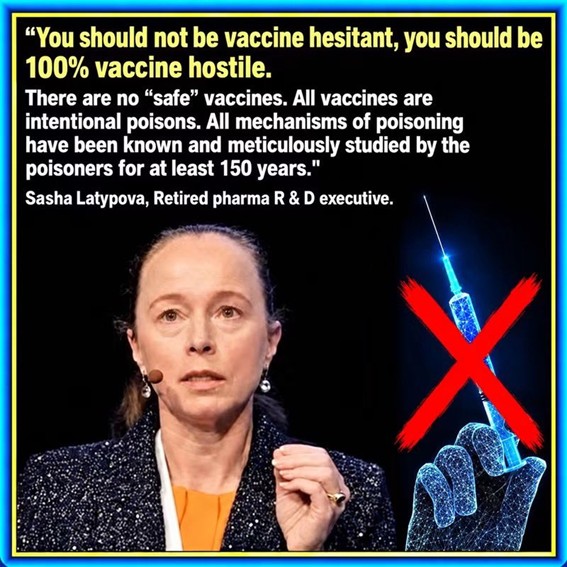
What happens when someone who spent twenty-five years in the pharmaceutical industry begins accusing that industry—and the government agencies that work alongside it—of fundamental deception? Of biological terrorism? Of murder? Do we listen carefully, investigate the evidence, and confront the possibility of institutional wrongdoing? Or do we dismiss the person as a conspiracy theorist because her conclusions threaten everything we have been told?
Alexandra “Sasha” Latypova presents precisely this challenge. She is not an outsider unfamiliar with pharmaceutical research. She spent much of her professional life working in drug development, clinical research, cardiovascular safety assessment, and pharmaceutical business operations. She holds an MBA from Dartmouth College and co-founded I-Cardiac Technologies, a company that develops technologies to evaluate cardiac safety during clinical trials.
Her professional activities included partnerships with Pfizer and interactions with FDA researchers. She worked in an industry whose procedures, contractual relationships, and regulatory expectations she came to know from the inside.
Today, she is one of its fiercest critics. And every parent should listen to her. Every doctor should listen to her. Every politician in the world should listen to her, but will they? Every newspaper in the world should publish her, but you know not one will.
Latypova’s accusations go far beyond the argument that pharmaceutical companies sometimes produce unsafe products or that regulatory agencies occasionally make mistakes. She alleges that the COVID response exposed a much deeper arrangement linking government, military institutions, pharmaceutical corporations, and emergency legal authorities.
She believes the public has misunderstood the very structure through which COVID vaccines were developed, purchased, regulated, and distributed. For that, we have Dr. David Martin.
These are extraordinary accusations. And the proper response to extraordinary accusations is not automatic belief or automatic rejection. It is serious investigation.
The Military Dimension of Pandemic Medicine
One of Latypova’s most important investigations concerns Operation Warp Speed and the United States Department of Defense’s involvement in the COVID vaccine program.
This military involvement is not speculation. On July 22, 2020, the Department of Defense and the Department of Health and Human Services publicly announced an agreement with Pfizer to produce and deliver 100 million vaccine doses, with provisions for hundreds of millions more.
The initial agreement was valued at approximately $1.95 billion. Latypova asks why emergency pharmaceutical development became so deeply intertwined with military procurement and national-security structures. She examined government contracts, including arrangements under Other Transaction Authority, a procurement mechanism that offers greater flexibility than conventional federal acquisition procedures.
She argues that these contracts reveal a system whose priorities and legal arrangements differed substantially from those of ordinary pharmaceutical development.
In her series Contracts for Crimes, she examines contractual language, technical direction documents, manufacturing obligations, and how government agencies and private manufacturers shared responsibility.
Her interpretation is uncompromising. She alleges that emergency procurement structures helped create an appearance of conventional pharmaceutical legitimacy while weakening ordinary accountability. The documents establish extensive government–industry coordination and unusual procurement arrangements.
The Question about Manufacturing and Batch Variation
Another major part of Latypova’s work concerns vaccine manufacturing and adverse-event reports associated with different production lots. She has examined reports of injuries and deaths linked to specific vaccine batches, arguing that variations in adverse-event distribution warrant investigation.
Latypova eventually moved beyond accusations of regulatory failure. Her public statements have alleged deliberate poisoning, coordinated wrongdoing, and intentional harm.
Latypova has assembled a body of work involving government contracts, pharmaceutical development records, regulatory provisions, and adverse-event reporting. Some of her interpretations are strongly disputed by those whose lives depend on public vaccination. Others concern documented institutional arrangements that deserve sustained public examination.
Sasha Latypova has asked questions that cut to the relationship between medicine, government, military power, corporate interests, and human freedom.
Sasha Latypova does not ask people to become more cautious about vaccination. Her position is far more radical. She declares:
“You should not be vaccine hesitant; you should be 100% vaccine hostile.”
She continues by asserting that no vaccines are safe, that all are intentional poisons, and that the mechanisms of poisoning have been understood and studied by those responsible for at least 150 years.
These are not the words of someone requesting modest improvements in pharmaceutical regulation. They represent a complete rejection of the scientific, ethical, and institutional foundations on which vaccination programs are built.
And the most explosive word in her statement is intentional.
Latypova is not merely accusing the pharmaceutical industry of producing dangerous products, overlooking adverse reactions, or protecting profits at the expense of patients. She is alleging knowledge, deliberate conduct, and a long history of organized harm.
If such accusations were established, the implications would reach far beyond pharmaceutical liability. They would raise questions of criminal responsibility, institutional complicity, and the fundamental moral legitimacy of institutions entrusted with protecting human health. They would challenge the sanity of modern civilization and, certainly, the integrity of modern medicine and health officials worldwide.
This essay is a chapter from my upcoming vaccine book, which I hope to finish in the next ten days. It’s a true horror story I’ve known for 23 years, since I wrote my first vaccine book, The Terror of Pediatric Medicine. And yet, since all things COVID arrived, the picture has darkened considerably, and that is perhaps the greatest understatement I have ever made.
In the meantime, while you wait, I suggest you read Carbon Dioxide Medicine, which I published two weeks ago. It is probably one of the most important published works of my life.
If you want to live longer and be more beautiful, or are deathly sick and don’t want to die, breathing CO2 gas (Carbogen, 95% O2 and 5% carbon dioxide) is one of the safest and most effective medical treatments you can do at home now. Doctors used to use it liberally but seem to have amnesia about this almost perfect medicine. The last thing you want is to be CO2 deficient in your blood. One medical secret I will let you in on is that CO2 deficiency and bicarbonate deficiency are the same thing.
Dr.Sircus is a reader-supported publication. To receive new posts and support my work, consider becoming a free or paid subscriber.
Subscribe now

comments