


Climate campaigners made a serious strategic mistake. They demanded that voters treat uncertain long-term projections as more urgent than present-day necessities. They attached climate policy to higher fuel prices, restricted consumer choice, expensive electricity, industrial regulation, and enormous government subsidies. Then they acted surprised when voters resisted. Well, what did they expect when they lied, were overly dramatic, and were wrong time and time again?
The “climate crisis” headlines forced down the throats of the American people began to really ramp up when socialist Rep. Alexandria Ocasio-Cortez and unhinged leftist Sen. Ed Markey introduced the Green New Deal in early 2019. Today, after a summer of climate hysterics about warming, as we shall see below, reality is asserting itself as we have record cold and ice gains where it counts. When you see what is happening right now at the poles, in Canada, South America, Russia, and Greenland, there is really concerning climate news, but it’s cold news, bitterly cold.
The public was repeatedly told that every heatwave, storm, drought, and wildfire confirmed an accelerating planetary emergency. This approach created fatigue, suspicion, and resentment. As a result, climate change barely registers as a voting issue in America.
A Washington Post/Ipsos poll asked registered voters which issues would most influence their vote in November’s midterms. The economy and high prices dominated at 54%, followed by immigration at 28%. Climate change? 3%—tied for 14th (and last) place. CNN data analyst Harry Enten said voters, when it comes to climate change, “don’t care.”
Since governments, climate experts, and the UN have been lying for so long, people are tired of the subject when, in reality, we do have something not only to worry about but something to prepare for. Prepare for a long, cold winter and worry that the future reality of our planet is going to be the exact opposite of what the climate maniacs have been screaming into our ears about for decades.
The only climate scientist teaching at West Point, the US Army’s
military academy, was fired after he resisted an order to stop
teaching about the human causes of the climate emergency.
High Arctic’s Coldest Summer On Record
The High Arctic has just completed its coldest summer in a temperature series stretching back to 1958. Data from the Danish Meteorological Institute show the mean 2-m temperature north of 80°N averaged approximately -0.91C (30.4F) across June, July and August 2026. June averaged -2.20C (28F), July essentially 0C (32F), and August -0.55C (31F).
Greenland Posts Sixth-Highest Ice Gain Since 1981
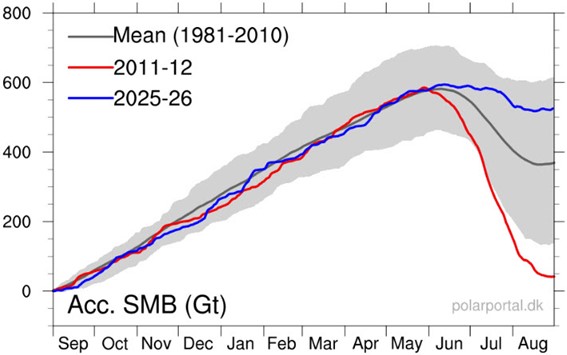
Greenland’s 2025–26 surface mass balance is closing at around 525 billion tons—roughly 43% above the 1981–2010 average and the strongest showing in nine years.
Antarctic Station Sets New All-Time Cold Record
Antarctica’s exceptionally cold 2026 is carrying into September, with temperatures again plunging below -100F. On Sept 5, Concordia Station at Dome C registered an unusually low -76.6C (-105.9F), roughly 12.5C (22.5F) below the typical September daily minimum, according to Italy’s Antarctic Meteo-Climatological Observatory. Concordia is holding below -100F for four consecutive days, an intense run of cold even by Antarctic Plateau standards—roughly 10–12C (18–22F) below the norm.
A new all-time cold record has been confirmed at the Belgrano II station in Antarctica, as severe late-winter cold gripped the southern Weddell Sea sector. On Aug 25, Belgrano II posted a daily high of just -35.2C (-31.4F)—the station’s lowest maximum temperature on record, edging below the previous -35C (-31F) mark reached in 2001. Infoclimat’s archive now ranks the reading as the station’s coldest August daily maximum in data extending back to June 1956.
Antarctica Has Been Gaining Ice Since 2020 — Study
Between 2020 and 2024, the Antarctic Ice Sheet gained ice at an average rate of 67.5 billion metric tons per year. The finding comes from a 2026 study in Communications Earth & Environment that used GRACE and GRACE-FO satellite measurements. From the early 2000s to 2020, the continent lost roughly 90–142 gigatons (Gt) of ice per year. But from 2020–2024, the researchers found a statistically significant mass-gain trend of +67.53 ±31.4 Gt per year.
Winter Persists In South America
Polar air has surged into southern Brazil. At São Joaquim, Santa Catarina, the historical Epagri/INMET station fell to -4C (24.8F) on Sept 7—the coldest Sept 7 in its 72-year record, beating the previous -3C (26.6F) set in 1973. Nearby Caminhos da Neve reached -5.9C (21.4F). Bom Jardim da Serra sank to -6.1C (21F), with Urupema at -5.4C (22.3F). Snow was observed across the highlands of Santa Catarina and Rio Grande do Sul, including around Urubici, Bom Jardim da Serra, Cambará do Sul and São José dos Ausentes. These temperatures are very cold for Brazil, a land where almost no houses have heating.
Southern South America’s stubborn winter has spilled into meteorological spring, breaking cold records in Chile and bringing fresh snow to unusually low elevations across Argentina. At Balmaceda, southern Chile, temperatures plunged to -9.4C (15.1F) on Sept 5, breaking the previous daily record of -9C (15.8F) from 1976. The following morning dropped to -9C (15.8F), smashing the Sept 6 record of -7.2C (19F) set in 1994.
Summer Cold Breaks Records In Russia
A sharp late-August cold outbreak across Russia has broken a string of long-standing station temperature records, with new lows stretching from the Arctic northwest through the Urals, western Siberia and the Volga region. At Kandalaksha, Murmansk Oblast, -2C (28.4F) was posted on Aug 28, breaking the previous daily record of -1.6C (29.1F) set in 1989. Sarapul, Udmurtia, dropped to 2.6C (36.7F), beating 3C (37.4F) from 1937. The cold intensified Aug 29.
Magnitogorsk, in Chelyabinsk Oblast, fell to -0.7C (30.7F) on Aug 31, according to SYNOP station data compiled by meteorological archive Pogoda i Klimat. That reading broke the station’s previous Aug 31 record of 1.1C (34F), set in 1962, and also undercut its previous absolute August minimum of 0.0C (32F) from 1969 and 1978 (station data extends back to 1948).
Elsewhere, Markovo, in Chukotka, dropped to -5.9C (21.4F), beating its Aug 31 record of -5.5C (22.1F) from 1905. Sarapul, Udmurtia, reached 1C (33.8F), breaking 2.6C (36.7F) from 1993. And Remontnoye, Rostov Oblast, fell to 5.9C (42.6F), besting 6.8C (44.2F) from 1983. The records extend the unusually cold finish to August across large parts of Russia, from the Far East through the Urals and into southern European Russia.
Meanwhile, across the Bering Strait and to the southeast, Anchorage, Alaska, fell to 36F (2.2C) on Sept 1, matching the record from 1962, according to an NWS report. Sounds like a real warming trend, doesn’t it?
Winter Returns To Canadian Rockies
Summer delivered another taste of winter across the Canadian Rockies Sunday, with fresh snow coating resorts in Alberta and British Columbia. Snow settled at Banff Sunshine Village (photos below), Lake Louise and Kicking Horse, where several centimeters accumulated.
Europe’s problem is now as political as it is economic. For decades, its establishment sold CO2 cuts as an existential necessity—worth any cost. Reversing course without exposing the deception is proving a headache, particularly with alarmist factions now so deeply invested and entrenched.
European leaders originally presented the Green Deal as an economic revolution that would create industries, jobs, technological leadership and energy independence. Instead, aggressive decarbonization collided with expensive energy, industrial decline, dependence on imported fuels and growing voter resistance.
Summer Cold Sweeps Iberia
A sharp late-summer chill is sweeping Spain and Portugal, with temperatures running as much as 15°C below normal. The cold peaks today, Thursday, Aug 27, with 2-meter anomaly maps showing most of the Peninsula below average. Much of Portugal and Spain is forecast to be 5 °C to 10 °C colder than normal, with localized pockets approaching 15 °C below.
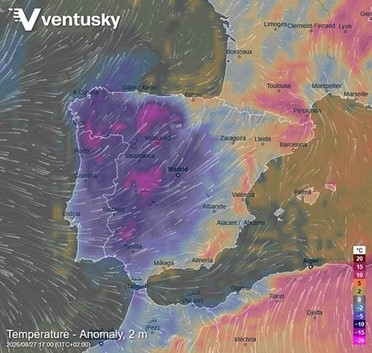
The chill extends from Galicia and northern Portugal through Madrid and deep into southern Spain, with a pronounced Atlantic flow driving the cool air inland. This is a substantial late-August departure, though one unlikely to receive any mainstream attention. The end of summer will probably hold some surprises for a public already disconnected from climate-expert mania.
Dr.Sircus is a reader-supported publication. To receive new posts and support my work, consider becoming a free or paid subscriber.
Subscribe now

comments