

Two major atmospheric phenomena: a super El Niño and the collapsing Arctic polar vortex will be blamed for everything that is happening with the weather this winter. Winter is arriving early, which doesn’t make much sense in a warming world, but blame El Niño and the polar vortex, and that explains everything. Climatologists are really confused because the collapsing vortex promises cold, and the record El Niño promises a warmer winter.
Our world today could not possibly be getting colder. Global cooling could not be responsible for record cold and record snow. And a colder climate could not be more dangerous than a warmer climate. Climate scientists’ DNA always reads things as hot, no matter how cold the world gets. If you haven’t noticed, the media always shouts about record heat, but do you ever hear it crying about record cold?’
A new study finds that such vortex disruptions can increase the likelihood of extreme electricity demand by 1.5 to 3 times across northern and central Europe. And Europe’s electricity grids are already proving ruinously expensive to manage. You see what they are saying: they talk about the vortex but do not mention the word cold, or that record-shattering cold is about to be unleashed on Europe, increasing electricity demand by 1.5 to 3 times.
The totally trustworthy politicians that we love are meeting in Turkey for another climate conference totally certain, enough to bet the farm, that global warming is in our future and that anyone who says otherwise should not be listened to, and that includes some of the best scientists on the planet.
Once a system has reached the point where authentic change becomes impossible because it disrupts the delicate balance of self-interest, it has reached its limits and is set on a run to failure. That is a serious principle of systems thinking. An institution can become so invested in its own conclusions, funding structures, political commitments, and reputation that changing course becomes extraordinarily difficult—even when circumstances warrant it. That describes the global warming climate change crowd perfectly. You will see in the last paragraph of this long but complete essay that if they are wrong, which I believe they are, people will die, and not in some far-off future but die this winter of the cold and inaffordability of keeping warm. (If I waited any longer to publish this essay, it would have turned into a book.)
Super El Niño could kill 870,000 people worldwide, warn climate scientists, who have gotten just about everything wrong these past 20 years. Did they mean the cold was going to kill that many people? Meanwhile, at the end of October we read that Japan broke October cold and snow records, and late October cold persisted across Antarctica, with Concordia Station plunging to -66C (-86.8F) on October 28—an extraordinarily low reading for this stage of the austral spring. Oh, and Greenland’s ice sheet gained nearly 10 billion tonnes of surface mass on October 29 alone, pushing accumulation further above the long-term average.
Winter is truly coming. Everything will change as
Europe’s ruling elites try to pretend nothing has.
We’ve heard the “climate change” canard for so many decades — including the institutionally hyped promises from “respected” political leaders and broadcast “news” anchors that we’d all be dead by now from “global warming. The truth is that the “green new deal” is nothing more than a scam for centralizing government power and making Al Gore and his doomsaying fraudsters filthy rich. Lucky them.
Now It’s November
Japan Hits -20C Earlier Than Ever Recorded
An exceptional early-November freeze has plunged northern Japan to -20.2C (-4.4F), the earliest such reading in the country’s nationwide AMeDAS records, dating back to 1978. At Horokanai, Hokkaido, temperatures fell to -20.2C (-4.4F) on Nov 11, an extraordinary 18.8C (33.8F) below the November 11 average minimum of -1.4C (29.5F).
On Nov 12, Yabukawa, Iwate Prefecture, fell to -7.7C (18.1F), some 5.1C below the average minimum. Nearby Kuzakai reached -7.3C (18.9F), an anomaly of -5.9C, while Kuzumaki plunged to -6.2C (20.8F), some 6.3C below normal. Across Iwate, 28 monitoring stations saw conditions more typical of late December. At Asahikawa, temperatures plunged to -12.5C (9.5F), an astonishing 11.9C (21.4F) below normal — a level of cold more typical of late January. Local reporting compares the reading with the exceptionally early freeze of November 1906.
NOAA predicts a steep decline in sunspot activity through 2029. Its
updated forecast projects a fall from the Solar Cycle 25 peak of 160.9 in
October 2024 to approximately 19 by November 2029—a decline of roughly 88%.
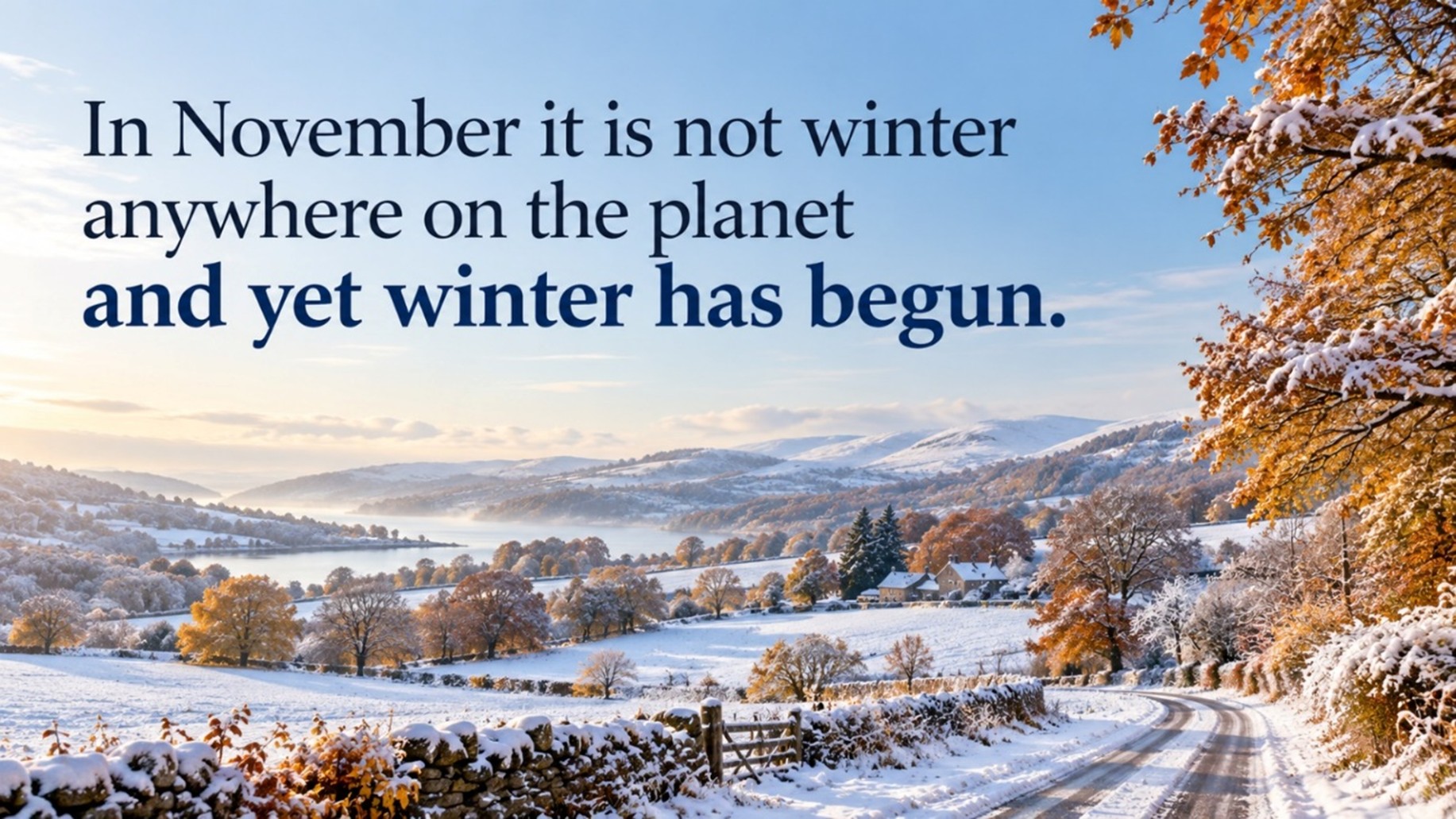
In November, it is not officially winter anywhere on the planet, except at the poles, of course, where it is always cold. Yet, winter has begun where it normally would be Fall in the North and Spring in the South—first reports from November: Buenos Aires Logs Coldest October Since 1955. October brought exceptional spring cold to Buenos Aires, Argentina, with average daytime highs falling to their lowest in 71 years, while across the Andes, historic snowfall has pushed Chile’s ski season into November.
Delhi Breaks 75-Year Cold Record. India’s capital recorded its coldest October daytime high in 75 years on October 30—and Greenland Posts Strong Early-Season Gains. Greenland’s ice sheet has accumulated 164.3 billion tonnes of net surface mass since September 1, its strongest start to a season in four years and 41% ahead of the same point in 2025. Is something happening that the big bosses on Earth don’t want to tell us about?
On November 2, heavy snow swept the western United States, hitting mountain resorts across Utah, California, and Colorado. Widespread frost has swept France in the first week of November. On Nov 2, Arbent fell to -4.9C (23.2F), breaking its old Nov 2 record of -4.3C (24.3F), set in 2007, according to local reporting.
On Nov 5, Eudunda, South Australia, provisionally fell to 1C (33.8F), some 9.4C below normal. The Bureau of Meteorology lists Eudunda’s November record minimum as 1.7C (35.1F), set on Nov 21, 1968, in a temperature series dating back to 1965. Also on Nov. 5, an Arctic outbreak has sent temperatures plunging across central and southern Siberia, with early-November readings running as much as 11.5C below normal . The freeze has also extended into northeastern China.
China now burns more coal than the rest of the world combined. Meanwhile, Britain’s wind
generation has slumped to barely 1%, and electricity prices are soaring across Europe.
A sharp late-spring freeze has broken November temperature records across southeastern Australia. On Nov 5, Eudunda, South Australia, fell to 1.1C (34F), about 9.3C below average and beating the station’s November minimum of 1.7C (35.1F), set on Nov 21, 1968. Early-winter cold has broken at least 17 daily temperature records across Czechia, as cold extends across Europe. The Czechia freeze began setting records on Nov 5, when Jihlava–Hruškové Dvory fell to -5.8C (21.6F), beating its previous daily minimum of -4.5C (23.9F) from 1965.
Heavy early-season snow has broken a November snowfall benchmark in northern Japan, with snow depths exceeding 11 times normal across parts of Hokkaido. Greenland’s ice sheet has accumulated 197.4 billion tonnes of surface mass since September 1, among the highest on record. According to the DMI, accumulated surface mass balance (SMB) reached 197.4 gigatonnes (Gt) by Nov 9, approximately 50% ahead of the same date last year. Does not sound like global warming is much of a problem.
South Pole’s Second-Coldest Winter On Record
This year, the South Pole recorded its second-coldest coreless winter in nearly seven decades of observations, with temperatures averaging -60.9C (-77.6F) from April through September — 2.3C (4.1F) below normal.
The latest South Pole Meteorology Office data, updated in November, confirm an exceptionally cold September at Amundsen–Scott South Pole Station. The month averaged just -63.6C (-82.5F), a substantial 4.8C (8.6F) below the 1991–2020 reference period, making it the coldest September since 1995.
The result caps an extraordinary six-month stretch. Across April–September — the Antarctic Plateau’s coreless winter — temperatures averaged -60.9C (-77.6F), surpassed only by the record-setting winter of 2021, which averaged -61.1C (-78F). July was particularly severe, averaging -64.4C (-83.9F), some 4.2C (7.6F) below normal. August followed at -62.8C (-81F), 3.2C (5.8F) below average.
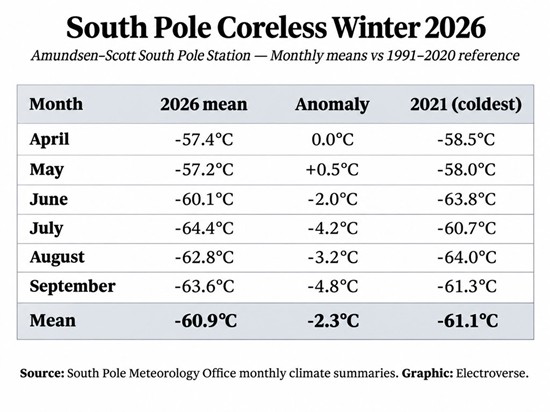
The Antarctic interior has endured another exceptionally cold winter—again unreported by the media.
However, in certain places, winter arrives in September and October. A pattern of early, longer winters doesn’t jibe with the global warming hysteria. But there is no denying the historical pattern, which you will see below. The key word here is pattern, which speaks more about climate than the simple weather.
My September 9 article, “Climate Experts Failed to Fool Americans,” gathers reports of late-August frost in Russia, snow in the Canadian Rockies, and September cold in southern Brazil, Chile, and Antarctica. The geographical distinction matters: the Northern Hemisphere examples concern early cold; the Southern Hemisphere examples concern winter conditions persisting toward or into spring. Together, they frame concern about cold extending beyond the expected season.
My September 25 article, “Winter Is Coming and When Winter Meets War,” develops that theme with mountain snow in western North America, frost in Russia’s Far East, September snow in the Carpathians, and Japan’s first subfreezing reading.
In August of 2026, a sharp summer chill swept the northern Rockies and High Plains on August 4 and 5, breaking or tying at least 19 daily cold records across seven states.
My October 30, 2019 article, “Winter Has Arrived Months Early,” contains strong examples of patterns that global warming fanatics continue to ignore. In that year, National Weather Service records confirmed heavy late-September snow in Montana, another October storm, and Great Falls reaching 0°F on October 10—the earliest such reading on record, beating October 26, 1919.
Documented autumn snow events occurred in every intervening year, 2020–2025. These examples come from weather-service records.
In 2020: On September 8, Denver recorded one inch of snow, tying its second-earliest measurable snowfall and its earliest freeze. Its average first measurable snowfall date is October 18.
In 2020, my essay What Happened to Summer: Summer came to an abrupt end in the mountains of northern Spain when a sudden cold snap left the Picos de Europa range buried under a blanket of white. The Alps and Pyrenees have recently received heavy summer snow, and now the French are reporting all-time record August lows. And we have strong upticks in the ice in Greenland and Antarctica, where the ice this year is greater than on the same date in 1979, as well as on the same date in every year of the 1980s and 1990s (barring 1985, 1994, 1998, and 1999).
In 2021: An October 12–13 storm deposited one to two feet of snow across the northern Black Hills, with 27 inches reported near Deadwood, South Dakota, and substantial accumulations in northeastern Wyoming.
In 2022: On October 17, lake-enhanced snow brought one to four inches to northern Indiana and southwestern Michigan. Heavy wet snow and strong winds damaged trees, interrupted electricity, and made roads hazardous. weather.gov
In 2023: The October 24–26 storm brought up to two feet of snow in Montana and six to eighteen inches across parts of the Dakotas. Bismarck’s 8.5 inches on October 26 made it the city’s second-snowiest October day on record. Travel restrictions, school disruptions, and harvest interruptions followed.
In 2024: During November 5–9, parts of eastern Colorado received two to three feet of snow, with localized totals exceeding forty inches. Major roads closed, some rural roads remained blocked for days, and approximately 30,000 Denver-area customers lost power on November 9.
In 2025: On November 9–10, an early lake-effect storm produced localized accumulations around one foot in northeastern Illinois and northwestern Indiana. Indianapolis recorded its largest early-season snowfall since 1993.
We know what climate experts would think and say. The hotter the climate, the earlier we will see record cold and snow. The experts’ logic: heat confirms warming, and cold also confirms warming. The hotter the climate, the earlier the record cold and snow makes perfect sense to global warming cheerleaders. They have decades of practice perverting the truth. It makes sense to call them climate perverts, with Al Gore leading the pack.
New Study: Fossil Fuels Did Not Drive CO₂ Rise
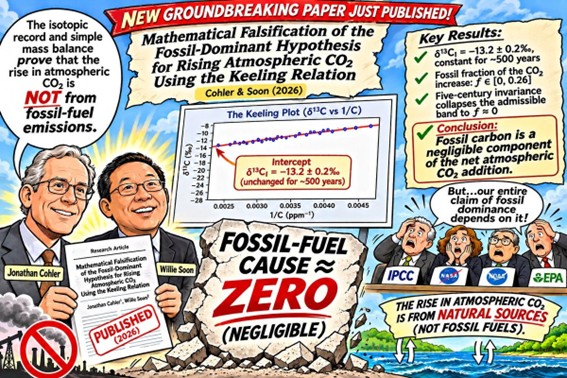
A newly published peer-reviewed paper claims fossil fuels contributed virtually nothing to the rise in atmospheric CO₂. Published November 1 in Science of Climate Change, the study by Jonathan Cohler and Willie Soon challenges the position of the IPCC, NASA, and NOAA that fossil-fuel emissions are responsible for the long-term increase in atmospheric CO₂. Their argument rests on a chemical fingerprint. Carbon exists in different forms, including carbon-12 and the slightly heavier carbon-13. Fossil fuels contain relatively little carbon-13, meaning CO₂ released by burning coal, oil, and gas has a recognizable isotopic signature.
New Happer Study: CO₂’s Warming Effect Diminishes Sharply
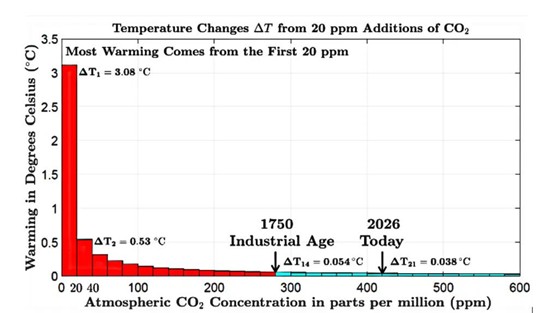
A new analysis by Princeton University professor emeritus of physics William Happer and Laura Klett calculates that atmospheric CO₂ delivers sharply diminishing warming returns as concentrations rise. Published October 27, the paper, Saturation of Warming by the Greenhouse Gas CO₂, examines how the greenhouse effect changes as atmospheric CO₂ increases. The authors find that CO₂’s warming effect becomes increasingly saturated.
At very low concentrations, warming rises almost linearly with added CO₂. At higher concentrations, the relationship becomes logarithmic, meaning each additional increment has less impact.
Starting from a hypothetical atmosphere containing no CO₂, the first 20 ppm produces 3.08 °C (5.54°F) of warming in their model. The next 20 ppm adds just 0.53 °C (0.95°F).
At the preindustrial concentration of 280 ppm, the calculated warming from another 20 ppm falls to just 0.05 °C (0.09°F). At modern concentrations, the effect diminishes further still. Increasing CO₂ from 400 to 420 ppm produces just 0.038 °C (0.068°F) of additional warming under the model.
Raising it from 420 to 440 ppm yields about 0.036 °C (0.065°F). The calculations use the authors’ adopted temperature sensitivity of about 0.54 °C per CO₂ doubling.
Happer and Klett estimate that, in their hypothetical progression from zero to 420 ppm, more than half the total calculated CO₂ warming comes from the first 20 ppm alone. They also conclude that atmospheric CO₂ is already heavily saturated in its infrared absorption, leaving further increases with comparatively little additional warming influence.
These calculations illustrate how CO₂’s warming effect does not increase proportionally with concentration. Instead, each successive addition delivers a smaller temperature response—a principle the authors argue substantially limits the warming potential of future CO₂ increases.
Solar activity has taken another sharp dive.
October 2026 closed with a preliminary monthly sunspot number of just 45.7 — the lowest since November 2021.
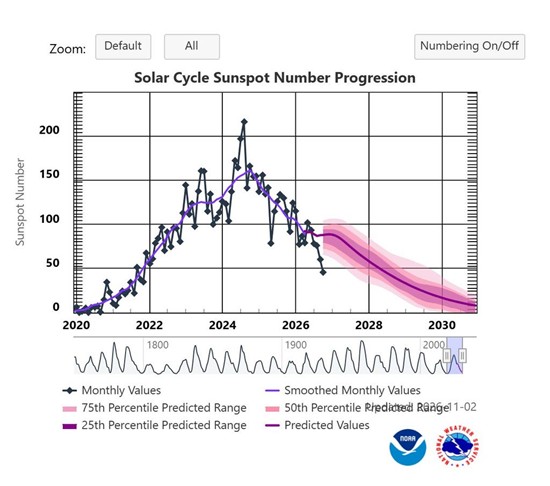
The reading is down from 60.3 in September and 114.8 in October 2025. Solar Cycle 25 reached its official peak in Oct 2024, with a smoothed sunspot number of 160.9. Just two years later, activity has declined sharply, far more sharply than the descent suggested by NOAA/NASA and others.
Germans Not Really Smart
Wind Stops, German Power Prices Soar Ninefold. Germany’s electricity prices have surged ninefold following a collapse in wind generation. On Oct 24, renewable generation reached a record 114.8% of German electricity demand, according to Fraunhofer charts. Wholesale electricity averaged just €30.12/MWh, falling to €13.12/MWh the following day.
This was celebrated as a triumph for renewable policy. Then the wind dropped. Between Oct 29 and Nov 1, renewables supplied an average of just 29.7% of demand, while wholesale prices jumped to €272.70/MWh — nine times the Oct 24 level. Wind generation collapsed from 46.5 GW on Oct 24 to roughly 4–5 GW daily during the lull, a decline of around 90%. On Oct 29, wholesale electricity averaged €314.85/MWh, with individual 15-minute prices exceeding €570/MWh. The pressure has persisted. By Nov 4, wholesale electricity still averaged an eye-watering €248.99/MWh. Coal and gas generation ramped up to cover the renewable shortfall.
When Energy Becomes Too Expensive, People Die
Winter is approaching Europe, and millions of households are facing a frightening choice between heating their homes and paying for food, medicine, and other necessities. On November 9, Britain paid the Langage gas power station the equivalent of £1.4 million an hour as wind generation slumped and emergency electricity prices soared. Britain had to turn to expensive gas generation to maintain electricity supplies when the wind failed to deliver.
The human consequences are not hypothetical. England recorded an estimated 2,200 cold-associated deaths during winter 2025–2026, according to the UK Health Security Agency. Cold weather increases cardiovascular and respiratory risks, particularly among older adults and those already struggling with illness. Meanwhile, millions of British children live in fuel poverty, and household energy prices are expected to rise again as winter deepens.
Governments speak endlessly about protecting future generations from climate change. But who is protecting the elderly, the sick, the poor, and the families who cannot afford to heat their homes today? Energy security is not an abstract environmental debate. It is a matter of public health, economic survival, and human life. No energy policy deserves to be called successful if the people it is supposed to serve cannot afford to stay warm.
Dr.Sircus is a reader-supported publication. To receive new posts and support my work, consider becoming a free or paid subscriber.
Subscribe now

comments