

Winter is coming, whether the people in the Northern Hemisphere are prepared for it or not. The beauty and power of winter will collide with the destruction and hardship of war. It was still summer when I started writing this essay, but winter was already in the air, as it has been each year for the last few years.
It seems strange that in the warmest years in forever, according to the media that hardly anyone trusts, the cold creeps in before summer even finishes. An early-season cold shot has delivered accumulating September snow across the mountains of the Pacific Northwest, Alberta, and Montana on September 14. Crystal Mountain, Washington, picked up around 6 inches (15 cm) over that weekend—enough for crews to shovel pathways around the resort.
The same mountain had already recorded its first snow back in August. An early-season cold shot has broken or tied temperature records across California and Oregon. And oh, this is just the beginning. No more sweating from intolerable heat, except in the minds of global warming expert fanatics who will sweat their mistakes all winter long.
This summer, the news media got hysterical about the record heat. I wonder if they will get hysterical about the record cold and the fact that many people won’t be able to afford to stay warm this long, cold winter, which it promises to be. The real danger this winter is not cold weather alone, but cold weather arriving in a world already struggling with war, disrupted energy supplies, inflation, and declining public trust. (See Below)
Serbia’s mountains are receiving their first snow of the season Tuesday,
Sept. 22 — roughly three weeks ahead of schedule. A sharp cold front is sweeping
the country, with snow forecast to 1,800 m (5,900 ft) during the afternoon.
I doubt they will have cold hysterics; they would never admit they are wrong, and they would not want to scare anyone about reality, the real truth of climate change, or the fact that the wars will hit the human race particularly hard this winter, not only because of the price of energy but because stocks of natural gas and diesel and heating oil are already dangerously low. Almost everyone knows (71%) that the government and the press cannot be trusted for anything, and that will bite hard when people get hungry and cold as food and energy prices continue to soar.
Shell estimates that approximately 36 million tonnes of Middle Eastern LNG (natural
gas) have been lost this year because Qatar and the UAE cannot export normally
through Hormuz. Asian spot LNG has approached $30 per million BTU, versus roughly
$10 before the war. Simultaneous Russian and Gulf refinery losses are driving physical
diesel rationing, directly affecting Brazilian imports, farming, trucking, and food.
The cold first hit northern California and southern Oregon on September 4. Mt. Shasta City fell to 33F (0.6C), breaking the previous daily low of 38F (3.3C) set in 1990. Montague dropped to 35F (1.7C), beating 40F (4.4C) from 1964, while Klamath Falls hit 32F (0C), tying its September 4 record from 1912. The chill then drove south.
Canada Back Below -10C
Canada has registered its first -10C reading of the new season, with Alert, Nunavut, tanking to -14C (6.8F) on September 11. This is the lowest reading seen this early at Alert since 2017, when the station reached -14.2C (6.4F) on September 9.
Antarctica Gained 695 Billion Tonnes Of Ice In 22 Months
Antarctica added roughly 695 billion tonnes of ice in just 22 months—the largest such gain in the satellite record. The finding comes from a new study published in Nature, using satellite-gravity observations of the Antarctic Ice Sheet. Between July 2021 and April 2023, Antarctica gained approximately 695 Gt of land-ice mass—the “largest 22-month mass gain in the past two decades,” according to the researchers. And as Spring approaches, Antarctica logged- 100°F cold for 10 Straight Days. Antarctica’s prolonged 2026 cold has continued deep into September.
Antarctica Plunges To -81.4C (-114.5F)
Antarctica’s exceptional 2026 cold is refusing to let up.
On Sept 19, Concordia Station plunged to -81.4C (-114.5F), according to the Italian Antarctic Meteo-Climatological Observatory, a reading just a nudge above Concordia’s September minimum of -81.9C (-115.4F), set in early September 2007.While the Antarctic Plateau can still produce biting lows in September, daylight is rapidly returning by Sept 19—making a plunge to -81.4C (-114.5F) exceptionally late. In fact, -81.4C is now Concordia’s coldest temperature ever recorded this late in the year. Meteorological spring is three weeks old.
Cold Descends On Russia’s Far East
An early-season cold shot has descended on parts of Russia’s Far East, delivering sharp frosts and breaking daily temperature records in Amur Oblast. At Norsky, the temperature fell to -4.9C (23.2F) on Sept 16. Station records show this broke the previous Sept 16 minimum of -2.8C (27F) set in 1935—a benchmark that had stood for 91 years. Norsky’s daily climate series extends back to 1925. Farther southeast, Arkhara dropped to -2.1C (28.2F), beating its previous Sept 16 record of -1.7C (28.9F) from 1984. Its data extends back to 1936. The cold was part of a wider frost event across Amur Oblast. Authorities warned of overnight lows locally reaching -7C (19.4F). Sounds a little cold for summer, doesn’t it?
The Atlantic has reached late September without producing
a single hurricane — the first season since 1914 to do so.
Hot Visakhapatnam Experiences Record Cold
Visakhapatnam, India, has logged its coldest September daytime maximum on record at both its city and airport stations, as a deep depression smothered India’s east coast in cloud and rain. At Visakhapatnam Airport, the maximum reached only 26C (78.8F) — 7.4C (13.3F) below normal. Visakhapatnam has never seen a colder September day in records dating back to 1870.
Cold Bay Breaks 47-Year Record
Alaska’s Cold Bay dropped to 30F (-1.1C) Wednesday, breaking a daily cold record that had stood since 1979.
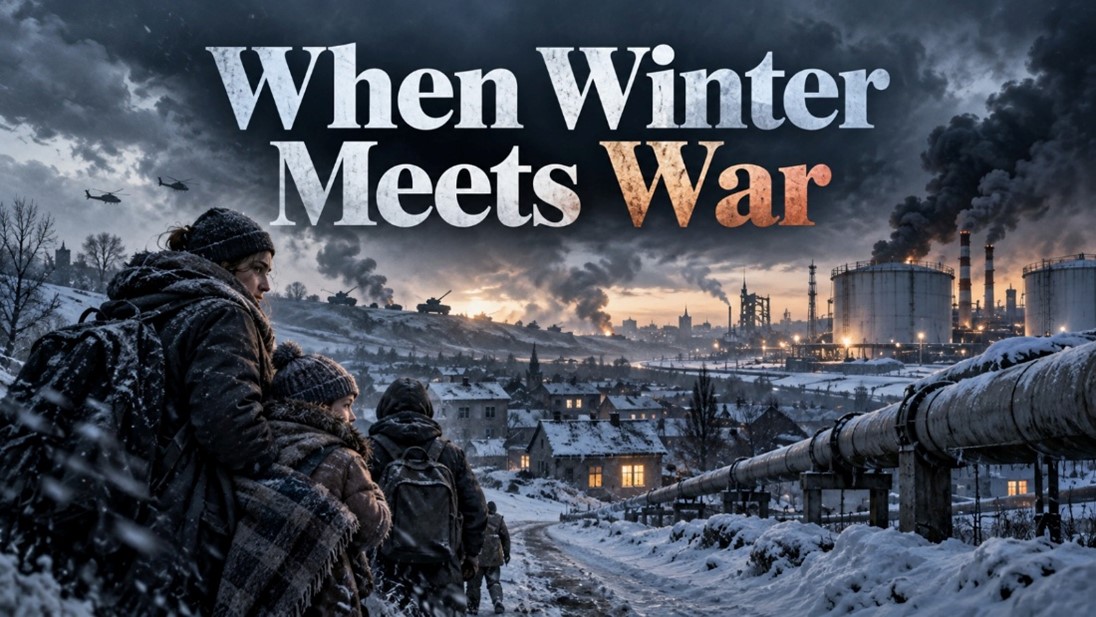
The real danger this winter is not simply the cold. It is the convergence of cold weather, war, energy shortages, and increasingly desperate household finances. A winter that might ordinarily be uncomfortable can become a humanitarian crisis when millions cannot afford to heat their homes. People cannot burn political promises to stay warm, and they cannot eat government reassurances when food prices rise beyond their means.
Energy is not just about keeping warm. Natural gas runs industries, produces electricity, and helps manufacture fertilizers. Diesel moves our food, powers farm machinery, and keeps civilization’s supply chains running. When energy becomes scarce or prohibitively expensive, everything costs more. The farmer pays more, the trucker pays more, the supermarket pays more, and eventually the family at the dinner table pays for it all.
The wars are now reaching into people’s kitchens, bedrooms, and bank accounts. Ordinary people who had nothing to do with those decisions may feel the consequences. An elderly person choosing between heating and eating is experiencing the consequences of geopolitical conflict just as surely as someone living much closer to a battlefield.
That’s why the early arrival of cold deserves attention. A few September snowstorms cannot tell us how severe an entire winter will be, but they remind us how vulnerable modern civilization has become to the weather. We have built societies that depend on abundant, affordable energy, then allowed that energy security to become entangled in wars and political confrontations.
Winter does not negotiate. It does not care who started the wars, who controls the oil, or who was right about climate change. When temperatures fall, people need heat. When food becomes expensive, they need to eat. And when governments cannot provide security, their citizens discover how fragile the foundations of modern life really are.
The question is no longer simply how cold this winter will be. It is how many people can still afford to survive it comfortably.
Winter Sweeps The Carpathians
Winter has arrived in the Carpathians in September, spreading snow across the high ground of both Ukraine and Romania—and already forcing plows onto the roads. On Ukraine’s Mount Pip Ivan, the season’s first snow arrived Sept. 22 as temperatures dropped to -1C (30.2F). Two days later, the cold deepened to -3C (26.6F), and rescuers warned that full winter conditions had taken hold across the summit. Farther south, the Romanian Carpathians were hit harder still. Let’s see how much diesel will be available this winter to clear the roads.
Japan Freezes Early As Cold Record Falls
Japan has logged its first subfreezing reading of the season, 12 days earlier than last year and a week ahead of the average. At Numakawa, northern Hokkaido, the temperature sank to -0.4C (31.3F) early Sept 25 — Japan’s first subfreezing reading of the season outside high mountain stations, 6.9C (12.4F) below normal and more typical of early November.
Dr.Sircus is a reader-supported publication. To receive new posts and support my work, consider becoming a free or paid subscriber.
Subscribe now

comments