


As Javier Vinós points out, “Models can’t be trusted. Anything we don’t know is not included, and many things we do know are incorrectly included. Only a fool would trust a model that hasn’t been properly validated.” Forecast models currently assign roughly equal probability to a very strong, strong, moderate, or weak-to-neutral El Niño, yet on X, climate maniacs are trying to spread fear like a plague about El Niño, the Atlantic Current, and everything else related to climate.
Few would claim to trust the “truthiness” of social media content or
its sources, but that no longer matters. What matters is the signal
embedded in the content that triggers a dopamine cascade in the “consumer”
of content–what Big Tech calls engagement, and others call addiction.
It is not that we do not have anything to worry about regarding climate. For example, California’s residential electricity rates are close to double those in the rest of the US, in large part because of the state’s ambitious climate policies and wildfire-prevention costs. Don’t bother telling climate maniacs, but the sun, not politics, rules climate change. What we have is a steady stream of media propaganda, little to none of which is true.
Dr. Richard Lindzen, Professor Emeritus of Atmospheric Science at MIT,
says data don’t drive global warming fear, but money and control do.
In a clear sign that we are about to all die from the heat, winter has returned to the Northern Hemisphere in mid-April, and as we nudge toward May, we are still seeing record snow and cold. And the Greenland Ice Sheet is still adding mass into late April. Daily surface mass balance has been spiking well above the 1981–2010 average in recent days, with roughly 7 gigatons posted on April 21 alone.
And as predicted, snow is still falling across both coasts as of April 22. A Winter Storm Warning was issued last week as nearly 5 Feet of snow and a 40-degree temperature drop were approaching. Here’s what that headline, from mid-Spring, was signaling, in plain terms:
A major winter storm was expected to hit, bringing extreme snowfall (up to nearly 5 feet / ~1.5 meters) along with a sharp temperature drop of about 40°F (~22°C) in a short period. That combination is what makes it especially dangerous.
What this typically means on the ground:
- Heavy snow accumulation → travel shutdowns, road closures, flight cancellations
- Rapid temperature drop → flash freezing, ice formation, increased risk of accidents
- Power outages likely → due to snow weight on trees/power lines
- Wind + snow (possible blizzard conditions) → near-zero visibility
- Danger to people unprepared → exposure risk rises fast with sudden cold
The key issue isn’t just the snow—it’s the speed of the change. A 40-degree drop doesn’t give much time to adapt, so infrastructure and people both get caught off guard.
An ex-NASA guy sent me the video above about climate change. It is simple, direct, and to the point. The world is split over climate change and manmade global warming. I have been writing and publishing on this subject since 2009. No matter what we think and believe, in the end, the truth will be known. In the long run, it is quite difficult to hide the reality of climate change, but there is no shortage of politicians, governments, and organizations willing to bet against Nature.
Ferdinand Meeus, a chemist and IPCC-listed expert reviewer, argues,
“Thermometers in urban areas give 5 °C higher temperature… satellite measurements
are clear: the urbanization effect is 3–5 °C higher temperature measurements.”
US Temperature Extremes Have Declined Since 1899 — New Study
A new study by John Christy has returned to the raw US station records and extended them from 1899 through 2025 using the Historical Climate Network. Christy has stitched together daily observations — more than 40 million of them — across 1,211 stations to create a near-complete national record. He found that across the full dataset, US temperature extremes have generally declined.
Start with heat. If extreme heat were accelerating, it would be clearly evident in 127 years of station data. It doesn’t. The most intense heat remains concentrated in the early 20th century, with the 1930s dominating every meaningful measure. In 1936 alone, around 22% of stations recorded their all-time highs. No modern year comes close. Expand the lens to include multi-day events, and the same pattern holds. The highest concentration of heatwave days sits between 1930 and 1944, followed by a sharp drop mid-century and only a partial recovery since.
“Comeback-Winter” For Eastern Europe
Following the frost candles lit across France’s vineyards last week, it is now Eastern Europe’s turn to shiver. Roughly 6 inches of fresh snow fell on Jahorina Mountain through April 23, with flakes still falling. Looking ahead, eastern Europe’s chill is set to intensify further as the calendar flips to May:
Record April Cold in Australia
Southeast Australia logged widespread cold over the last weekend, with freezing minima sweeping multiple states. Several stations posted their lowest April temperatures on record. New South Wales led the drop, with Perisher Valley tanking to -5.5C (22F), Goulburn to -4.1C (25F), and Orange to -2.3C (28F). Canberra reached -1.8 °C (29F).
Spring Frosts Persist Across France
Cold air continues to grip much of Europe into mid-April. Fresh frosts were again recorded on the morning of April 14 in France, from the southwest through to the north. Temperatures dropped to -3.4C (26F) at Mourmelon-le-Grand, and -2.2C (28F) at Chaumont.
Longer Winters Shorter Summers
Well, it could be said that winter is no longer a season. It arrives out of time, strikes without warning, and retreats only to return. Snow falls in September—while it is still technically summer—in the mountains of the United States. Crops begin to grow under early warmth, only to be killed weeks later by a sudden freeze like the one experienced last week. Spring no longer unfolds; it fractures. And yet, in the same breath, we are told the world is simply getting warmer—as if a single word could explain a system that no longer behaves.
Across the United States, winter refuses to stay in its place. Snow falls in the mountains as early as September, weeks before summer ends. Freezing temperatures return deep into April. In some regions, snow lingers into May and even June.
If this were a stable warming trend, we would expect coherence: longer growing seasons, smoother transitions, a steady shift. Instead, what we see is volatility—violent swings between heat and cold, often in the wrong place, often at the wrong time.
Agriculture does not fail because of averages. It fails because of timing. A late frost after early warmth can wipe out entire fruit harvests. A freeze in April does more damage than any winter cold ever could. Farmers cannot plan around chaos. Crops cannot negotiate with instability.
Conclusion
What is breaking is not just the weather. It is the timing system of life itself. Seeds no longer know when to trust the soil. Farmers no longer know when to plant. Supply chains no longer know when to move. And governments, still speaking in averages and models, are blind to the reality unfolding in seasons that no longer hold.
A world that cannot keep time cannot feed itself, cannot stabilize itself, cannot think clearly about its future. This is how systems fail—not in a single dramatic collapse, but in the quiet erosion of reliability, until one day nothing works the way it should. And when that moment arrives, it will not feel like a surprise. It will feel like something that has been coming for a long time—because it has. The war in the Middle East and in Russia is not helping at all in this regard, due to disruptions in oil, diesel, and fertilizer supplies.
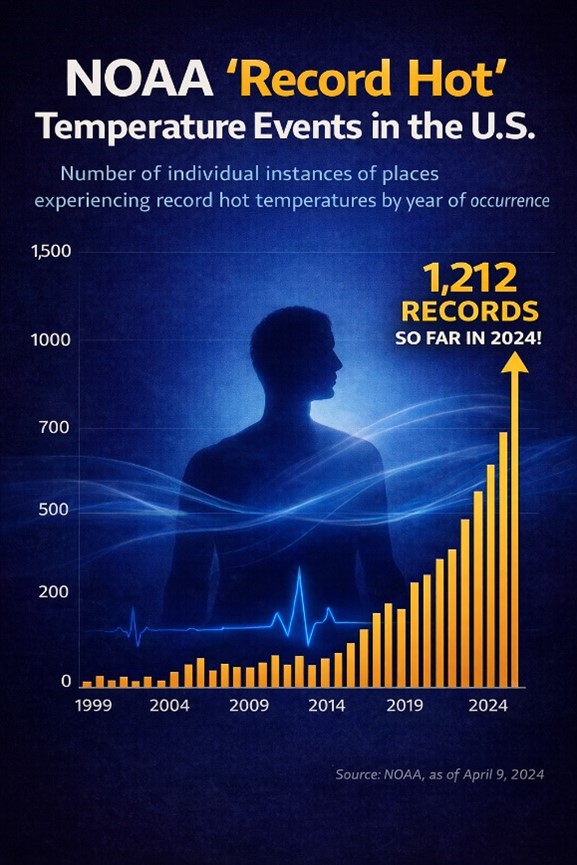
They love to ram down our throats that this is the warmest time in modern history. I do not believe a word of it. I do not trust the mainstream press nor most modern organizations in health, medicine, or climate. I do not trust politicians and what they say. They and the press are delusional, thinking they can translate science into truth.
Cuba experienced a historic freeze this past winter. On February 3, 2026,
the country officially reached 0°C (32°F) for the first time in recorded
meteorological history. Sounds like runaway global warming to some.
They say 10 states experienced the hottest temperatures on record in March, according to new data from the National Oceanic and Atmospheric Administration. They say that California, Nevada, Arizona, Idaho, Utah, Wyoming, Colorado, New Mexico, Texas, and Oklahoma each experienced their hottest March on record, going back 132 years. Oh really. These claims rely on reconstructed datasets with uneven historical coverage and significant adjustments, yet they are presented to the public with a level of certainty that exceeds the underlying data.
On record, it sounds definitive. It sounds precise. It sounds like something measured cleanly and continuously over time. It is not. What we are being shown is a reconstruction—built from sparse data. Yet it is presented as an unquestioned fact. The issue is not whether temperatures have changed, but whether the certainty of the narrative matches the uncertainty of the data.
Early in the record (late 1800s/early 1900s), weather stations were sparse, coverage was uneven, and large rural areas had little or no measurement. So the idea of a perfectly measured, uniform dataset going back 132 years is not only not true, it is a pathetic attempt to scare the public.
Blue Shows Colder Than Normal For March
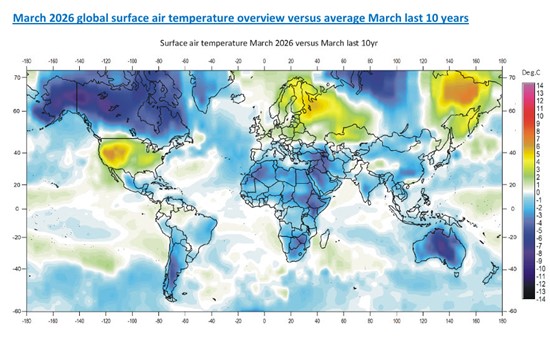
While pockets of anomalous warmth dominated the western US and Far Eastern Russia, practically all of Canada and Alaska shivered through a historically cold month. Central Asia shivered, with a broad cold belt extending down through Kazakhstan into China and India. Elsewhere, much of the planet sat below baseline. Africa was largely cool. South America likewise. Much of Australia also experienced anomalously cold conditions, particularly in central regions.
Dr.Sircus is a reader-supported publication. To receive new posts and support my work, consider becoming a free or paid subscriber.
Subscribe now

comments