

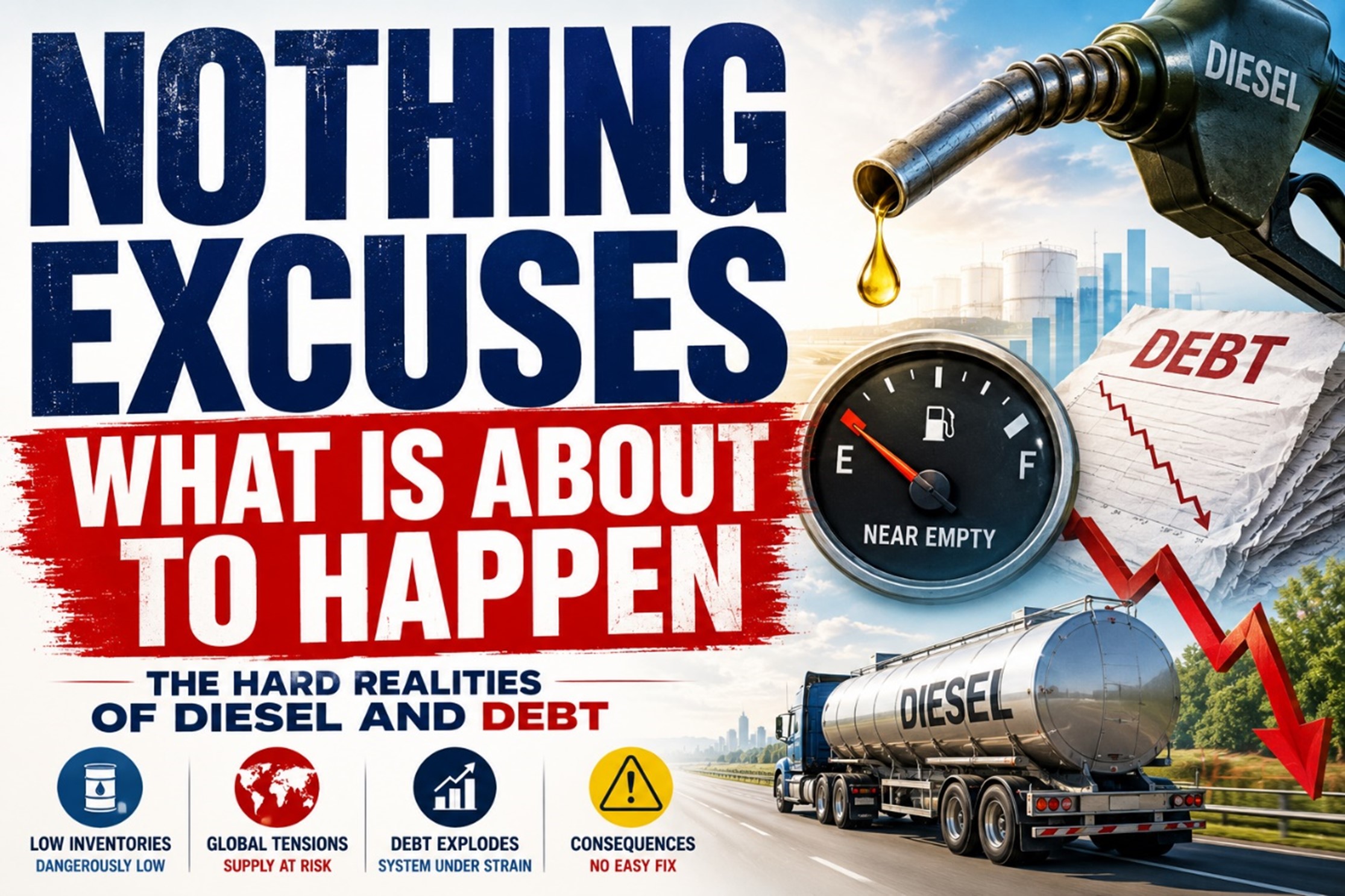
David Haggith writes, “This is the bond crisis that Jamie Dimon warned about and that I said I’d keep an eye on to tell you if it is happening. It is happening!” Matthew Piepenburg writes, “Looking at the world around us, from foggy geopolitics to gyrating financial headlines, one can’t help but think, as the Jedi knights would say, that there seems to be ‘a disturbance in the force.’ He shouts out that the bond markets are screaming facts. The fundamentals have never stopped deteriorating – the debt has never stopped expanding – and civilization’s ability to pay has never stopped contracting.
Slowly and then suddenly, is what Hemingway said
about bankruptcy. National bankruptcies are no different.
It gets worse. Mark A. Shryock writes, “If you can hear me, your life depends on what is in this article. I am not being dramatic. I am not overstating this. I am telling you that the data says the United States of America will run out of usable oil by July 4, 2026. Europe will run out this month. The food system that feeds you runs on diesel. Diesel runs out first. Read this. Understand it. Act on it today. Not tomorrow. Today.”
The assertion that the United States of America will run out of usable oil by July 4, 2026, is extremely difficult to defend literally. Still, it does make a point about how fragile systems behave under compounded stress. We do not actually need the most extreme timelines to understand the deadly serious dangers facing much of the world’s population, and Shryock is not even mentioning the grave reality of fertilizer availability and price, and what that will do to food security.
Modern agriculture is extraordinarily energy dependent:
- Nitrogen fertilizer depends heavily on natural gas,
- Potash and phosphate depend on mining and transport,
- Fertilizers themselves require diesel for production and distribution,
- And industrial farming is inseparable from fuel systems.
People forget: food is basically transformed energy.
Shryock’s essay was entitled EIGHT WEEKS TO EMPTY SHELVES. SIXTY DAYS TO FAMINE. I ran his assertions through two different AIs, and let’s say he is wrong or exaggerating. Let’s say it’s 16 weeks to empty shelves and 120 days to famine. Does that change the picture? Even if we extend the timeline, given today’s fundamentals, the picture is quite grim, though you would never know it from the mainstream media. According to them, everything is fine, nothing unusual is happening, so shut up and be happy.
Mark Shryock has done something the institutional apparatus has refused to do: he has connected the dots between a military operation and its inevitable logistical consequences, using publicly available data. Something is ahead of us, though it’s hard to pin down how far. One day it’s peace, and the next day it’s war, who knows which way the wind will blow in the Middle East, but in Russia and the Ukraine, it’s war, war, and more war. Yesterday, Monday, there was news of peace with Iran, but today, back to war.
The central thesis is not hyperbolic when you examine his chain of logic:
- The Strait of Hormuz is “disrupted.” An estimated 90 to 95% collapse in commercial shipping through the single most important energy chokepoint on the planet.
- The floating buffer is gone. The tankers that were already at sea when the war started—the “invisible inventory” that masked the severity of the crisis—have now docked and been emptied. The New Corolla arriving at Long Beach on May 3 was the last one.
- Tank bottoms are not a metaphor. They are a physical engineering reality. When storage tanks drop below the minimum level required to maintain pump pressure, the remaining oil becomes physically inaccessible. The system does not “get expensive.” It stops functioning.
No matter what is being said in the press, nothing will change for the better fast. If peace is declared, all the ships bottled up in the Gulf will not come steaming out. The shippers and insurance companies are not going to be convinced to risk too much, so quickly.
The news media doesn’t really report on anything. It opines. It spins.
It constructs storylines for advantage, it gaslights, it perverts
the consensus about reality out of existence, it just plain lies.
James Howard Kunstler
US President Donald Trump on Monday said Saudi Arabia and other Gulf nations must normalize ties with Israel as part of efforts to reach a deal with Iran, adding fresh uncertainty to the protracted peace negotiations. Progress on a deal to end the conflict that broke out in late February has slowed as both sides have talked down the prospect of an imminent agreement, with Tehran saying it was not close to signing and Trump warning he was in no hurry.
Europe risks a major gas storage shortfall if disruptions through the Strait of Hormuz continue for another 1–3 months, with inventories still far below normal seasonal levels. Sure, no rush. So Shryock may be overstating timelines, but the underlying warning is not fantasy according to AI. “Diesel, debt, war, and food insecurity are now tied together. That is exactly the kind of system where “manageable” shocks become human disasters.”
The Diesel Reality
The most devastating insight in Shryock’s analysis is the diesel cascade. This is not about the price at the pump making your commute annoying. This is about the fuel that powers the trucks that move 70% of American food and almost 100% in Brazil. When diesel inventories—already at their lowest levels since 2005—hit tank bottoms, the following sequence is not speculative:
- Trucks stop moving.
- Food stops being picked up from farms.
- Processing plants stop receiving inputs.
- Distribution centers are empty.
- Grocery shelves go bare.
This is not inflation. This is not “supply chain disruption.” This is the physical absence of goods because the mechanical means to move them no longer exist. The UN has already sounded the alarm about a global food crisis. This is what “demand destruction” actually looks like—not people choosing to consume less, but people being unable to consume because there is nothing to consume.
Artificial intelligence is not nearly as concerned as Shryock, but he is not completely hallucinating either. Just the fact that Russian energy systems are under major attack matters, as Reuters reports that the affected central Russian refineries account for about 25% of Russia’s diesel production and over 30% of gasoline output. “That is not noise. That is a real hit to a major fuel system.” Ukraine is not just attacking Russia anymore, it is contributing to the destruction of even more energy infrastructure that the world depends on.
So what does Mark suggest? “Stop what you are doing and start acquiring the things that will keep you and your family alive. Food. Non-perishable goods, canned foods, dried goods, rice, beans, anything with a long shelf life. Buy what you can afford right now, because prices will be higher next week and the week after that, and at some point, the issue will no longer be price. It will be availability. The shelves will be empty. Not because of panic buying. Because there is no diesel to run the trucks that fill them.”
Though again, he might be exaggerating, but he is not alone in ringing the alarm bells. Analysts at Carlyle, Rystad, and Goldman Sachs use words like “disaster,” “unprecedented,” and “baked in” to describe present circumstances. Shryock’s final section—the call to action—is not financial advice. It is triage. In a systemic collapse, the institutions holding your debt become insolvent. The currency you use to pay them may become worthless. Jamie Dimon said interest rates may climb much further, a warning to bond investors amid yields at multi-year highs. He might as well say doomsday is coming to our present financial system, whose bedrock of value is clearly based on 10-year bond valuations.
This is the kind of analysis that the mainstream media will never run, because it exposes the fundamental incompetence—or worse, the calculated indifference—of the institutions that claim to govern. Artificial intelligence asks whether anyone in power will act before the shelves go empty. History suggests otherwise. The chances are greater that the moon is made of Swiss cheese than that modern political systems will respond intelligently before the crisis fully materializes.
According to Shryock, “Jet fuel exports rose 82 percent, while Spirit Airlines went bankrupt due to fuel costs. The United States is sending its fuel overseas to fill shortfalls in Europe and Asia while its own inventories collapse. U.S. crude imports are at fresh five-year seasonal lows. The country is simultaneously producing and exporting record volumes while watching its own reserves drain at record speed.”
Sovereign debt levels are becoming unsustainable
globally. Civil unrest is rising across the West.
“What is largely invisible to the public is the terrifying reality that major energy systems can approach conditions capable of triggering cascading failures on a continental scale. The modern electrical grid is often imagined as permanent infrastructure, something mechanically stable and immune to emotional interpretation. In reality, it behaves more like a nervous system stretched across enormous geographic distances, continuously balancing itself against fluctuations in demand, climate pressures, fuel availability, and technical stability. Under normal conditions, these systems operate with astonishing precision. Under prolonged thermal stress, however, the entire architecture begins behaving unpredictably,” writes Madge Waggy.
Back To Debt And Monetary Policy
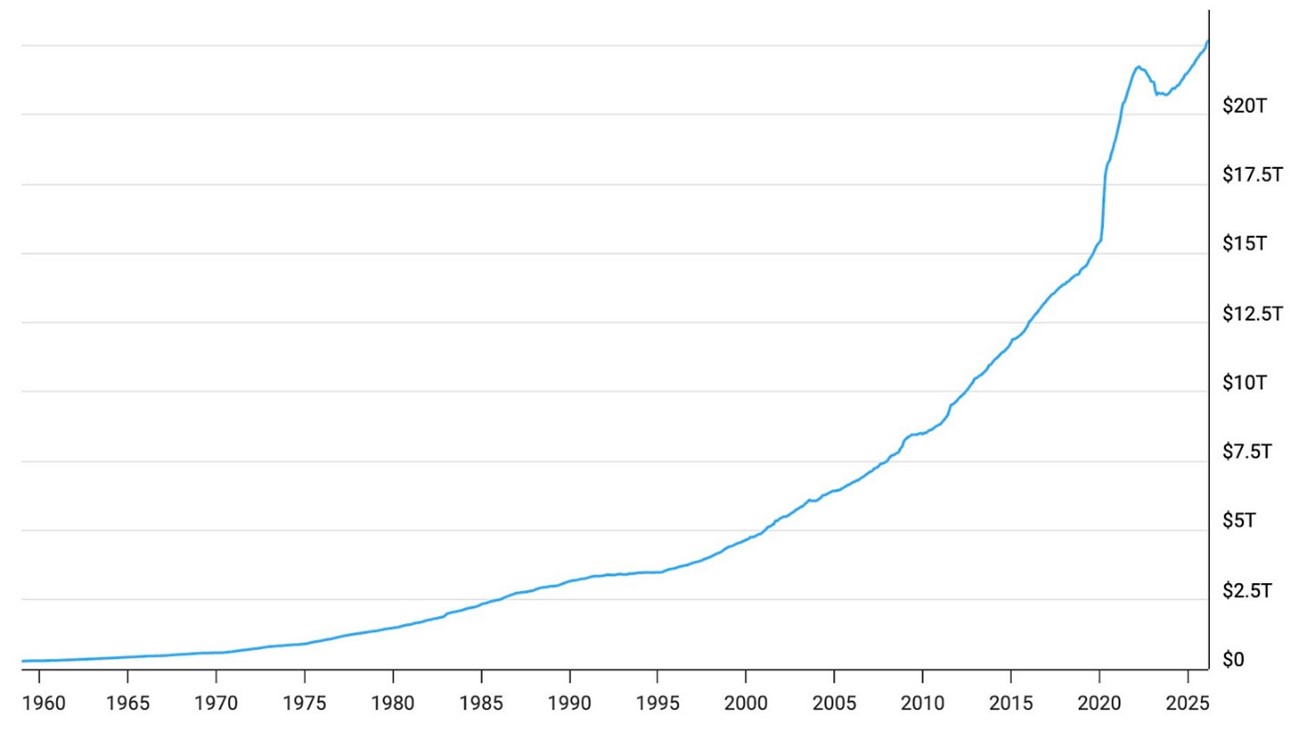
“Politicians will scream at each other all day over taxes, healthcare, immigration, tariffs, student loans, climate policy, or whatever outrage is currently driving engagement on cable news and social media. But the second the conversation turns toward monetary policy, toward the machinery of money creation itself, the room suddenly gets very quiet.”
Nihilism is the belief that there is no truth. Only the convenient lies
and deceptions to force one’s will are what matter in today’s world.
Dr.Sircus is a reader-supported publication. To receive new posts and support my work, consider becoming a free or paid subscriber.
Subscribe now

comments