

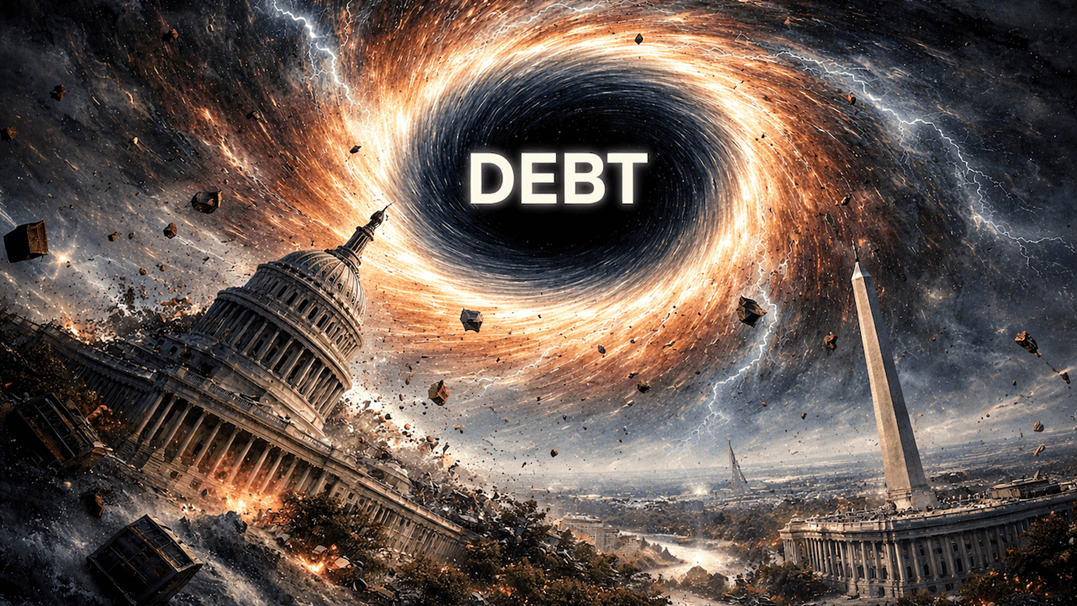
The world is spinning out of control, but you would never know it if you are paying attention to the mainstream media. Insanity has become the worst of all infectious diseases, with social media spreading the infection around like wildfire. A trip to X gives one instant exposure, and it’s wild enough almost to make one stop believing in freedom of speech.
My daughter insists it has always been this way, but I said to her, “Remember the time when you were caught in a fire in the middle of the night, and smoke filled the room? Well, imagine the smoke 10 times thicker.” We are running out of runway, running low on oil, diesel, fertilizer, jet fuel, natural gas, and even in helium needed to make computer chips. Supply chains are cracking, reports of hunger are beginning, starting in Africa, of course, and will spread around the world over the next year, so we will all be tested on how strong we can be.
With the United States government hitting 40 trillion in publicly recognized debt, there is no commitment to addressing the runaway spending that has persisted for as long as anyone can remember. Nobody is telling you how exposed, how fragile, how utterly compromised your retirement savings really are right now. Not in theory. Not “over the next 20 years.” Right now. Today. Everyone is watching the wars, but almost nobody is looking at the side of the screen that actually determines whether you can retire: the plumbing of the credit system, where your pension, your 401(k), your “balanced” fund is quietly suffocating.
All of this raises a troubling question about the direction of the modern world. For all our technological progress, the persistence of violence, exploitation, and social breakdown forces us to confront how fragile our claims to civilization can be. The bad news is that at some point, the problem is going to tackle us. Unfortunately, there comes a time when there is nothing you or anyone can do, when debt saturation is reached. Sure, individuals and companies can declare bankruptcy, but can civilization? The suffering is coming on full steam, even in the richest country in the world, as banks swipe 42,000 homes from struggling Americans in just one month.
The US Government sold $524 billion of Treasury Securities
last Week. Inflation to Surpass T-Bill Yields. Brutal Bond Math!
Fifty years ago, I saw and used the fact that when you have debt, you can always pay it off with new debt, but that game eventually ends. In the end, there is an inevitable crash, some call it a doom loop of debt, and then all hell breaks loose, which has happened many times in history. No one in government today is going to rock the boat or pass judgment on its monetary lunacy, so the cake is baked and about to burn, since no one will turn off the fire.
The world’s fiat currencies are staging a kind of mass suicide versus most of the things we hope to buy going forward. All the money in the world is connected to some debt, and without a doubt, all the new money being spent is borrowed, since all the real money in the world has already been spent or spoken for.
Honest Money Has Been Bannished
A real financial crisis would start with banks refusing to lend to other banks overnight. In 2008, if this hadn’t been bailed out just days later, the entire system would have locked up, as our entire economy runs on credit.
The first thing the average guy would notice if the entire financial system entered a black hole would be that credit card transactions would have been declined. The next thing he would notice is that access to his bank and brokerage accounts was no longer available, and not long after, the financial markets would fall hard.
Businesses such as grocery retailers operate on letters of credit, which they would obviously lack in a real crisis (we have not seen anything yet) and which would prevent them from keeping their shelves stocked. Power companies also operate on letters of credit. As it all comes to a stop, there will be no credit, no banking, diminishing food supplies, and likely no power! How long can that state of affairs exist?
Oil is surging on the Iran strikes. Gas costs more.
Everything costs more. That pain is real.
Current reductions of oil and natural gas supplies amount to a loss of 4.5 percent of the world’s total energy, which, given the economy’s direct dependency on energy for everything, likely means a loss of about 4 percent of world economic activity. For comparison, the United States’ economy shrank 4.3 percent from the beginning of the Great Recession to its bottom.
All fiat, meaning all currencies are ultimately IOUs (Debt) backed only by the confidence that they may be exchanged later for something of real value. This confidence can be expected to vaporize quickly and catastrophically when the music stops, which it keeps threatening to do. But more debt saves the day and has been saving the day heavily in the 21st Century.
External enemies rarely destroy great nations.
They are more often destroyed by debt.
In a fiat system, your money is constantly being devalued. That means you are losing purchasing power month after month. The government employed masses of economists who would rebut skeptics, confuse the public, and support government spending policies. Yet rising prices tend to impoverish more and more people.
Debt is not merely a financial obligation. It is a gravitational force—a system of psychological weight, social engineering, and geopolitical control. While economists measure debt in numbers and percentages, the true burden is far more insidious: it bends time, narrows choices, and alters the fabric of human agency. Today, nearly every individual, institution, and nation operates under the invisible pull of debt, and yet its deeper implications remain under-examined.
It’s probably fitting that we’ve closed most of the
mental institutions, since the entire country has largely devolved
into the largest insane asylum the world has ever seen. We have
accomplished the very difficult feat of elevating the wrong
people into the wrong jobs in all the wrong places. The lunatics
wielding power at every level has left nothing to chance.
Donald Jeffries
To understand debt is to understand how human freedom can be gradually compressed, repackaged, and resold as liability. It is to witness how economic systems disguise dependency as participation, and how the architecture of lending quietly rewires behavior, biology, and belief. Debt doesn’t just impoverish — it colonizes the imagination.
This paper argues that debt must be approached not only as an economic mechanism but as a psychological weapon, a social structure, and a spiritual trap. Charles Hugh Smith writes, “Should a state’s finances enter a self-reinforcing death-spiral, the desperation will quickly reach a level in which nothing is off the table–no extreme is too extreme. The typical self-reinforcing death-spiral is a currency crisis in which the currency loses value so rapidly that everyone holding it wants to convert it into some other form of value. That selling is self-reinforcing.”
The Psychological Gravity of Personal Debt
To the nervous system, debt is indistinguishable from danger. The ongoing pressure of owing — whether a credit card balance, a student loan, or medical debt — triggers chronic stress responses that fundamentally alter mental and physiological health. Cortisol levels rise. Sleep declines. The prefrontal cortex — responsible for planning, focus, and impulse control — loses functional capacity. Over time, debt doesn’t just burden a person financially; it literally changes how they think and feel.
Debt enforces a loop of hypervigilance and helplessness. The constant background anxiety conditions the brain into a state of learned powerlessness, a phenomenon akin to trauma. For many, the result is emotional exhaustion, self-blame, and a diminished sense of agency. Debt makes people feel smaller than life — shrinking their ambitions, creativity, and capacity to imagine a different future. Perhaps debt should be considered another cause of disease and even cancer.
The Reality On The Ground in America
Defense Secretary Pete Hegseth will testify before the Senate Armed
Services Committee this week to push for the Pentagon’s $1.5 trillion
budget request, which does not include the cost of the War with Iran.
A tidal wave of economic warning signs is quietly building across the country, becoming even more pronounced after the war against Iran began and the Strait of Hormuz was closed, disrupting supply chains and fundamental inputs like oil, gas, fertilizers, and even helium, on which the world economy and our stomachs depend. Many say reality is becoming far worse than most people realize. Everything is hitting at once, and Americans are feeling the squeeze in real time.
New analysis reveals a surge in financial strain, with consumer confidence collapsing, delinquencies rising, and foreclosures climbing at an alarming pace. Student loan defaults are reaching unprecedented levels, while over 100 million Americans now carry credit card balances they can’t fully pay off. It is not a pretty picture.
Once fairness and honesty have been stripped out of a social order,
social trust collapses. Once trust collapses, society disintegrates.
Charles Hugh Smith
Meanwhile, the cost of basic living keeps climbing. Housing payments have surged, grocery prices are up more than 40 percent since 2019, and in many areas, a single pound of ground beef now costs more than the federal minimum wage. Layoffs are spreading across major industries, and every day Hormuz remains shut, the situation gets worse.
Modern life is not built to handle total failure. It is built on
assumptions, and those assumptions are now gone with the wind.
Milan Adams writes, “For most of modern history, money has been treated as something constant—something stable enough to build entire lives around. We plan futures with it, measure success through it, and depend on it for survival. But there is a hidden assumption behind all of this: that money will always be available, always moving, always functioning. That assumption has failed before. And the uncomfortable reality is that the conditions forming today look disturbingly familiar—just dressed in a more advanced, more controlled system.”
Conclusion
The unspoken promise of civilization—that even if something breaks, there is always someone, somewhere, fixing it. But what happens when nothing comes back?
Madge Waggy
Debt is not neutral. It shapes minds, organizes societies, and governs the fate of nations. It is a system of control that extends far beyond economics — a psychological, cultural, and spiritual matrix that defines how we live, how we relate, and how we imagine what is possible.
To understand debt in its full dimension is to awaken from its spell. It is to see the invisible infrastructure that turns freedom into obligation, creativity into constraint, and worth into a number. The time has come to tell a different story — one in which human dignity is no longer collateral, and the future is no longer sold before it arrives. Debt is a trap that closes slowly, giving just enough time for awareness to grow, but not enough for an effective response.
Dr.Sircus is a reader-supported publication. To receive new posts and support my work, consider becoming a free or paid subscriber.
Subscribe now

comments