

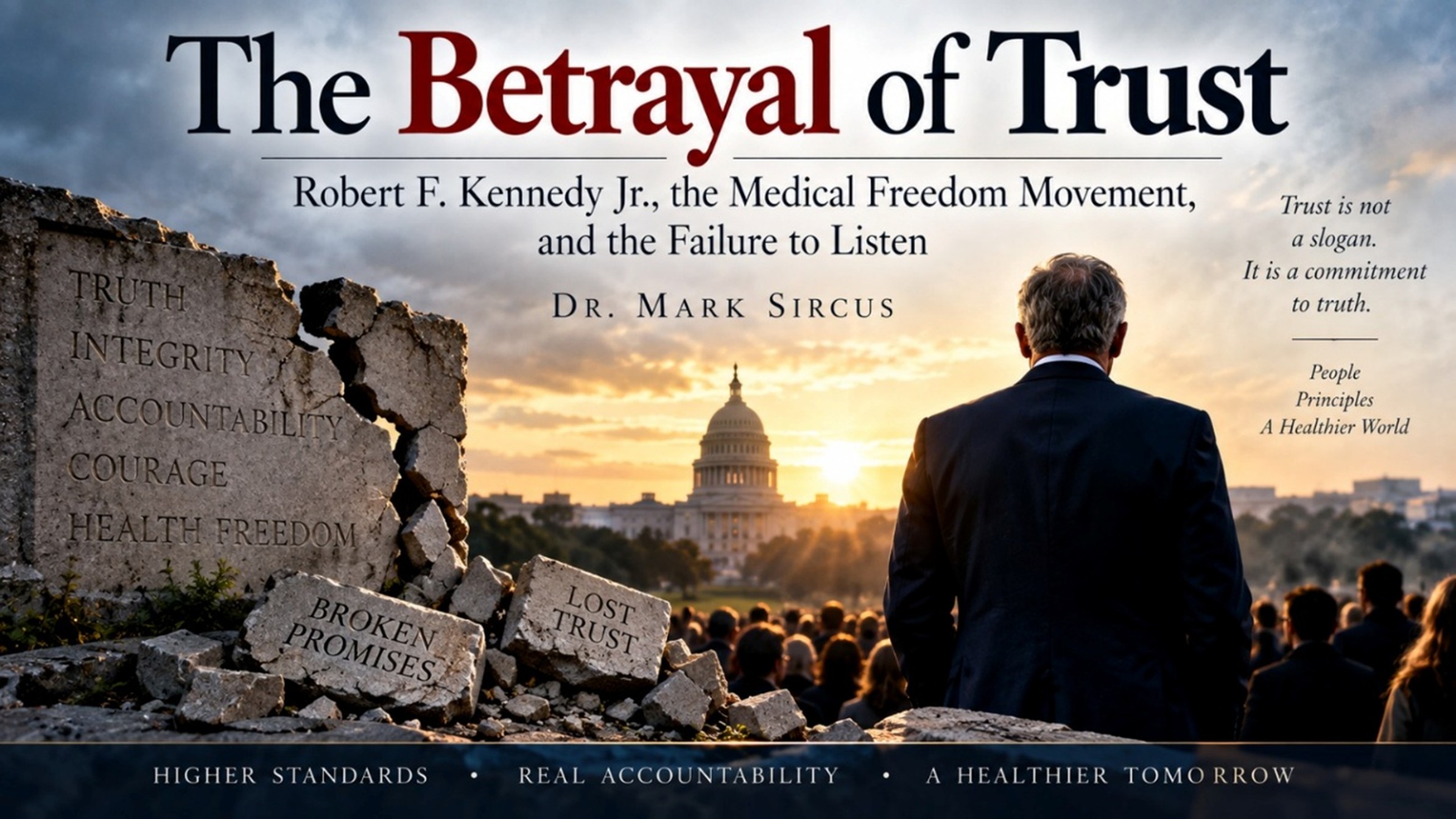
Trust is one of the most precious things people can give one another. It underpins marriage, friendship, medicine, and government. We trust people because we believe their words match their intentions and that those intentions will eventually become actions. When that correspondence breaks down, something much deeper than disappointment occurs. We begin to question the relationship itself.
The COVID era brought an extraordinary collapse of public trust in medicine, public health authorities, and the institutions that were supposed to protect us. A major study published in JAMA Network Open found that Americans’ trust in physicians and hospitals fell from 71.5% in April 2020 to just 40.1% in January 2024. The erosion of confidence extends far beyond medicine.
Americans are still losing confidence in the medical establishment. Gallup’s July 2026 report found that only 28 percent of Americans have confidence in the medical system, down from 51 percent in 2020. Meanwhile, only 57 percent rate medical doctors highly for honesty and ethical standards, compared with 77 percent in 2020.
In September 2026, Gallup reported that an astonishing 89% of Americans believe corruption is widespread in their government, the highest percentage recorded in the twenty years Gallup has asked the question. Republicans, Democrats, and independents may disagree about almost everything, but overwhelming majorities agree that corruption is widespread. We are living through a crisis of trust in the very institutions modern society depends on. And when people have already lost faith in government and medicine, the betrayal of trust by someone who promised to reform those institutions carries an especially painful significance.
On September 21, 2026, Dr. Robert Malone and Dr. Jill Glasspool Malone published an essay titled The Kennedy Exception. Its central question was whether Robert F. Kennedy Jr., now Secretary of Health and Human Services, was receiving a degree of loyalty and protection from the medical freedom movement that its members would never have extended to previous health secretaries. Their concern was not merely that Kennedy had failed to accomplish everything his supporters hoped for. It was that some of the very policies he had spent years challenging remained in place under his leadership, while influential figures in the movement continued celebrating him.
In their September 21 essay, The Kennedy Exception, Robert Malone and Jill Glasspool Malone question why COVID mRNA products remain licensed, why federal mRNA research continues, and why the COVID PREP Act protections remain in place. They are asking why his earlier commitments have not produced the outcomes many supporters expected.
On September 21, Nicolas Hulscher reported that a coalition of 168 physicians, scientists, researchers, and public figures, collectively claiming more than 63 million social-media followers, had sent an open letter to Kennedy and President Trump.
Coordinated by Dr. Mary Talley Bowden, the coalition includes Dr. Peter McCullough, Dr. Robert Malone, Tucker Carlson, and Congressman Thomas Massie. It calls for removing mRNA vaccine products, ending the COVID PREP Act declaration, repealing the PREP Act, banning direct-to-consumer pharmaceutical advertising, and confronting conflicts of interest within federal health agencies. The signatories warn that they may withdraw political support if their demands remain unanswered.
The complete report: Massive MAHA Coalition Sends Open Letter to Trump and RFK Jr. The issue is trust. Trust cannot be restored through speeches, explanations, or promises alone. It requires listening, transparency, accountability, and conduct that corresponds to words. At this point, few expect either man to listen.
For years, Kennedy presented himself as an adversary of pharmaceutical influence and what he regarded as failures of vaccine regulation. He criticized COVID-19 vaccine authorizations, questioned the adequacy of safety oversight, and challenged the legal protections available to manufacturers. Children’s Health Defense, the organization he formerly chaired, petitioned the FDA in 2021 to revoke the emergency authorizations for COVID vaccines. His position was sufficiently clear that supporters expected major changes when he entered government, but all we have gotten is a lot of talk and little action where it really counted.
The Pfizer and Moderna COVID-19 vaccines remain licensed. Federal research involving mRNA technology continues. The Malones also point to the FDA’s approval of Moderna’s mRNA influenza vaccine in August 2026. They question the departure of officials who sought tighter vaccine restrictions and the postponement of an advisory committee meeting where a report on post-vaccination illness was expected to be discussed.
The Malones raise a question that reaches beyond Kennedy. What happens to a movement when its leader becomes too important to criticize? Those days are hopefully coming to a close.
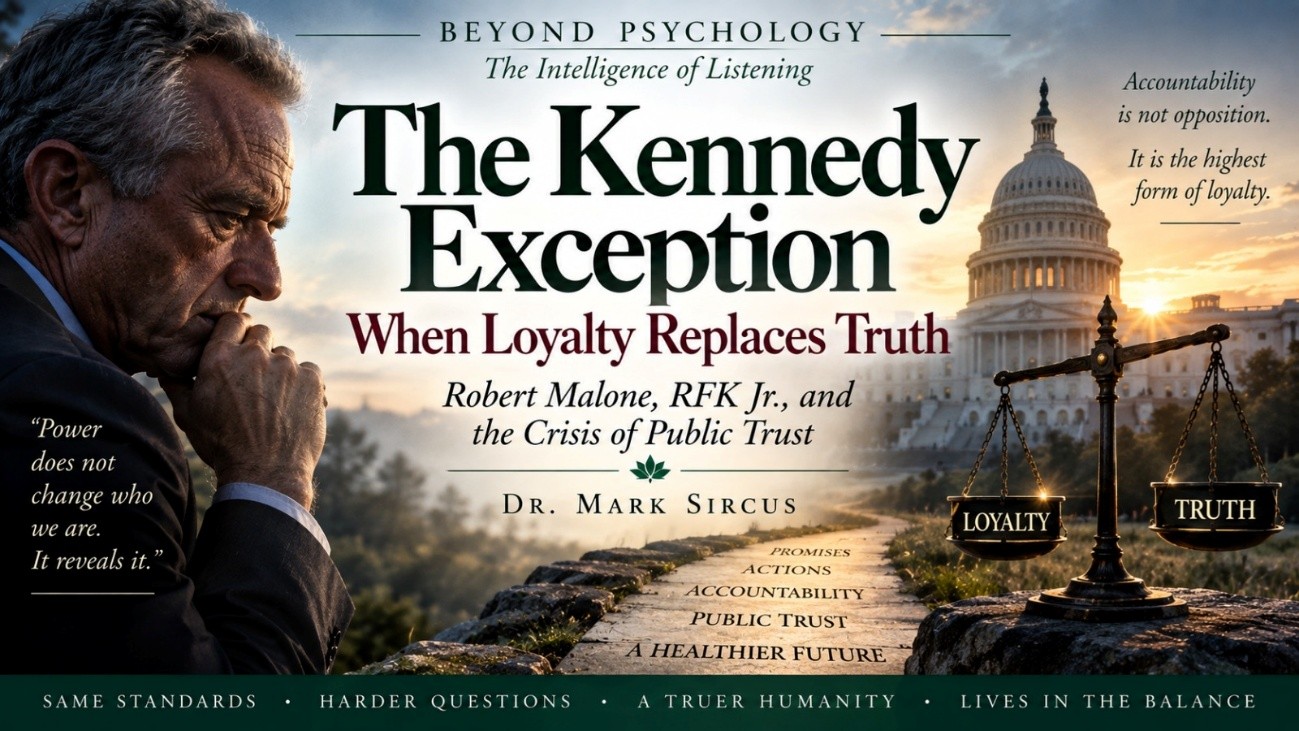
There is an old saying that once trust is lost, it is almost impossible to regain. I learned the truth of those words forty years ago at the University of the Trees, when I found myself in a situation where I had to work extraordinarily hard to restore trust. I succeeded, but the experience taught me something that has remained with me throughout my life: trust is not restored through words, explanations, promises, or declarations of good intentions. It is restored through conduct. A person who has betrayed trust must demonstrate, consistently and often at considerable personal cost, that something fundamental has changed.
For years, Kennedy was one of the most prominent critics of COVID vaccine policy, pharmaceutical manufacturers, regulatory agencies, and the legal protections surrounding medical countermeasures. He chaired Children’s Health Defense and argued that the public had been misled about vaccine safety. He supported efforts to revoke COVID vaccine emergency authorizations and called for changes to manufacturers’ liability protections. These were not incidental positions. They were central to the public identity he developed before becoming secretary of Health and Human Services.
Now he holds extraordinary authority over American health policy. He oversees a department that includes the FDA, CDC, NIH, and other institutions whose decisions affect millions of people. His authority is substantial, though constrained by legislation, scientific review requirements, the courts, the White House, and the responsibilities delegated to individual agencies.
In August 2025, Kennedy announced that HHS was winding down 22 mRNA vaccine development investments under BARDA, affecting nearly $500 million in projects. He presented the decision as a move away from a vaccine platform whose limitations he had publicly criticized. But the department’s own announcement explicitly stated that other uses of mRNA technology within HHS were not affected.
Then, on August 5, 2026, the FDA approved Moderna’s mRNA influenza vaccine, MFLUSIVA, for adults aged fifty and older. When I saw Kennedy and Trump in the White House with Pfizer’s CEO, Trump smiling, I knew in my heart where this was going.
Kennedy’s Personal Life
Why should anyone trust a person with a messed-up personal life in the public arena? Journalists have examined Kennedy’s marriage to Mary Richardson Kennedy in considerable detail, including in The New Yorker and in Isabel Vincent’s reporting on his private diaries. Those accounts describe repeated infidelity, a contentious divorce, and sharply conflicting accounts of what occurred within the marriage. People close to Mary alleged that Kennedy denied affairs and dismissed her suspicions. Kennedy gave a different account, including allegations that he experienced abuse within the marriage. Mary died by suicide in May 2012 while the divorce and custody dispute were ongoing. Her family disputed important parts of Kennedy’s public characterization of her.
The documented infidelity and the competing accounts of their relationship raise questions about trust that are relevant to understanding why this history remains so painful and contested. Robert F. Kennedy Jr.’s reported 2001 diary listed 37 women, including 16 with whom he reportedly had sexual intercourse while he was married to Mary.
The deepest injury of infidelity is often not the sexual act itself. It is the deception. It is creating a false reality for another human being. It is looking into the eyes of someone who trusts you and letting that person keep living with an understanding of the relationship that you know is incomplete or untrue. A person may betray trust in a moment. Maintaining a deception can require repeated decisions.
And once the deception is discovered, the betrayed person may begin questioning not only the partner but also the meaning of years of shared experience. Was the affection genuine? Were the promises sincere? What else was concealed? Which memories can still be trusted?
The person seeking to repair such a relationship cannot restore trust by explaining his behavior alone. He must become truthful in a way the other person can consistently encounter.
Kennedy’s diaries, as reported by journalists, contain his own reflections on sexual temptation, guilt, self-image, and the struggle to behave according to his stated ideals. Those writings reveal that he recognized an internal conflict.
The stakes of public-health decisions are enormous. Vaccine recommendations, product approvals, safety surveillance, injury-compensation procedures, and research funding can affect millions of lives. They require careful evaluation of both benefits and risks, not loyalty to a personality. Public confidence depends on transparent evidence and institutions that can correct mistakes.
Kennedy appeared before Children’s Health Defense on September 17 and told the audience that it had a friend in the White House. He pointed to policy changes made during his tenure and urged supporters to recognize the progress achieved. The Malones, writing four days later, asked why that same audience was not publicly pressing him on the issues it had once treated as essential.
A person cannot regain trust by persuading others that he is truthful. He must return to truth himself. One of the biggest problems we see in people is naivety in trusting people who should not be trusted. Naivety is dangerous. People trust the image, the reputation, the eloquence, the promises, or the cause someone claims to represent. We may even defend people against evidence of their misconduct because accepting that evidence would threaten our investment in them.
Once we place someone on a pedestal, we become reluctant to recognize contradictions between their words and their actions. This is now exactly where we are with Kennedy and Trump. And we cannot even begin to talk about Trump’s history; one would need a book for that. And all of Congress and the Senate just look at their financial ties to the pharmaceutical industry to see why we have the medical world we have. In terms of the medical industrial complex, it is in no one’s interest to make Americans healthy again.
Dr.Sircus is a reader-supported publication. To receive new posts and support my work, consider becoming a free or paid subscriber.
Subscribe now

comments