

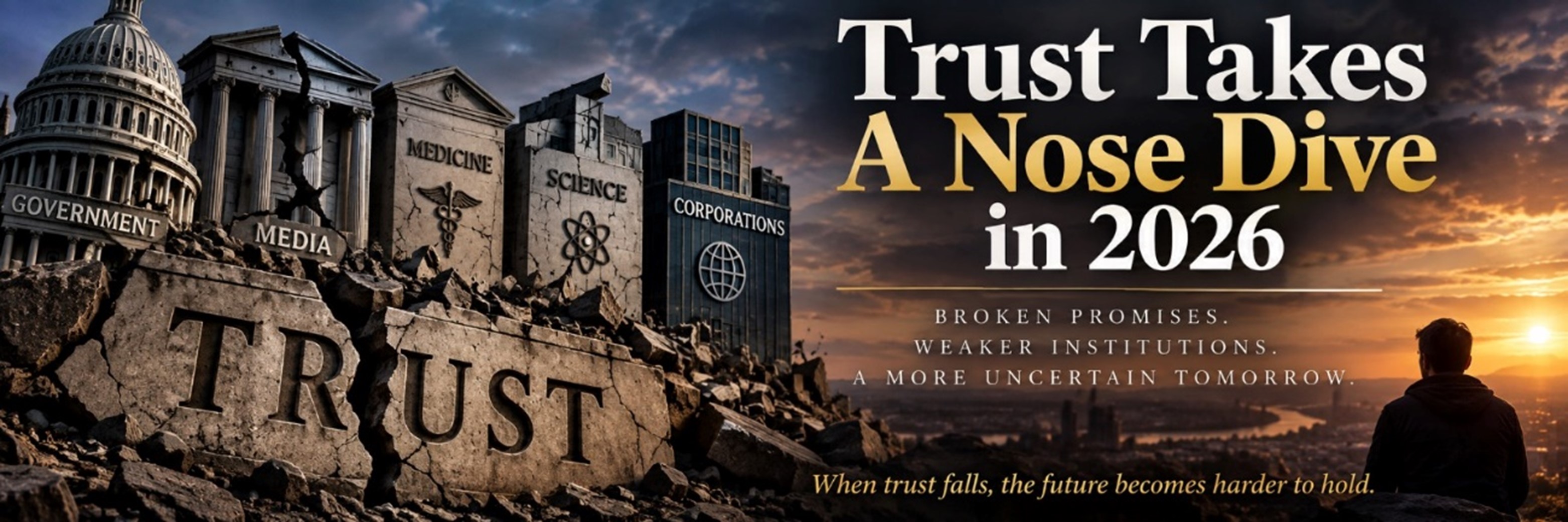
Trust is one of civilization’s invisible foundations. Money depends on trust. Medicine depends on trust. Government depends on trust. Courts, contracts, elections, banks, universities, journalism, science, and even ordinary commerce depend on people believing the institutions around them are basically honest and that the rules won’t change whenever it benefits those in power. When trust disappears, society can keep functioning for a while, but it increasingly relies on coercion rather than cooperation.
That is where America finds itself in 2026. Gallup reports that an astonishing 89 percent of Americans now believe corruption is widespread in government, the highest percentage recorded in the twenty years Gallup has asked the question. This is not merely one political faction complaining about the other. Ninety-one percent of Democrats, 90 percent of independents, and 83 percent of Republicans agree that corruption is widespread. At a time when Americans can hardly agree on anything, they have achieved something close to national consensus on distrust.
The broader picture is scarcely better. Average confidence in fourteen major American institutions stands at only 27 percent, just one percentage point above Gallup’s historic low. Confidence has remained below 30 percent for five consecutive years. This is no longer a temporary reaction to one president, one scandal, one war, or one recession. It has become part of American life.
Trustworthy people and institutions garner trust. Dishonest ones eventually lose it. That sounds almost ridiculously simple, yet political and institutional leaders frequently behave as though public confidence were something they are entitled to rather than something they must continually earn. When officials mislead people, conceal mistakes, protect insiders, tolerate conflicts of interest, manipulate statistics, promise accountability that never arrives, or demand obedience while exempting themselves from consequences, they spend the accumulated capital of public trust.
The tragedy is that trust takes decades to build and moments to destroy. Worse, once people discover that they have been deceived in one important area, suspicion spreads into others. If they cease trusting politicians, they begin questioning regulators. If they cease trusting regulators, they question corporations working with them. If they cease trusting the news organizations reporting on those institutions, they no longer know where to turn for reliable information. Eventually distrust becomes generalized. People stop asking, “Is this particular statement true?” and begin assuming, “They are probably lying again.”
That is a dangerous point for any civilization to reach. And it is obvious that we are in danger; our civilization is in danger. The very structure and underpinnings are under attack via two war theaters, leaving us to navigate through hostile change with untrustworthy information via corrupt government and the media, which is very good at lying through its teeth.
A society with practically no trust becomes enormously expensive to operate. Every transaction requires more verification. Every rule requires more enforcement. Every disagreement becomes potentially adversarial. Governments respond with greater surveillance, regulation, policing, censorship, or coercion. Citizens respond by withdrawing cooperation. Each side then regards the other’s reaction as justification for going still further. Distrust begins feeding upon itself.
Medicine provides an especially important example because trust between patient and physician is fundamental. A patient who believes his doctor is acting entirely for his benefit approaches treatment very differently from one who suspects that pharmaceutical money, institutional protocols, liability concerns, government directives, or professional pressures are influencing the advice. Public-health institutions therefore cannot demand trust merely because they possess impressive buildings, government seals, scientific credentials, or enormous budgets. They must earn it through transparency, intellectual honesty, acknowledgment of uncertainty, disclosure of conflicts, willingness to admit mistakes, and respect for informed consent.
The same applies to science. Genuine science does not require faith in authority. It requires evidence that can withstand challenge. When scientific institutions become politically aligned, financially conflicted, intolerant of dissent, or unwilling to acknowledge error, they damage something much larger than one particular scientific argument. They damage the public’s willingness to believe scientists when the scientists genuinely are right.
And this is perhaps the greatest cost of institutional dishonesty: eventually even the truth becomes difficult to communicate.
When trust collapses, a truthful government warning may be dismissed as propaganda. A legitimate medical recommendation may be rejected because people perceive previous recommendations as misleading. Accurate journalism may be ignored because people no longer distinguish reporting from advocacy. An honest politician inherits the distrust created by dishonest predecessors. Everyone pays for accumulated deception.
History gives little reason to treat such conditions casually. Pew’s long-term series shows that in 1958, 73 percent of Americans trusted the federal government to do the right thing always or most of the time. By September 2025, that figure was only 17 percent. The decline unfolded across Vietnam, Watergate, economic crises, wars, political scandals, and increasingly bitter partisan conflict. Trust was not destroyed overnight. It was spent over generations.
And Now Comes AI
Mike Adams says, “The same groups that pushed mass censorship during COVID are rebranding and re-launching new censorship scare campaigns to try to control AI and block your access to open-source knowledge,” responding to the recent hysteria about AI. Some people do not want us common folk to be empowered, and there is nothing new about that. The public appears to have reached a critical mass of concern about AI. How come? Dr. Robert Malone has a lot to say about what the AI panic is all about.
Artificial intelligence is arriving precisely when confidence in the institutions likely to control and deploy it is extraordinarily weak. Governments, militaries, intelligence agencies, pharmaceutical corporations, financial institutions, technology companies, and media organizations are gaining access to systems that can process information and exercise influence at previously unimaginable speed and scale. Giving extraordinary technological power to institutions that much of the population does not trust creates an explosive contradiction.
Technology cannot manufacture legitimacy. Surveillance cannot manufacture trust. Censorship cannot manufacture trust. Public-relations campaigns cannot manufacture trust. Force certainly cannot manufacture trust. These things may produce compliance, but compliance and trust are not the same thing.
Only one durable way back exists. Institutions have to become trustworthy, but that might not happen in our lifetime. Politicians have to tell the truth even when it’s inconvenient, but that will never happen either. Regulators must regulate the powerful rather than depend on them. Wishful thinking.
Scientists must welcome legitimate challenges rather than protect orthodoxy. Doctors must put individual patients ahead of institutional convenience. Journalists must be willing to investigate the institutions they sympathize with as aggressively as those they oppose. Corporations must understand that enormous power brings enormous responsibility. Maybe some of this will happen when aliens take over the Earth.
Trust cannot be commanded. It cannot be legislated. It cannot be restored through another advertising campaign. It must be deserved. Fat chance of that. The current hype of AI extinction mania is really just a cover for creating a cartel of billionaire AI companies and regulatory capture in a familiar form.
The outlook for a civilization that cannot restore trust is bleak. Economic problems become political crises. Political disagreements become existential struggles. Public-health measures become battles. Elections cease settling disputes because the losing side distrusts the process. Institutions respond to declining legitimacy by exercising more power, while citizens interpret that additional power as further evidence that the institutions cannot be trusted. That road ends badly. It will end badly, and we are already on that road to nowhere.
The extraordinary 2026 trust numbers should therefore be understood as much more than another opinion poll. When nearly nine out of ten Americans believe corruption is widespread in their government, the country is receiving a warning, which most people will ignore.
The deepest crisis may not be inflation, debt, war, immigration, medicine, or even political polarization. It may be the disappearance of the social glue needed to confront the hell-on-wheels politics has become. A civilization can survive mistakes. It can survive incompetent leaders. It can survive recessions, wars, scandals, and periods of terrible judgment. But when people cease believing almost everyone entrusted with authority, the foundation itself begins to crack.
Trust is civilization’s invisible currency. Once spent, no printing press can replace it. It has been spent. It is gone and is not coming back, not by political means, of that there is no doubt.
Dr.Sircus is a reader-supported publication. To receive new posts and support my work, consider becoming a free or paid subscriber.
Subscribe now

comments