

Though this essay was essentially about Ukraine, Europe, and Russia, it is only fair to say similar things about the Gulf War and the worldwide consequences of shortages and higher prices of fertilizer and other related products like diesel fuel. Few are taking it seriously, though hundreds of millions could die over the next few years as famine spreads throughout the world in 2027. The picture Adams paints in his essay is grim, and he’s not wrong about the fundamental math though perhaps overstated, which does not reduce the concern nor the insanity of war in the 21st Century.
Adams is right that the Strait is the single most vulnerable artery in global civilization. Though things are never as bad as some people like to present them, and even Adams, a few days later, reduced his estimates from billions to hundreds of millions. But if you reduce global calorie production by 25-30% for a sustained period, you don’t get everyone eating 25% less. You get:
- Price spikes that price the poorest billion out of food markets entirely.
- Hoarding and export bans by producing nations.
- Just-in-time supply chains that collapse within weeks, not months.
- Political instability that makes a coordinated response impossible.
The global food system operates on roughly 90 days of stored grain at any given time. It’s not built for sustained disruption. The core of Adams’ argument is correct: the closure of the Strait of Hormuz, combined with the destruction of Persian Gulf gas infrastructure, is the single greatest threat to global food security in modern history.
Hunger has always been a problem for humanity, but that is about to get worse. Farmers worldwide are already feeling squeezed not only by a diminishing supply of fertilizers, but also by high diesel and fertilizer costs.
Global food production is doomed to contract; it’s already written in stone. It seems, no matter what numbers we use, that more people will die outside the war zones than inside them. From the wars in Russia, Ukraine, and the Gulf, more people could die of starvation around the world than died in the Holocaust. Meaning war has never been so insane. Meaning the public health and medical implications are more than dramatic.
The Insanity of Zelensky and All Who Support Him
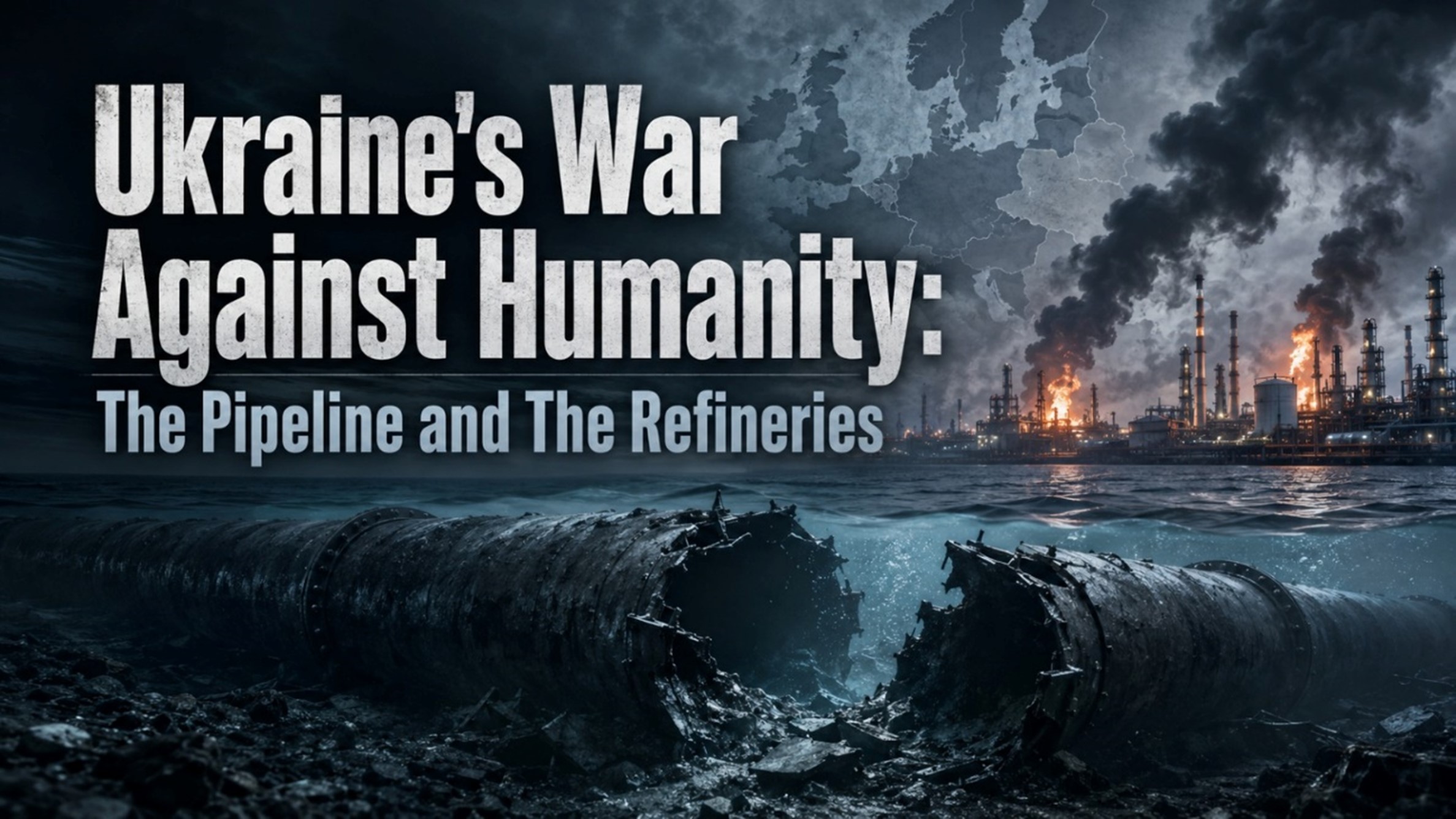
The Nord Stream Truth Finally Surfaces. For nearly four years, the Western press performed its usual circus act over who blew up the Nord Stream pipelines. Russia did it to itself. No, rogue pro-Ukraine operatives. No, it was a mystery wrapped in an enigma. Seymour Hersh said the United States did it with Norwegian assistance—and the media memory-holed him with impressive speed.
Now the German Federal Prosecutor has filed an indictment. July 2, 2026. A Ukrainian military officer, Serhii K., stands charged with co-perpetrating a war crime—an attack on civilian objects—acting on orders of Ukrainian state authorities. Not rogue. Not freelance. State-directed sabotage.
Let’s be clear about what this means:
- Ukraine attacked the energy infrastructure of its own ally. Germany had poured billions in military and financial aid into Ukraine. And Ukraine responded by blowing up the pipelines that supplied roughly half of Germany’s annual natural gas demand.
- This was an act of war against a NATO member. If Russia had done the same thing, we’d be at a nuclear flashpoint. Because Ukraine did it, we get diplomatic awkwardness and quiet hopes that the defendant gets acquitted.
- The objective was to cut off gas supplies permanently. Not temporarily disrupted, not symbolically damaged. Permanently destroy. The indictment states this plainly.
The sheer chutzpah here is staggering. Ukraine knowingly detonated the energy artery connecting Russia to Europe—plunging German industry into crisis, driving energy prices through the roof, and releasing record-breaking amounts of methane into the Baltic Sea—all while holding out its hand for more German tanks, more German howitzers, more German cash. This is the geopolitical equivalent of stabbing your host in the back during dinner and then asking for dessert.
The Refinery Campaign: Economic Warfare Against the Entire Planet
Now we move from the pipeline attack—a targeted strike against a specific ally—to something far more sweeping. Ukraine has taken its drone campaign to Russian oil refineries with a ferocity that makes the pipeline operation look like a firecracker.
The numbers are brutal:
- 42.74% of Russia’s oil refining capacity was turned off as of early July 2026, by Ukraine’s own gleeful admission
- Over 50 reported attacks on refineries, depots, and terminals since late March.
- Russian crude processing down 25% year-over-year—the lowest level in over two decades
- Gasoline production has fallen 17% to 850,000 barrels per day
- 60+ storage tanks destroyed or critically damaged
- One-third of Russia’s refining capacity is offline
- Fuel rationing in over half of Russia’s regions
Now watch what happens when you choke off one of the world’s largest energy producers from the global supply chain. The Iran war has already knocked out nearly 9% of global refining capacity. Russian diesel and gasoline are now being pulled from international markets at precisely the moment the world can least afford it. EU diesel prices hit a record 2.11 euros per liter in April. Jet fuel supplies are strained to the breaking point. Fertilizer production—entirely dependent on natural gas and diesel for transport—faces cascading disruptions.
And who suffers?
Not Zelenskyy in his bunker. Not the Western politicians preening at podiums. Not the president of the United States. The US is complicit in both wars that hold the potential to end billions of lives via mass starvation.
The US and EU are, in part, responsible for the diesel fuel that Russia can no longer export. That diesel powers tractors in Africa. Irrigation pumps in South Asia. Generators in rural hospitals. Shipping fleets that move grain across oceans. Refrigeration trucks that keep vaccines cold. When diesel supply tightens, food prices spike. When food prices spike, the poorest billion people on Earth skip meals. Children go hungry. Political instability erupts. Governments fall.
Ukraine’s refinery campaign isn’t just attacking Russia. It’s attacking the global poor. It’s attacking food security. It’s attacking the fragile supply chains that keep modern civilization from tipping into chaos.
And Ukraine’s military announces these strikes with pride. They issue Telegram posts bragging about the billions in damage. They post the black smoke plumes like trophy photos. There is not a whisper of concern for what happens downstream—literally and figuratively—when you take a major energy exporter’s refining capacity offline during a global fuel crisis.
The Insanity of Western Political Support
Here is where the cognitive dissonance reaches clinical levels.
Germany is simultaneously:
- Prosecuting a Ukrainian officer for blowing up the country’s energy infrastructure.
- Sending Ukraine more weapons.
- Pretending these two facts can coexist in the same universe without contradiction.
The German government knows—knows, with the full weight of its own federal prosecutor’s office behind the finding—that Ukraine committed an act of sabotage against German civilian infrastructure on orders from Kyiv. And the response is not to cut off aid. Not to demand accountability. Not to summon the Ukrainian ambassador for the diplomatic equivalent of a broken nose.
No. The response is to keep the weapons flowing and hope the trial stays quiet. This is not foreign policy. This is Stockholm syndrome at the nation-state level.
The Reckoning Will Come
History does not reward this kind of recklessness indefinitely.
Germany’s prosecution of Serhii K. is a crack in the facade—a sign that at least some institutions within the German state can no longer swallow the fiction that Ukraine is an innocent victim defending itself with clean hands. The indictment says plainly: Ukraine ordered an attack on German civilian infrastructure. That fact, once entered into the legal record, cannot be un-entered.
The fuel crisis spreading across Russia—and the knock-on effects spreading across global markets—will generate political pressure that no amount of media spin can fully contain. When European voters are paying record diesel prices and watching their economies stagnate, someone will eventually do the math.
And the developing world? The billions of people who depend on affordable energy and food for basic survival? They are not stupid. They can see who is disrupting the systems they depend on. The geopolitical realignment away from the Western order is already underway—and Ukraine’s scorched-earth energy campaign is accelerating it.
Zelenskyy is not defending democracy. He is waging economic war against the global poor while his Western patrons applaud and foot the bill. Trump is doing the same thing. Israel as well.
The pipeline attack was a declaration of contempt for Germany. The refinery campaign is a declaration of contempt for everyone who needs affordable energy to survive. And the Western response—endless indulgence, infinite funding, zero accountability—is a declaration of contempt for the basic needs of humanity.
The bill for all of this will come due. When it does, the people who cheered the black smoke over Russian refineries will discover that smoke travels—and what goes around, economically speaking, comes around with compound interest.
Dr.Sircus is a reader-supported publication. To receive new posts and support my work, consider becoming a free or paid subscriber.
Subscribe now

comments