


Carbon dioxide (CO2) is widely labeled a “pollutant” by climate activists, regulators, and even school systems. That label did not emerge from toxicology or exposure science. It came from politics. In the United States, CO2 was formally classified as a pollutant under the Clean Air Act following the Environmental Protection Agency Endangerment Finding in 2009.
By definition and history, pollutants cause direct harm at real-world concentrations. Carbon monoxide poisons. Lead damages brains. Sulfur dioxide burns the lungs. CO2 does none of these things. Today’s concentration is ~428 ppm. Occupational safety limits allow 5,000 ppm exposure for eight hours at a time — more than ten times higher than outdoor air. Carbon dioxide has been used for healing for 227 years since the first medical book about it curing cancer was printed. Doctors began using it widely around 1900 to make both surgery and anesthesia safer.
Yet despite this, CO2 is now taught to children as pollution. In the UK, secondary school exam papers expect 15–16-year-olds to identify carbon dioxide as a pollutant. Students are marked wrong if they do not. Yet it is essential for life, and one of the best medicines ICU doctors have at their fingertips to save lives.
Over the oxygen supply of the body carbon
dioxide spreads its protecting wings.
Friedrich Miescher
Swiss physiologist, 1885
Plants Love the Stuff and So Should We
Higher CO2 Has Boosted US Crop Yields. A new working paper from the National Bureau of Economic Research analyzes the effect of rising atmospheric CO2 on US crop yields using historical farm data and satellite measurements.
The authors find that higher CO2 levels have significantly increased yields across major U.S. crops over multiple decades, with the most significant response in wheat. Based on county-level yield records matched with satellite-derived CO2 concentrations, the study estimates that each 1 ppm increase in CO2 raises yields by about 0.4% for corn, 0.6% for soybeans, and up to 1% for wheat.
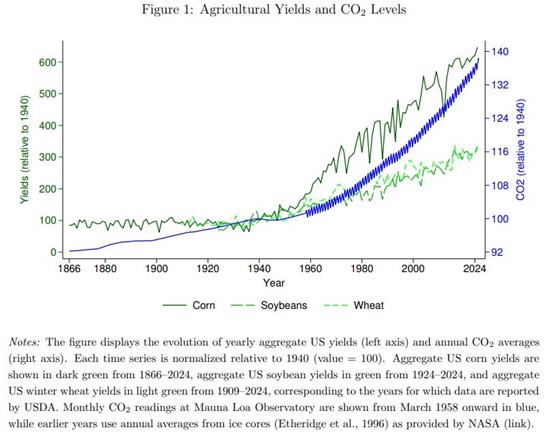
When these yield responses are applied back to US agricultural data as a counterfactual exercise, rising CO2 explains a substantial share of productivity growth since the 1940s. The results indicate that CO2 has been an essential contributor to historical yield gains, alongside technological improvements. Physicist Steven Koonin, former US Department of Energy undersecretary and IPCC reviewer, says climate science was misrepresented to the public to justify policy.
I once wrote an essay about plants having orgasms over CO2 because they genuinely love it, and another that 125 years ago, in terms of plant health, carbon dioxide levels were too low.
Also read about CO2 being one of the best and most important medicines, how CO2 controls and makes oxygen safe, how bicarbonates turn to carbon dioxide, why CO2 is vital in cancer treatment, the history of CO2 medicine, and the exciting possibilities for health and longevity with carbon dioxide inhalation therapy. It is also essential to understand why low blood carbon dioxide levels lead to reduced cellular oxygenation. And for sure, one will live longer with sodium bicarbonate, simple baking soda, because bicarbonates and carbon dioxide are kissing cousins.
Manmade Global Warming Freaks and CO2

Using daily maximum and minimum temperatures from 992 long-running, high-quality weather stations across 29 countries, covering 1899–2024, a new study compares observed temperature trends directly against cumulative human CO2 emissions.
The only conclusion: the historical temperature record does not track emissions. From 1899 to 1940, the planet warmed at 0.022 °C per year, even though global CO2 emissions were low by modern standards.
Then from 1941 to 1982, temperatures cooled by about -0.011 °C per year, all while cumulative CO2 emissions more than tripled. From 1983 to 2024, warming resumed — but at a slower rate of 0.017 °C per year, despite emissions being 8.6 times higher than during the early 20th century warming phase.
Given this pattern, CO2 is not the dominant temperature control knob. The strongest warming consistently occurs before large-scale industrial emissions, while later periods with far higher CO2 output show weaker warming—or even outright cooling.
Satellites Show Clouds, Not CO2, Driving Earth’s Energy Imbalance
Climate models predict that rising CO2 should reduce the amount of heat escaping to space. For 2000-2020, the IPCC said outgoing longwave radiation (OLR) should have fallen by about -0.4 W/m² per decade as greenhouse gases trap more heat. Satellite data actually show the opposite.
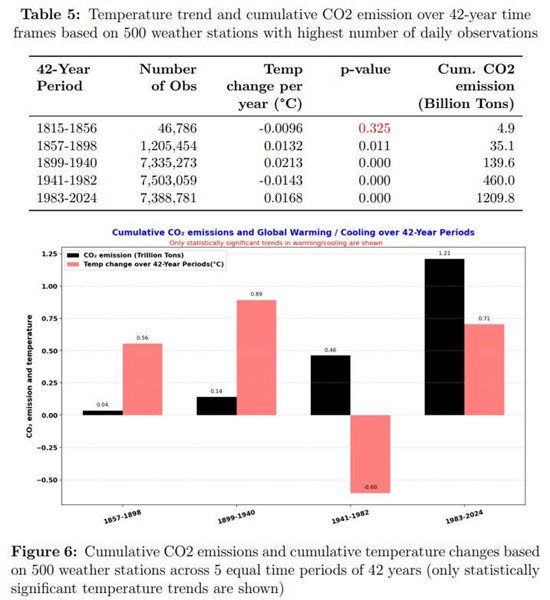
The study does not rely on models, reconstructions, or homogenized global averages. It uses over 40 million daily observations, applies station-level fixed effects to isolate local trends, corrects for seasonal cycles, and explicitly accounts for urban heat-island bias.
Dr. Bibek Bhatta, Senior Lecturer at Queen’s University Belfast, concludes: “These findings challenge the conventional assumption that human-induced CO2 is the primary driver of global warming.”
Anthropogenic CO2 Is A Bit Player

A new peer-reviewed paper by W. Jackson Davis asserts human CO2 is not driving modern warming. Using empirical data rather than model assumptions, the study finds that 98.43% of total climate forcing comes from sources other than anthropogenic CO2. Even if warming were assumed to be entirely CO2-driven, only 6.27% of CO2 forcing since 1750 is attributable to human emissions. And when realistic estimates are applied, Davis estimates the maximum human CO2 contribution to total temperature forcing at just 1.57%.
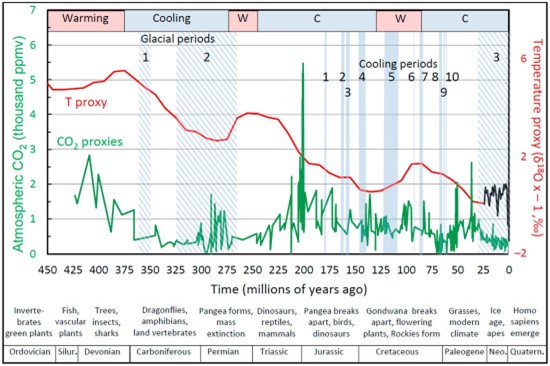
Over the past 425 million years, CO2 and temperature show a negative correlation (r = −0.19), meaning temperature often rises as CO2 falls, and vice versa. CO2 does not control climate on geological timescales, and its influence today is both minor and shrinking. Natural variability—solar input, water vapor, aerosols, and large-scale climate oscillations—dominates the system.
Propaganda Dream Machine
Covering Climate Now (CCNow), founded by Columbia Journalism Review and The Nation, has the purpose of standardizing climate coverage across global media. CCNow openly tells newsrooms how climate is framed: as an emergency, as the dominant story of our time, labeling CO2 as the enemy of humankind, and as a problem requiring urgent political solutions.
More than 500 media outlets now operate inside this framework. The list includes Reuters, Bloomberg, ABC News, NBC News, CBS News, PBS NewsHour, Al Jazeera English, TIME, The Weather Channel, and others with a combined audience in the billions.
Dr.Sircus is a reader-supported publication. To receive new posts and support my work, consider becoming a free or paid subscriber.
Subscribe now

comments