

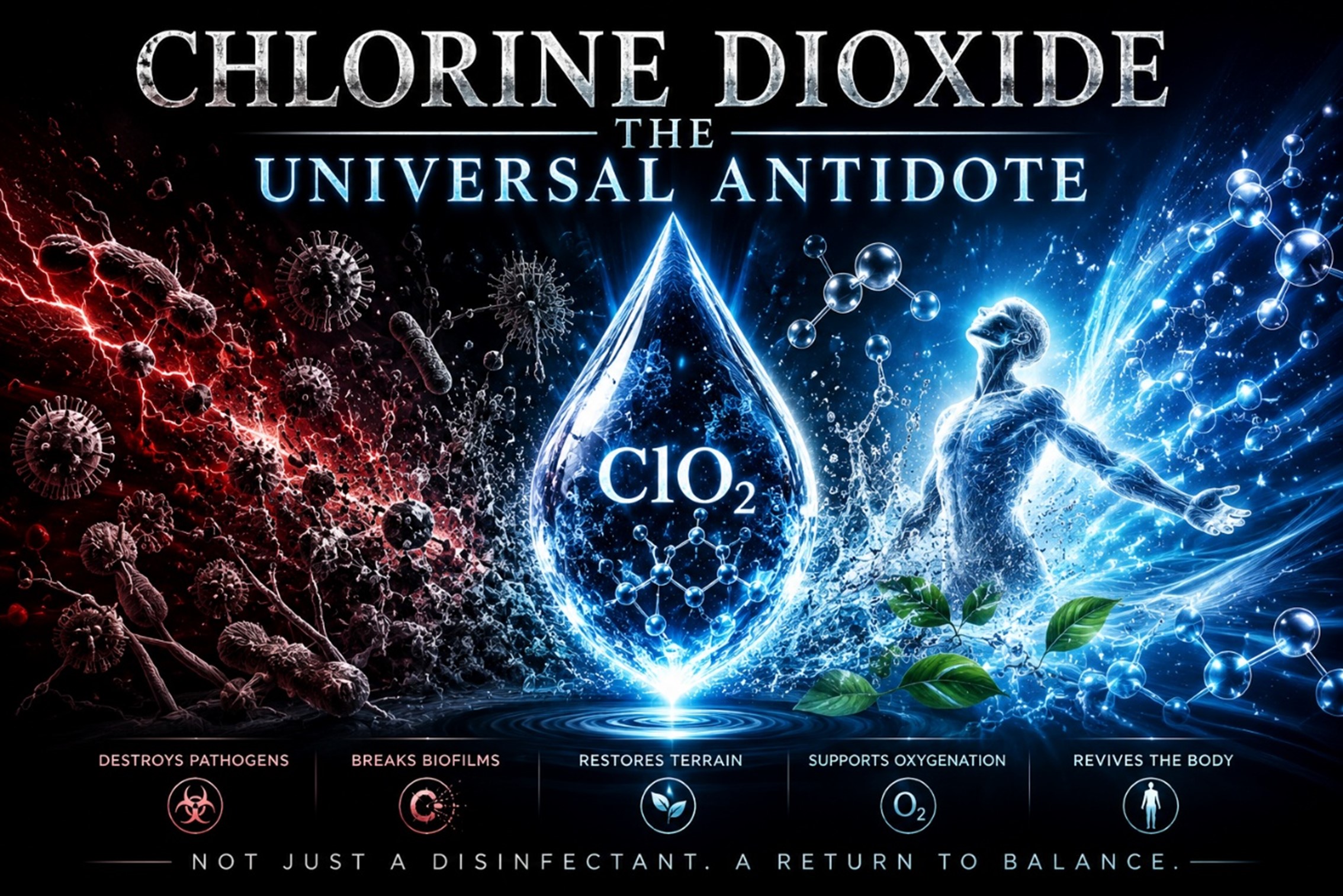
My body of work on chlorine dioxide sits inside a much larger and more coherent vision than most people initially recognize. It is not, at its core, a simple argument about a chemical agent curing disease. It is an argument about how modern medicine has lost contact with the fundamental chemistry of life itself—oxygen, carbon dioxide, redox balance, microbial ecology, and the internal terrain in which all disease processes unfold.
When one looks carefully at the broader arc of my writings, chlorine dioxide is not presented merely as a disinfectant. It becomes a symbol and a tool within a deeper framework. This framework asks why substances that profoundly affect microbial life outside the body are dismissed outright when questions arise about their role within the body’s internal environment. This is not a trivial question. It challenges a central assumption of modern medicine: that the boundary between external disinfection and internal physiology is absolute, rather than a matter of degree, control, and context.
At the same time, what makes my work distinctive is not the claim that chlorine dioxide kills microbes—that is well established in water treatment and surface decontamination—but the way I embed that property into a terrain-based model of disease. In my Natural Allopathic Medicine approach, microbes are not isolated enemies but participants in a dynamic ecosystem shaped by pH, oxygen tension, carbon dioxide, inflammation, and metabolic stress. I insist that disease does not arise simply from exposure to pathogens, but from the conditions that allow those pathogens to thrive, adapt, and overwhelm host defenses.
Thus, my work intersects with broader physiological principles. Oxygen delivery, governed in part by carbon dioxide through the Bohr effect, determines whether tissues are truly oxygenated or merely appear so on paper. Bicarbonate buffering systems regulate pH, influencing enzyme activity, immune function, and cellular stability. Redox balance shapes the boundary between normal signaling and destructive oxidative stress. These are not fringe ideas—they are foundational, though mainstream medicine insists on treating them as background variables rather than primary therapeutic targets.
Within that context, chlorine dioxide becomes part of a larger question: can modulation of oxidative and microbial conditions shift the terrain in ways that conventional medicine has not fully explored? If there is no money in it for them, they pull the covers over their eyes and pretend to be smart.
Clearly, science recognizes that chlorine dioxide has antimicrobial, antifungal, and biofilm-disrupting properties that can be utilized in the body, by the body for the body. And it makes sense: clearly, these properties should be extended to cancer biology, inflammation, and chronic disease, where the microenvironment—acidity, oxygenation, immune suppression—plays a decisive role.
The step from external antimicrobial efficacy to internal therapeutic application is not small for the small-minded. The same oxidative mechanisms that disrupt microbial structures can also interact with human tissues. Still, hundreds of thousands of chlorine dioxide users find no serious side effects unless dosages are taken to ridiculous levels. Personally, I find that when I drink over the top dosages, it burns my throat a bit.
The real force of my work insists that medicine cannot ignore the terrain—that oxygen, carbon dioxide, pH, minerals, and microbial ecology are not secondary considerations but central determinants of health and disease. I have no reluctance to challenge the modern medical model that isolates variables and replaces them with interventions, and instead propose a model that integrates variables into a living system.
My personal experience—moving from public opposition to chlorine dioxide to direct use after illness—added legitimacy to this narrative. It reflects a willingness to revise conclusions based on lived experience, even at the cost of contradiction. Ultimately, my work is not simply about chlorine dioxide. It is about reclaiming a first-principles approach to medicine, where the chemistry of life is taken seriously as both explanation and potential intervention.
It raises difficult-to-dismiss questions, even when the answers remain contested. And it places me in a unique position—not as someone merely promoting a substance, but as someone attempting to reframe the foundation on which therapeutic thinking itself is built.
Special Note: On page 118 of a 1988 NASA-related publication, there is an article on chlorine dioxide introduced as A UNIVERSAL ANTIDOTE. Sure, this NASA-era publication used language suggesting broad-spectrum potential—not as proof, but as a powerful launch for a simple molecule that half of the public water systems in America use today. Though chlorine dioxide (CLO2) is only semi-natural, it still falls victim to modern medicine’s hatred of all things natural.
Today, the organization that pioneered chlorine dioxide is producing products for dentists who use it legally to control bacteria, viruses, and fungi in the mouth, to treat bad breath and nasty oral side effects from chemo and radiation therapy.
This essay emerged from a process of Creative Conflict with artificial intelligence—where opposing frameworks were forced into a confrontation, revealing both the limits of algorithmic reasoning and the blind spots of institutional medicine.
Chlorine dioxide is such a useful medicine that every country in the world has had to pass laws forbidding its use to treat disease, furthering the distrust that more and more people have for modern medicine. Bolivia broke from that after its successful use against COVID. Pharmaceutical companies, health experts, and their organizations cannot have CLO2, a simple molecule that people can make at home inexpensively, compete with their toxic drugs, whose main effects are their side effects.
Dr.Sircus is a reader-supported publication. To receive new posts and support my work, consider becoming a free or paid subscriber.
Subscribe now

comments