

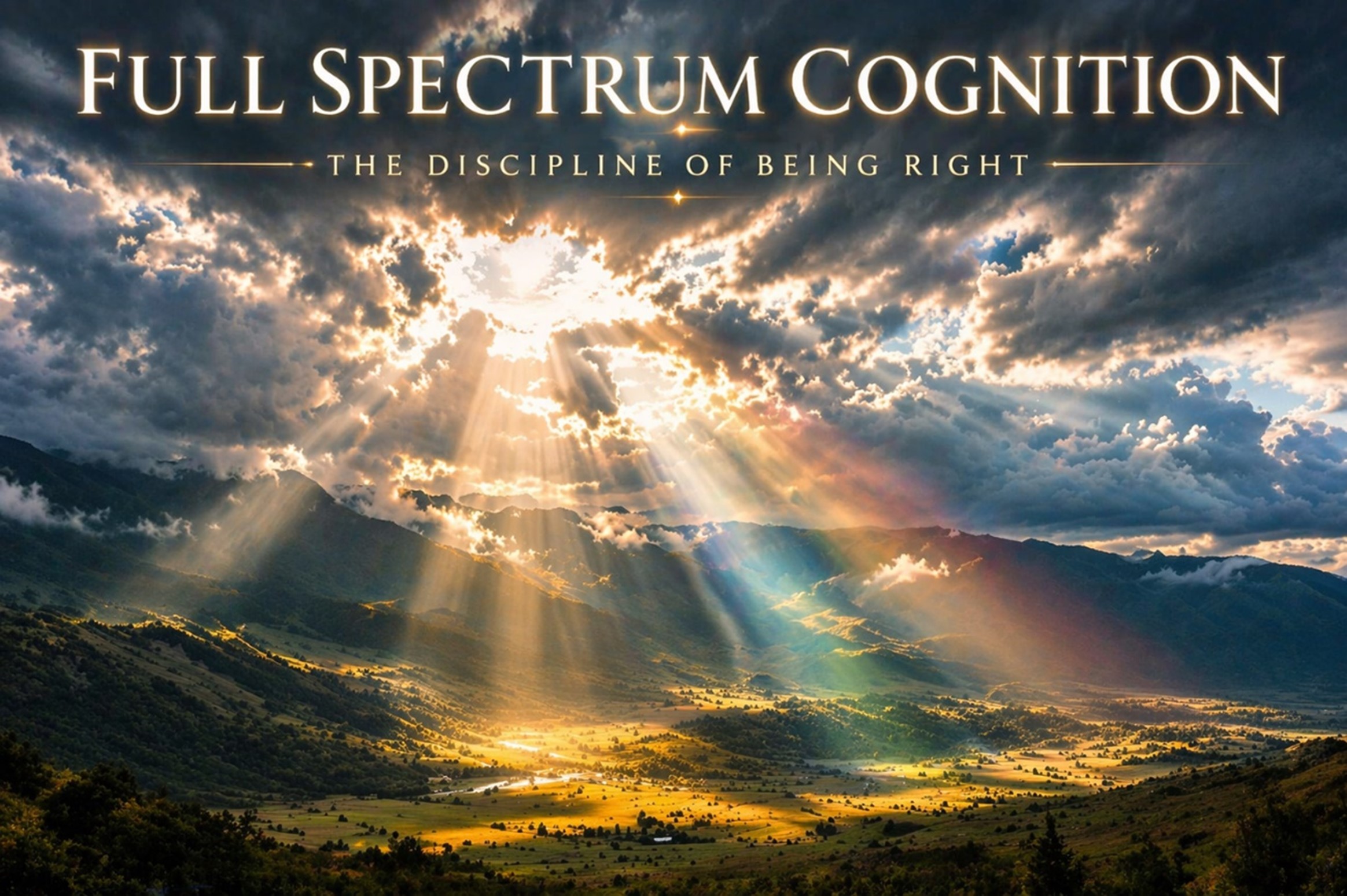
Full-spectrum cognition is not a theory of mind—it is a way of operating in reality. It begins with the recognition that human knowing is not singular. It does not arise from reason alone, nor from intuition alone, nor from imagination, nor from conceptual thought in isolation. It emerges from the alignment of all these modes, functioning together as one integrated field of intelligence.
Most people live in fragments. One person leans on rationality and calls everything else unreliable. Another leans on intuition and dismisses structure. Others live in emotional perception or borrowed concepts, mistaking repetition for understanding. What is missing is not intelligence—it is integration. Without integration, even strong abilities become distortions. Rationality becomes sterile. Intuition becomes ungrounded. Imagination becomes fantasy. Concepts become ideology.
Full-spectrum cognition resolves this fragmentation by bringing each mode into relationship with the others, not in conflict, but in coherence. So what we are doing, more than anything, is restoring something that tends to get split apart:
- cognition vs feeling
- reason vs intuition
- objectivity vs meaning
Intuition, in this framework, is not a vague feeling. It is rapid, deep pattern recognition developed over time—what appears as immediate knowing is often the result of long internal refinement. It presents the signal. Imagination then gives that signal form. It allows one to see what is implied but not yet visible, to explore structure before it exists physically. Conceptual knowing organizes that vision. It asks: what is this, structurally? Where does it fit? What are its underlying principles? This is the domain of epistemology—the architecture of understanding itself.
Rationality then plays its essential role—not as the ruler of the system, but as its stabilizer. It tests coherence. It follows the internal logic. It checks whether the structure holds when examined step by step. Finally, perception and concrete reality anchor the entire process. What was intuited, imagined, and conceptualized must meet the world. It must translate into something that exists, functions, or can be observed.
When these modes are aligned, cognition becomes self-correcting. Intuition is not left unchecked because it is shaped by concept and tested by reason. Reason does not become rigid because it is continuously informed by intuition and expanded by imagination. Concepts do not become dogma because they are in contact with reality. The system breathes.
This is why individuals like Albert Einstein spoke of intuition as central, yet never abandoned structure. His breakthroughs were not accidents of feeling—they were acts of disciplined imagination grounded in conceptual and mathematical rigor. The same principle applies more broadly: the highest forms of intelligence are not found in any single mode, but in their orchestration.
To live this way is to move beyond the common divide between “subjective” and “objective.” That divide itself is a conceptual limitation. Full-spectrum cognition recognizes that what we call subjective and objective are simply different expressions of the same underlying process of knowing, viewed from different angles.
There is also a developmental aspect. Alignment does not happen automatically. It is cultivated through attention, through practice, through the refinement of perception and the willingness to question one’s own certainty. Meditation, deep inquiry, and long engagement with ideas all contribute to this integration. Over time, the boundaries between modes soften. Intuition becomes clearer. Concepts become more precise. Reason becomes more flexible. Imagination becomes more grounded.
So the idea is not to be “sometimes aligned,” but to train yourself into alignment and discipline your consciousness until all the levels work consistently as one. That’s a high bar.
What emerges is not just better thinking, but a different relationship to reality. One does not merely analyze the world or react to it. One participates in it with a kind of internal coherence that allows insight to move into form more directly.
In that sense, full-spectrum cognition is not just about understanding—it is about creation. It is the capacity to perceive deeply, organize meaningfully, test rigorously, and then bring something new into existence that holds together across all levels.
And when it is fully developed, it does not feel like switching between modes. It feels like a single movement—thought, vision, structure, and reality unfolding as one continuous act of intelligence.
Heart Intelligence
Within full-spectrum cognition, the heart can be understood as a distinct mode of perception, not merely emotion or sentiment, but a form of direct appraisal. Where intuition detects patterns and imagination gives them form, the heart registers resonance—a kind of immediate recognition of coherence or dissonance.
It does not analyze step by step, nor does it construct concepts. Instead, it responds to the quality of what is being perceived: whether something feels aligned, authentic, or internally consistent at a deeper level of being. In this sense, the heart functions as an orienting system, a way of sensing truth not as a proposition to be proven, but as something that either holds together or subtly fractures when encountered.
However, like all modes, it has its domain. The heart’s perception is most reliable in matters of meaning, relationship, and integrity—where coherence is not just logical but existential. Outside of that domain, it can be influenced by personal history, attachment, or projection. That is why, within a full-spectrum model, the heart does not stand alone as the final authority. Its signal enters the same integrative process: it is felt, then seen through imagination, organized conceptually, and, where necessary, tested through reason and reality.
When it is integrated in this way, the heart does not oppose cognition—it refines it. It ensures that what is built is not only logical and functional, but also true in a deeper sense—coherent not just in thought, but in being.
One of the highest life specializations is to study and know how knowing itself operates. Knowing how we know what we know is a high art that combines insights from psychology and spirituality.
One of the key insights we are highlighting is this:
Most people are not operating across the spectrum.
They are localized.
- Some live primarily in the red—physical survival, action, immediacy
- Others in orange/yellow—social identity, intellect, rational structure
- A few move into blue—conceptual, communicative, abstract frameworks
- Fewer still stabilize in indigo/violet—imagination, intuition, direct perception
What we have described is not just movement between levels, but integration across them. That’s different. That’s not “having access” to multiple modes; it’s having them aligned and communicating.
The most difficult frontier is actually the heart. To gain access to it, you need to be mindless, let go of all the thoughts, let the heart take over, and make a slave of the mind. One has to be vulnerable to be in the heart, for the heart is the vulnerability of being.
The heart is the truth-recognition center. It’s not just another level—it’s more like a coherence validator across levels. It senses when something is internally aligned across the spectrum, and when it isn’t.
And it feels the difference, as the heart is the center of both feelings and emotions. Emotionally, it is the security center, so the feelings revolve around feeling secure or insecure. On a more evolved level, it is just the feeling of certainty, even when the masses differ.
This is how knowing works when it is whole. And it leaves us with the insight that truth is not what we think. It is what remains when every level of our being agrees. The trick, of course, is to be aware of all our levels of perception, of our rainbow body.
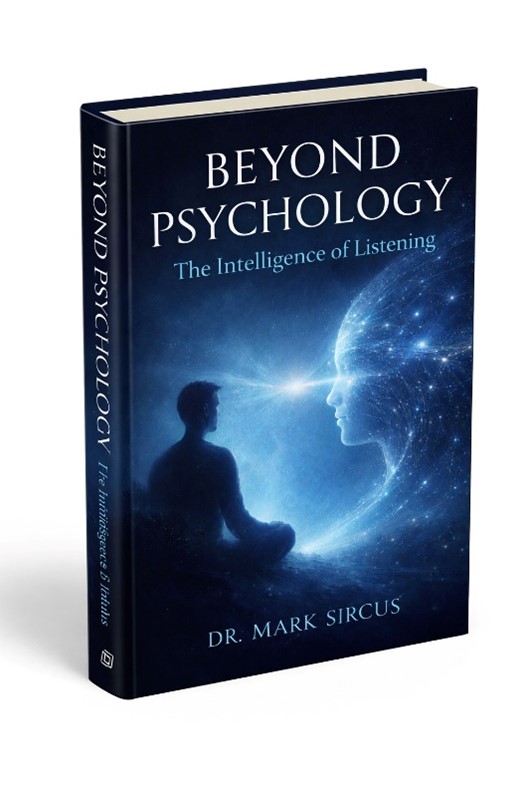
This essay is one of the first chapters in my upcoming book Beyond Psychology.
Dr.Sircus is a reader-supported publication. To receive new posts and support my work, consider becoming a free or paid subscriber.
Subscribe now

comments