

Magnesium is good for just about everything. Studies indicate a link between magnesium deficiency and chronic joint pain, as magnesium deficiency causes muscle tension and spasm (Freeman, 1999). One study asserts that magnesium sufficiency can reduce depression, irritability, anxiety, and tension (Community Pharmacy, 2003). Thus, the magnesium case is loud and clear. This intentionally forgotten but crucial mineral plays an important role in helping the body convert food into energy and function properly (Raloff, 1997). The problem is that mainstream doctors are deaf, dumb, and blind to the importance of magnesium and how it can be and should be used as a principal medicine, not just as a supplement.
Many studies show that magnesium is not only an important component of healthy, strong bone construction; it also helps the nervous system and heart rhythm function smoothly. Research further indicates that those with low magnesium levels need more oxygen and energy and therefore get tired more quickly (Bliss, 2004). Evidence suggests that magnesium plays an important role in many biochemical and physiological processes, directly affecting lung function, asthma management, joint pain, smooth muscle function, neuromuscular excitability, immune function, inflammation, and oxidative stress (Kazaks, 2006).
Evidence further indicates that magnesium balances calcium and helps regulate blood pressure. Magnesium also supports energy metabolism and helps with muscle contraction and bone mineralization (Miller, 2005). Another study indicates that magnesium activates more than 300 enzymes in the body. Most of these enzymes are involved in energy metabolism (Schrader, 1999).
Can you think of one pharmaceutical that even comes close to what magnesium can do? Magnesium is crucial for a healthy and lasting life, yet doctors cannot seem to remember it. Do they all have memory problems, dementia, or even Alzheimer’s? What can explain such a gross absence of mind in such an important medical and health matter?
People will pay almost any price when the
alternative is death, disability, or severe suffering.
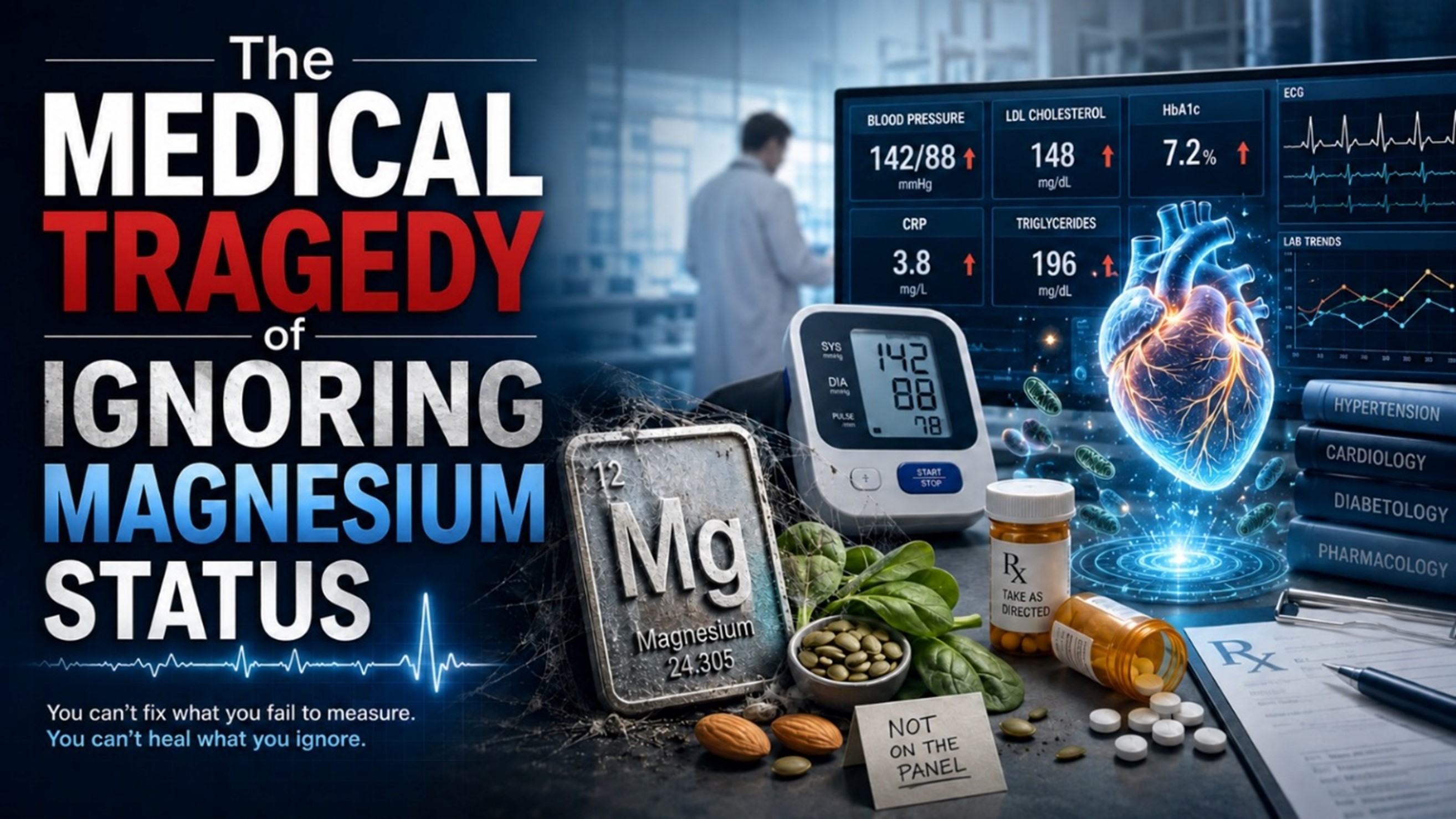
Modern cardiology can measure blood pressure to the millimeter, cholesterol to the decimal point, coronary calcium by CT, glucose continuously, and heart rhythm beat by beat, yet somehow neglects one of the most fundamental minerals required for the cardiovascular system to function normally: magnesium.
That is not a small oversight. It is a failure of physiological thinking. Magnesium stabilizes and enables ATP, regulates calcium movement, influences vascular tone, electrical conduction, insulin sensitivity, endothelial function, inflammation, and mitochondrial energy production. To investigate hypertension, arrhythmias, metabolic dysfunction, vascular disease, and heart failure while barely considering magnesium status is like studying a failing electrical grid while refusing to examine the wiring.
If one does not use magnesium to treat
diabetes, one is not treating diabetes.
The absurdity becomes especially obvious when hypertension is presented as though it were a primary cause rather than a physiological consequence. Blood pressure rises for reasons. Arteries constrict for reasons. Vascular smooth muscle loses normal relaxation for reasons. Magnesium is one of the minerals that helps oppose excessive calcium entry into cells and supports normal vasodilation.
When magnesium availability falls, calcium can become relatively dominant. In reality, calcium becomes toxic in the face of magnesium deficiencies. Vascular tone can increase, endothelial function can deteriorate, and blood pressure may rise. Yet the conventional response is often to diagnose hypertension, prescribe one or more antihypertensive drugs, and congratulate ourselves for treating the disease.
High blood pressure is a measurement, not an explanation of why the pressure became
high. High LDL is a measurement, not a complete explanation for why an artery
became diseased. Obesity and elevated glucose are metabolic manifestations.
Doctors have treated the number but not the physiology that produced it. But we still call them doctors. The same blindness appears in metabolic disease. Magnesium is deeply involved in glucose metabolism and insulin signaling. Low magnesium status frequently accompanies insulin resistance, diabetes, obesity, and metabolic syndrome—the very conditions increasingly associated with cardiovascular mortality.
Magnesium and Vital Energy
Then there is the heart itself, an organ that never stops spending energy. Every contraction, every relaxation, every ion gradient, every heartbeat depends upon ATP, and biologically active ATP is overwhelmingly handled as magnesium-ATP.
Magnesium is not merely sitting somewhere in the background while the heart works. It is intimately involved in the energetic currency that makes cardiac work possible. The myocardium also depends on exquisitely controlled movements of calcium, potassium, and sodium. Magnesium helps regulate this electrical and ionic choreography.
It all comes down to the ATP-Magnesium-Cancer Axis. Dr. Boyd Haley expresses the biochemical core of the truth about this: “ATP without Mg²⁺ bound cannot create the energy normally used by specific enzymes of the body to make protein, DNA, RNA, transport sodium or potassium or calcium in and out of cells, nor to phosphorylate proteins in response to hormone signals. ATP without enough Mg²⁺ is non-functional and leads to cell death.”
It is therefore hardly surprising that serious magnesium depletion can contribute to electrical instability and arrhythmias. Hospitals know this perfectly well when they administer intravenous magnesium in particular cardiac emergencies. Somehow, however, magnesium becomes less fashionable when the discussion shifts from emergency treatment to chronic prevention.
Dietary research makes the omission even stranger. Modern diets dominated by refined grains, sugar, ultra-processed foods, and nutrient-poor calories can provide substantially less magnesium than diets rich in leafy vegetables, seeds, nuts, legumes, and minimally processed foods. So when researchers identify a “poor diet” as a major cardiovascular risk factor, magnesium deficiency hides inside that category.
Medicine loves sophisticated terminology, advanced imaging, predictive algorithms, and enormous epidemiological databases. But sophistication is not depth. Sometimes the most important medical questions are embarrassingly basic.
Does the patient have enough magnesium? When that question is absent from serious discussions of cardiovascular disease, the problem is not that magnesium has become unimportant. The problem is that medicine has forgotten how to think about what keeps people healthy and why we have an epidemic in chronic illness among old and young alike.
Early magnesium medicine
- Pierre Delbet — the great French surgeon who introduced magnesium chloride into wound care during World War I and developed the concept of magnesium-enhanced immune defence or “cytophylaxis.”
- Auguste Neveu — extended Delbet’s magnesium-chloride work into infectious and respiratory illnesses.
- E. M. Lazard — pioneered intravenous magnesium sulfate for eclampsia beginning in 1924.
- Jack Pritchard and Fred Zuspan — developed the magnesium-sulfate regimens that subsequently saved countless mothers from eclamptic seizures.
- Edward B. Flink — among the first to describe the recognizable syndrome of human magnesium deficiency.
- Maurice E. Shils — conducted controlled human magnesium-depletion experiments, documenting neurological, psychological and metabolic consequences.
- Jerry K. Aikawa — one of the first great systematic investigators of human magnesium metabolism and author of Magnesium: Its Biologic Significance.
- Warren E. C. Wacker and Alfred F. Parisi — brought magnesium metabolism into mainstream medical scholarship through their landmark 1968 New England Journal of Medicine series.
The central giants of magnesium research
- Mildred S. Seelig — perhaps the greatest overall magnesium scholar. She connected deficiency with cardiovascular disease, pregnancy, childhood development, stress, calcium imbalance, osteoporosis and chronic disease. Her publication record spans decades.
- Jean Durlach — the European architect of clinical magnesium medicine; author of Magnesium in Clinical Practice, leader of the International Society for the Development of Research on Magnesium and a driving force behind Magnesium Research.
- Burton M. Altura and Bella T. Altura — established magnesium’s fundamental roles in vascular tone, hypertension, atherosclerosis, stroke, inflammation, cellular calcium control and neuroprotection.
- Robert J. Elin — exposed the limitations of serum-magnesium testing and advanced recognition of chronic latent magnesium deficiency.
- Robert K. Rude — demonstrated magnesium’s importance to bone, parathyroid function, vitamin-D metabolism and osteoporosis.
- Richard Whang — clarified the clinical relationships among magnesium deficiency, potassium depletion, arrhythmias and refractory hypokalemia.
- Lawrence M. Resnick — advanced understanding of cellular magnesium in hypertension, insulin resistance and metabolic disease.
- Gary A. Quamme — made major discoveries concerning renal magnesium handling and magnesium transport.
- Michael E. Maguire — helped establish magnesium as both a regulated and regulatory cellular ion.
- Andrea Romani and Antonio Scarpa — clarified intracellular magnesium transport, cellular signaling and organelle magnesium regulation.
- Thomas Günther and Joachim Vormann — advanced magnesium transport, deficiency and cellular-biochemistry research.
- Yves Rayssiguier and Andrzej Mazur — linked magnesium deficiency to inflammation, oxidative stress, metabolism, and cardiovascular injury.
- Maria J. Laires — contributed substantially to magnesium metabolism, exercise physiology, diabetes and cardiovascular medicine.
- Klaus Kisters — produced extensive work on magnesium, hypertension and cardiovascular disease.
- Michael Shechter — conducted important clinical research into oral magnesium, endothelial function and coronary disease.
- Jeroen de Baaij, Joost Hoenderop and René Bindels — helped bring magnesium medicine into the molecular age through research on magnesium transporters and homeostasis.
- Carsten Schlingmann and Martin Konrad — identified genetic defects responsible for inherited magnesium-loss disorders.
Drinking-water and cardiovascular pioneers
- Y. Kobayashi — reported an early geographical relationship between water mineral content and cardiovascular mortality in Japan.
- Henry A. Schroeder — identified the relationship between soft water and increased cardiovascular mortality and argued that magnesium was a principal protective factor.
- Margaret D. Crawford, Michael J. Gardner and Jerry N. Morris — conducted the landmark British investigations connecting water hardness with lower cardiovascular mortality.
- J. R. Marier, L. C. Neri and T. W. Anderson — assembled evidence on water hardness, human health, and magnesium.
- Eva Rubenowitz, Gösta Axelsson and Ragnar Rylander — strengthened the evidence through case-control investigations of magnesium in drinking water and fatal myocardial infarction.
- Andrea Rosanoff — carried Seelig’s work forward and made the modern public-health case for magnesium-rich drinking water. She estimated that appropriate water magnesium could potentially prevent millions of cardiovascular deaths worldwide. Her 2013 paper remains essential reading.
- Paul W. Mason — preserved the scientific literature, created the Magnesium Online Library, fought the FDA, protected Adobe Springs and placed naturally occurring magnesium-bicarbonate water before the public. His Magnesium Online Library remains his monument.
The great public educators
- J. I. Rodale — brought magnesium deficiency before the public through Magnesium: The Nutrient That Could Change Your Life.
- Carolyn Dean — made magnesium understandable to millions through The Magnesium Miracle and decades of public education.
- Norman Shealy — promoted magnesium’s clinical and transdermal applications.
- Thomas E. Levy — presented magnesium as a broad therapeutic instrument across multiple disease processes.
- James DiNicolantonio — forcefully reintroduced subclinical magnesium deficiency as a neglected public-health crisis.
- Mark Sircus — developed one of the most comprehensive bodies of public writing on magnesium chloride, transdermal magnesium, cardiovascular medicine, diabetes, cancer, emergency medicine, and the magnesium–bicarbonate relationship.
Conclusion
I was motivated to write this essay after reading an article entitled, ‘Scientists Say These 3 Preventable Factors Drive Most Heart Disease Deaths.” The article was physiologically shallow. The JAMA paper did not discover the three fundamental causes of heart disease. It took the 12 risk factors already selected by the Global Burden of Disease framework and mathematically estimated how much ischemic heart disease mortality they could account for. Doctors are utterly hollow on causation. Blood pressure is a number. Diet is a category. Cholesterol is a lab value. None of them explain why these things are dysregulated in the first place. It is just too hard for anyone in the mainstream of modern medicine to even think of magnesium as a cause or risk factor or point of their own stupidity.
Because magnesium deficiencies are getting worse across broad swaths of populations, doctors are falling further and further behind in their obligations to accurately diagnose and treat chronic diseases effectively. It really seems like they have no idea. No idea of fundamental physiology, no idea of the Physics of Life. No idea how important carbon dioxide is in health and medicine.
You would think they would know that Magnesium deficiencies trigger chronic systemic inflammation that also potentiates insulin resistance. People with type 2 diabetes mellitus may end up in a vicious circle in which magnesium deficiency increases insulin resistance, and insulin resistance causes magnesium deficiency. You would think cardiologists would know to prescribe magnesium a million times before even thinking of statin drugs.
Most cases of magnesium deficiency are undiagnosed not only because doctors can no longer think rationally but because the entire edifice of modern medicine is designed to hurt more than it helps. Furthermore, because of chronic diseases, medications, decreases in food crop magnesium contents, and the availability of refined and processed foods, the vast majority of people in modern societies are magnesium deficient.
Dr.Sircus is a reader-supported publication. To receive new posts and support my work, consider becoming a free or paid subscriber.
Subscribe now

comments