

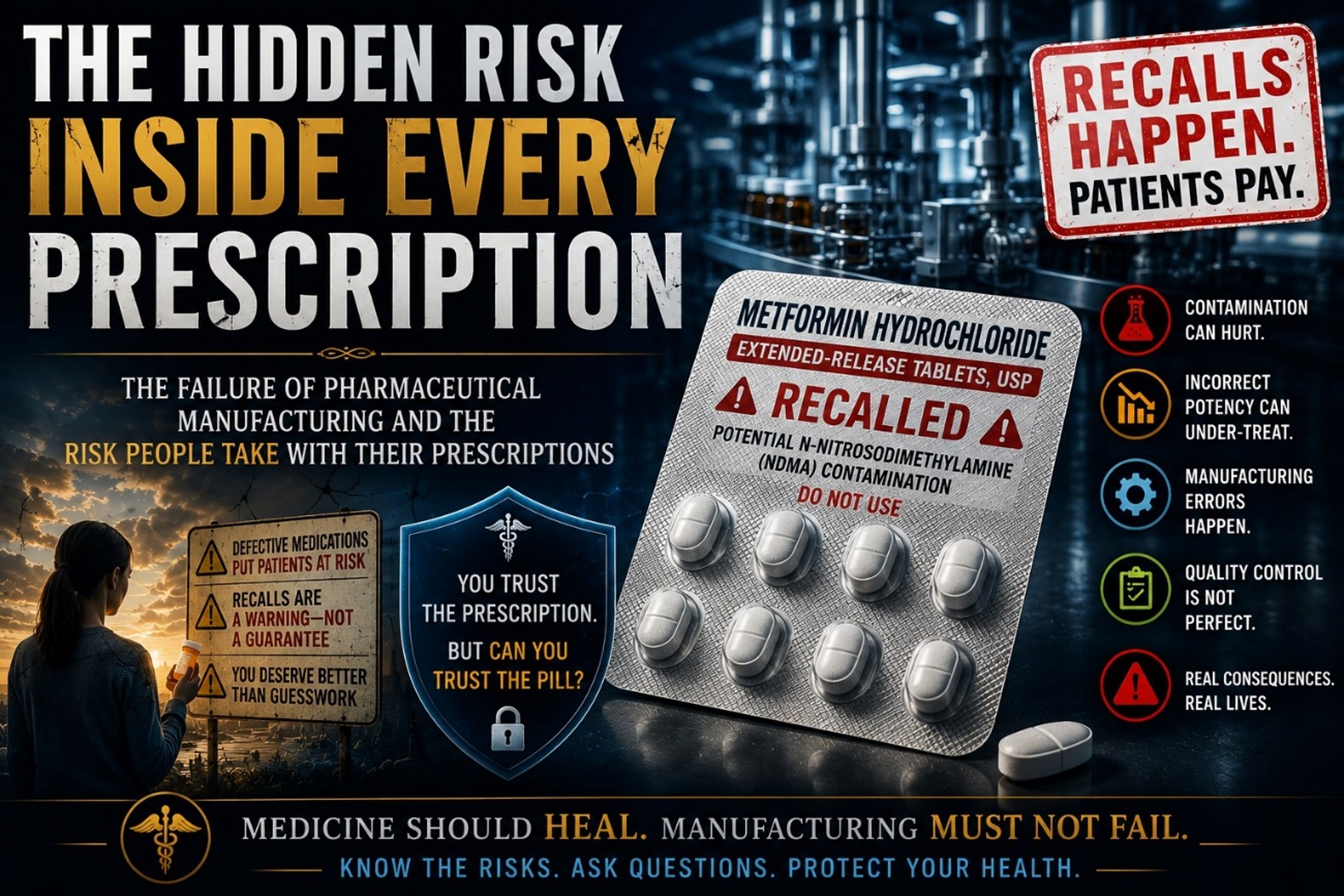
Every time a patient picks up a prescription, there is an unspoken assumption: that the tablet inside the bottle contains exactly what the label promises. Modern medicine depends upon that assumption. Physicians calculate dosages, patients trust the instructions, and entire treatment protocols are built on the belief that pharmaceutical manufacturing is so tightly controlled that every pill is essentially identical to the last. Yet one drug recall after another reminds us that this confidence is often far greater than the certainty behind it.
We are normally concerned with the side effects of pharmaceutical drugs, and often the main effects are indeed the side effects. And the uncomfortable reality is that approximately 100,000 Americans die each year from the adverse effects of properly prescribed medications taken as directed, making prescription drugs one of the leading causes of death in the United States.
In a landmark analysis published in JAMA, Lazarou and colleagues estimated that approximately 106,000 Americans died each year from adverse reactions to medications that were properly prescribed and correctly administered.
This sobering reality highlights a profound weakness in a medical system that relies primarily on pharmaceuticals to manage disease rather than restore normal physiology. While many medications save lives when appropriately used, the scale of medication-related mortality underscores the urgent need for safer, physiology-based approaches that support the body’s own healing mechanisms.
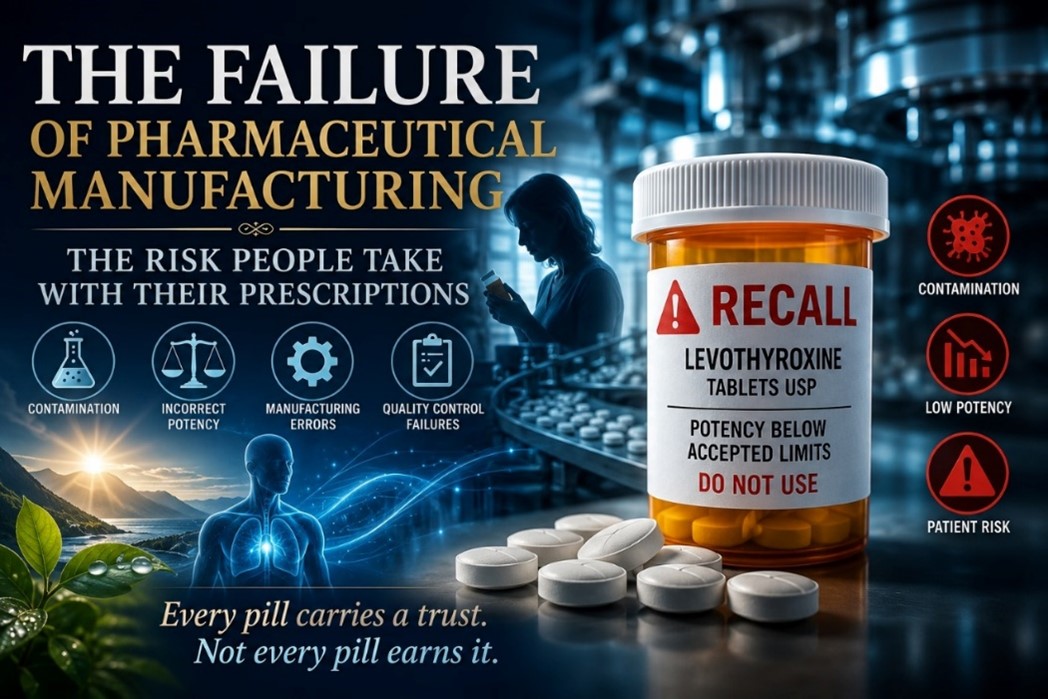
One of the latest nationwide recalls involves levothyroxine, one of the world’s most commonly prescribed thyroid medications. The affected tablets were recalled because they were found to be subpotent—containing less active ingredient than required. For someone depending on thyroid hormone replacement, this is not a trivial manufacturing defect. It means the patient may unknowingly be under-treated despite faithfully taking the prescribed dose every day.
Today we read that the Food and Drug Administration (FDA) has issued a report on a nationwide recall of millions of Rohto eye drops due to “lack of assurance of sterility.” A total of 12,460,649 bottles are affected. Also, most recently, more than 6,000 bottles of a prescription blood pressure medication have been recalled nationwide after testing found one of its active ingredients did not meet quality standards.
These are not isolated incidents. Every year, pharmaceutical manufacturers recall medications because of contamination, incorrect potency, stability failures, labeling errors, foreign particles, manufacturing deviations, or failures to meet quality standards. Some recalls involve impurities. Others involve tablets that contain too much medication, while others contain too little. Sometimes sterile products are found to be contaminated with microorganisms. Occasionally the problem is discovered only after thousands—or even millions—of doses have already reached patients.
The irony is striking. Modern medicine often speaks as though drugs represent the highest level of scientific precision, yet the manufacturing process itself remains imperfect. Pharmaceutical production is extraordinarily complex. Raw materials are sourced from multiple suppliers worldwide. Active ingredients may be synthesized in one country, formulated in another, packaged somewhere else, and distributed globally. Every step introduces opportunities for human error, equipment malfunction, contamination, or degradation. Regulatory oversight has undoubtedly prevented countless defective products from remaining on the market, but the recalls themselves remind us that quality control is not infallible. If it were, recalls would not be necessary.
For patients, this creates a largely invisible risk. Most people have no way of knowing whether the medication they swallowed this morning contains exactly the intended dose. If symptoms worsen, they naturally assume their disease has progressed. Few suspect that the tablet itself may have failed them. A physician may increase the dosage, order additional tests, or prescribe another medication, never realizing that the original problem began with the product rather than the patient.
This raises a broader question about the modern reliance on pharmaceuticals. Drug therapy assumes remarkable consistency not only in manufacturing but also in how individual human beings absorb, metabolize, and respond to medications. In reality, biological variability is enormous. Genetics, nutrition, liver function, kidney function, gut microbiota, age, concurrent medications, and environmental exposures all influence how a drug behaves inside the body. Manufacturing variability adds yet another layer of uncertainty to an already complex equation.
The lesson is not that every prescription is unsafe. Millions of people benefit from medications every day, and most batches meet quality standards. Rather, the lesson is one of humility. The pharmaceutical model is often presented as if it offers precise engineering inside the human body. In practice, it is a system that depends upon countless assumptions, each of which carries the possibility of failure.
This is one reason why physiology deserves far greater attention than pharmacology alone. The body’s need for oxygen, magnesium, bicarbonate, carbon dioxide, selenium, healthy nutrition, mitochondrial energy production, and proper metabolic regulation does not depend upon the flawless manufacture of a pill. These are the biological foundations upon which health rests. When medicine focuses exclusively on replacing or suppressing physiology with pharmaceuticals, patients become increasingly dependent upon an industrial manufacturing system that, despite its sophistication, continues to demonstrate its imperfections through a steady stream of recalls.
Every drug recall is more than an isolated manufacturing problem. It is a reminder that medicine has placed extraordinary faith in products made by human hands. Human beings make mistakes. Machines malfunction. Supply chains fail. Quality control occasionally misses defects. Biology, however, still obeys the same physiological laws it has followed since the beginning of life.
Perhaps the safest medicine will always be that which works with the body’s own design rather than depending entirely on the perfection of pharmaceutical manufacturing.
Below is a representative list of major U.S. drug recalls announced or classified by the FDA during roughly the past 12 months. It is not every single recall—there have been well over 100 drug recalls during that period—but it includes many of the most significant, widely distributed, or clinically important recalls. The FDA maintains a continuously updated database with more than 160 current and recent drug recall entries.
|
Drug |
What it’s used for |
Recall reason |
|
Levothyroxine Sodium Tablets |
Hypothyroidism, thyroid replacement, thyroid cancer |
Tablets found to be subpotent (too little active ingredient). |
|
Cetirizine (generic Zyrtec) |
Allergies, hay fever, hives |
Possible cross-contamination with ranitidine. |
|
Duloxetine (generic Cymbalta) |
Depression, anxiety, diabetic neuropathy, fibromyalgia |
Elevated nitrosamine impurity (potential carcinogen). |
|
Prazosin |
High blood pressure, PTSD nightmares |
Nitrosamine contamination. |
|
Papaverine Injection |
Blood vessel relaxation, surgical vasospasm |
Particulate matter. |
|
Cyclophosphamide Injection |
Chemotherapy for cancer |
Steel particulate contamination. |
|
Cefazolin in Dextrose Injection |
Intravenous antibiotic |
Cardboard particles in solution. |
|
Doxorubicin Liposome Injection |
Chemotherapy |
Glass particles detected. |
|
Lactated Ringer’s Injection |
IV fluid replacement |
Particulate contamination. |
|
Gas-X Extra Strength Softgels |
Gas and bloating |
Potential chemical contamination. |
|
Saline Nasal Spray |
Nasal congestion |
Microbial contamination (yeast and Aspergillus). |
|
ChloraPrep Applicators |
Skin antiseptic before procedures |
Potential fungal contamination. |
|
MG217 Eczema Cream |
Eczema treatment |
Contaminated with Staphylococcus aureus. |
Other important recalls over the last year or so
- Various compounded GLP-1/weight-loss products (FDA warnings rather than one single recall).
- Oxbryta (voxelotor) withdrawn because of safety concerns.
- Multiple compounded products from certain pharmacies due to sterility concerns.
Looking across these recalls, the reasons tend to fall into recurring categories:
- Incorrect potency (too much or too little active ingredient)
- Nitrosamine contamination (potential cancer-causing impurities)
- Microbial contamination
- Glass particles
- Metal particles
- Cardboard or plastic particles
- Incorrect labeling
- Cross-contamination with another drug
- Loss of sterility
- Chemical contamination
- Packaging failures
- Manufacturing deviations
- Stability failures
The striking point is that these are not failures of the drugs’ intended pharmacology—they are failures in manufacturing, quality control, packaging, or supply-chain integrity. They illustrate that modern drug therapy depends not only on the science of pharmacology but also on the flawless execution of a vast industrial production system. When that system fails, patients may receive contaminated, under-strength, over-strength, or otherwise defective medicines.
Dr.Sircus is a reader-supported publication. To receive new posts and support my work, consider becoming a free or paid subscriber.
Subscribe now

comments