

The medical consensus is that the MMR vaccine is considered safe and effective for preventing measles, mumps, and rubella. Every medical institution says this. Every medical institution lies about the MMR shot because they have to lie about autism, which remains a mystery disease because of all the lies.
But it is a deal with the Devil. Before dealing with all the side effects, including death by injection, that you would think would be reserved for criminals on death row, the first deal is this: We trade a natural, acute, childhood immune education for artificial, lifelong immune alteration.
We trade a week of fever, rash, and immune strengthening that, in a well-nourished child, was historically a rite of passage that left the immune system stronger, for an injection of live attenuated viruses, with aluminum, fetal cell lines, and foreign proteins that the body never learns to expel, only to tolerate.
It is a devil’s deal not because it does not prevent measles. It does, but not always. Measles, mumps, and rubella can all occur after MMR vaccination. These are called breakthrough infections. MMR substantially reduces risk, but it does not provide perfect or necessarily lifelong sterilizing immunity. The effectiveness is:
|
Measles |
About 93% after one dose; 97% after two |
|
Mumps |
About 72% after one dose; 86% after two |
|
Rubella |
About 97% after one dose |
Mumps provides some of the clearest examples. In one documented American outbreak, approximately two-thirds of identified patients had received at least two MMR doses. The CDC estimates that approximately three of every 100 fully vaccinated people exposed to measles may still become infected.
Measles, in a child with adequate vitamin A, adequate vitamin C, adequate magnesium, and adequate bicarbonate buffering, was a self-limited disease that left behind stronger, more mature immunity—including protection against certain cancers and chronic disease later in life—that is now rarely discussed.
It is a devil’s deal because of what we gave up to get it. We eliminated the acute disease without ever asking: What did that acute disease do FOR the immune system? Modern medicine looked at the rash and the fever and saw only danger. Perfect medicine looks at the same fever and sees a purification, a training, a reset, a natural occurrence that the vast majority of children navigate successfully through.
When you prevent a natural infection with an imperfect medicine, you do not create health. You create a child who has never been challenged. And an unchallenged immune system finds other enemies. Allergies. Autoimmunity. Chronic inflammation.
This is the hidden cost that no one puts on the consent form: We traded acute, nutritional diseases that could be supported with vitamin A, hydration, magnesium, and rest, for chronic, autoimmune diseases that sometimes require medicine for life.
Perfect medicines do not make deals. They do not say, “I will give you this, but you must give me that.” Vitamin A does not prevent measles by crippling another system. Magnesium bicarbonate water does not strengthen immunity by creating autoimmunity. Imperfect medicines always make deals. That is their nature. They block, suppress, and divert. They rescue today and bill you tomorrow. The MMR is not evil because it is intended to harm, but if you look at the history of the pharmaceutical industry, one can entertain serious doubts about this question.
Before the MMR Vaccine
The Terrain Determines Much of the Danger
This is where conventional discussions often become superficial. They talk as though the virus alone determines the outcome. It does not.
The outcome of infection reflects the relationship between the pathogen and the host:
- Nutritional status
- Vitamin A status
- Immune competence
- Age
- Pregnancy
- Respiratory health
- Existing illness
- Overcrowding
- Access to hydration and competent medical care
- Speed with which pneumonia or neurological complications are recognized
Vitamin A is particularly important in severe measles. Deficiency increases the risk of eye injury, immune dysfunction, complications, and death. Clinical vitamin A treatment is recommended for children with measles in specified circumstances, particularly severe illness or deficiency. That does not make vitamin A a guaranteed cure. It shows that the host’s condition powerfully shapes the danger of infection.
The Brady children represented an unusually favorable terrain: well-fed, housed, supervised, and connected to medical care. Their easy recovery was plausible. Unfortunately, it is not guaranteed for every child.
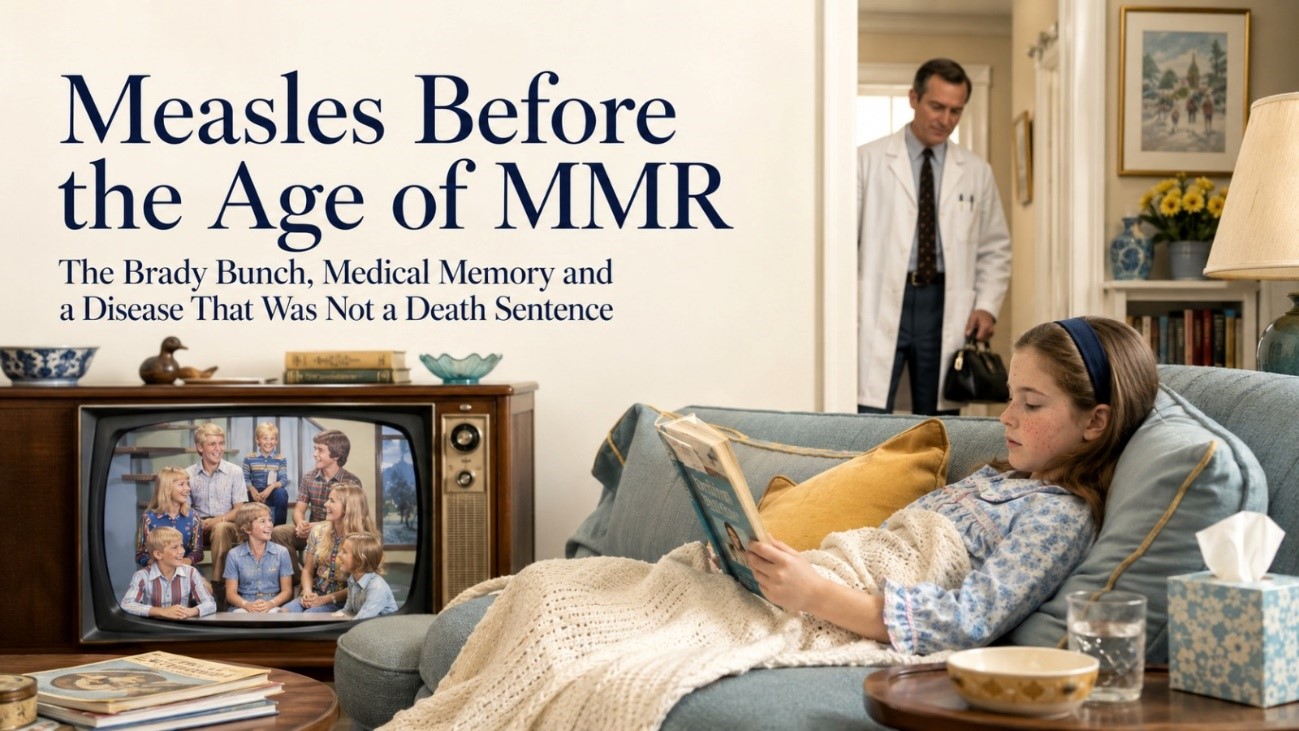
That forgotten cultural memory of Measles survives in a remarkable episode of The Brady Bunch titled “Is There a Doctor in the House?” It aired on December 26, 1969, when measles was still part of nearly every American family’s lived experience. All six Brady children contract measles. The central drama is not impending death, brain damage or emergency hospitalization. It is the comic rivalry between two pediatricians.
Carol Brady describes the children as having “a slight temperature, a lot of dots and a great big smile.” Marcia cheerfully says:
“If you have to get sick, sure can’t beat the measles.”
The children are relieved they don’t need injections or unpleasant medicine. They play games, receive attention, and recover. Measles serves as the setting for a family comedy—not a medical catastrophe.
History of Measles
Measles was very common before vaccination and could be dangerous, but for most healthy children in wealthy countries, it was usually not fatal. Before the measles vaccine was introduced in the United States in 1963, an estimated 3–4 million Americans caught measles every year. About 500,000 cases were officially reported annually. Of those reported cases, roughly 48,000 were hospitalized, about 1,000 developed encephalitis, and 400–500 died each year.
So in the U.S. by the late pre-vaccine era, death from measles was relatively uncommon compared with the enormous number infected. Using 3–4 million infections and 400–500 deaths gives a crude infection-fatality rate of about one death per several thousand infections. That is very different from saying measles was harmless. Pneumonia, encephalitis, dehydration, hearing problems, and permanent neurological injury were real complications.
If three to four million Americans were infected and 400–500 died, the estimated infection-fatality rate was roughly one death for every 6,000–10,000 infections—approximately 0.01%. More than 99.9% survived. That is not the same as saying nobody died. It is saying that the modern description of measles as though every infected child stood at the edge of death badly distorts how the disease usually behaved in a well-nourished population with functioning medical care.
The historical context matters tremendously. By the 1950s and early 1960s in the United States and Western Europe, measles mortality had already fallen dramatically compared with the nineteenth and early twentieth centuries because children were generally better nourished and had better sanitation, medical care, antibiotics for secondary bacterial infections, and supportive treatment. The vaccine then caused a huge further reduction in measles infections themselves, eventually eliminating continuous domestic transmission in the U.S. by 2000.
In poorer or malnourished populations, however, measles has historically been much more dangerous. WHO specifically identifies malnutrition, vitamin A deficiency, and weakened immunity as major risk factors for severe or fatal measles. Pneumonia and severe diarrhea/dehydration are among the main causes of measles deaths.
The claim that measles was a harmless childhood rite of passage is not true. But before vaccination, measles routinely killed healthy American children greatly overstates what measles looked like in the U.S. immediately before 1963. Its danger was dramatically greater in malnourished and medically underserved populations.
This distinction matters when examining the historical risk-benefit argument around measles vaccination, because measles mortality had already plunged long before the vaccine appeared, whereas incidence collapsed only after vaccination.
Reports of MMR Adverse Events
In VAERS, the U.S. Vaccine Adverse Event Reporting System, many adverse events have been reported after MMR vaccination, fever, rash, injection-site reactions, swollen lymph nodes, joint pain or arthritis, fainting, seizures—especially febrile seizures—thrombocytopenia/immune thrombocytopenic purpura, allergic reactions including anaphylaxis, encephalitis or encephalopathy, meningitis, Guillain-Barré syndrome, ataxia, vasculitis, pancreatitis, hearing loss, and other neurological events.
Many of these also appear in the FDA’s official M-M-R II post-marketing adverse-reaction information. The FDA specifically warns about febrile seizures and transient thrombocytopenia following MMR.
MMR is accepted to produce a small increased risk of febrile seizures, usually about 5–12 days after vaccination. CDC recognizes this explicitly. There is also a recognized association with immune thrombocytopenia and rare anaphylaxis.
VAERS also lists neurological events. A CDC/FDA investigation found 44 VAERS reports of apparently idiopathic sensorineural hearing loss following measles- or mumps-containing vaccines between 1990 and 2003.
For adults, a CDC/FDA review of VAERS between 2003 and 2013 identified 3,175 reports after MMR, of which 168—about 5%—were classified as serious, including 7 reported deaths. Those seven are deaths reported after vaccination, not seven deaths demonstrated to have been caused by MMR according to mainstream medicine.
VAERS contains reports of encephalitis, seizures, thrombocytopenia, and deaths after MMR is a factual statement. VAERS proves MMR caused every one of those events” is not true. However, much harm is hidden behind the words “rare” and “proof.”
It is helpful to compare the serious MMR injuries reported in VAERS—seizures, encephalitis, thrombocytopenia, permanent disability, and deaths—and compare them directly with the risk of measles in the U.S. immediately before the vaccine was introduced.
Measles Did Do Harm
In the decade before the first U.S. measles vaccine was licensed in 1963, virtually every child eventually contracted measles. CDC estimates 3–4 million infections per year, although only about half a million were officially reported. Annually, there were roughly 48,000 hospitalizations, 1,000 cases of encephalitis, and 400–500 deaths. An older CDC summary also estimated about 7,000 seizures per year.
Now look at the Harm of MMR Vaccines.
A current compilation of the public VAERS database specifically for MMR II shows, from 1990 through the available 2026 data, approximately 89,976 reports, including:
5,174 reports involving hospitalization
1,649 involving disability
497 mentioning death.
There are also 397 reports coded with “seizure,” including 110 hospitalizations among those reports.
Modern vaccine medicine mostly ignores VAERS because it explicitly states that a report establishes only that an event occurred after vaccination, not that vaccination caused it. VAERS is often publicly dismissed whenever its reports challenge reassuring safety narratives—even though detecting such patterns is precisely why the system exists.
A CDC-supported analysis estimated that VAERS captured only about 25% of anaphylaxis cases following MMR. In comparison, capture estimates across different vaccines ranged from 13% to 76% for anaphylaxis and 12% to 64% for Guillain–Barré syndrome.
An AHRQ-funded project conducted by Harvard Pilgrim Health Care between 2007 and 2010 identified 35,570 possible post-vaccination reactions following 1.4 million doses. The project reported that fewer than 1% of vaccine adverse events were ordinarily reported to the FDA.
Whatever the actual numbers, it is widely accepted that VAERS underreports adverse events because doctors are not obligated to report vaccine injuries and because, in more cases than not, most vaccine injuries and deaths are clearly not accepted as such.
Thus, we have Shaken Baby Syndrome and Sudden Infant Death Syndrome. We see this clearly with mRNA genetic injections, which mainstream medicine refuses to associate with the increase in deaths around the world starting in 2021
MMR can cause immune thrombocytopenic purpura (ITP), a potentially serious reduction in platelets that can produce bruising or bleeding. The CDC estimates roughly 1 case per 40,000 vaccinated children, or about 25 cases per million. Anaphylaxis is another accepted vaccine injury. Estimates range from about 1.8 to 14.4 cases per million doses.
MMR Is Perfectly Safe Is A Big Lie

The greatest lie ever told is that vaccines are safe and effective.
Dr. Len Horowitz
If somebody says “MMR is completely safe,” that statement is demonstrably wrong. It can cause serious adverse events. Febrile seizures, thrombocytopenia, and anaphylaxis are not theories or VAERS anecdotes; they are recognized vaccine complications. Rare severe neurological injury can also occur under particular circumstances.
By 1962, measles in the United States was not the mass killer it had been generations earlier. There were roughly 3–4 million infections against approximately 400–500 deaths annually. Mortality had already fallen enormously before vaccination. Measles was generally survivable for a well-nourished American child in 1960, but it wasn’t harmless. MMR eliminated a substantial disease burden, but MMR isn’t harmless either.
So we have to ask how certain we are about those numbers, which children are particularly vulnerable to either risk, and whether parents are being given that information honestly enough to make genuine informed decisions. In general, doctors and their medical associations are religious about vaccines and their safety when hard reality says something quite different.
Dr.Sircus is a reader-supported publication. To receive new posts and support my work, consider becoming a free or paid subscriber.
Subscribe now

comments