

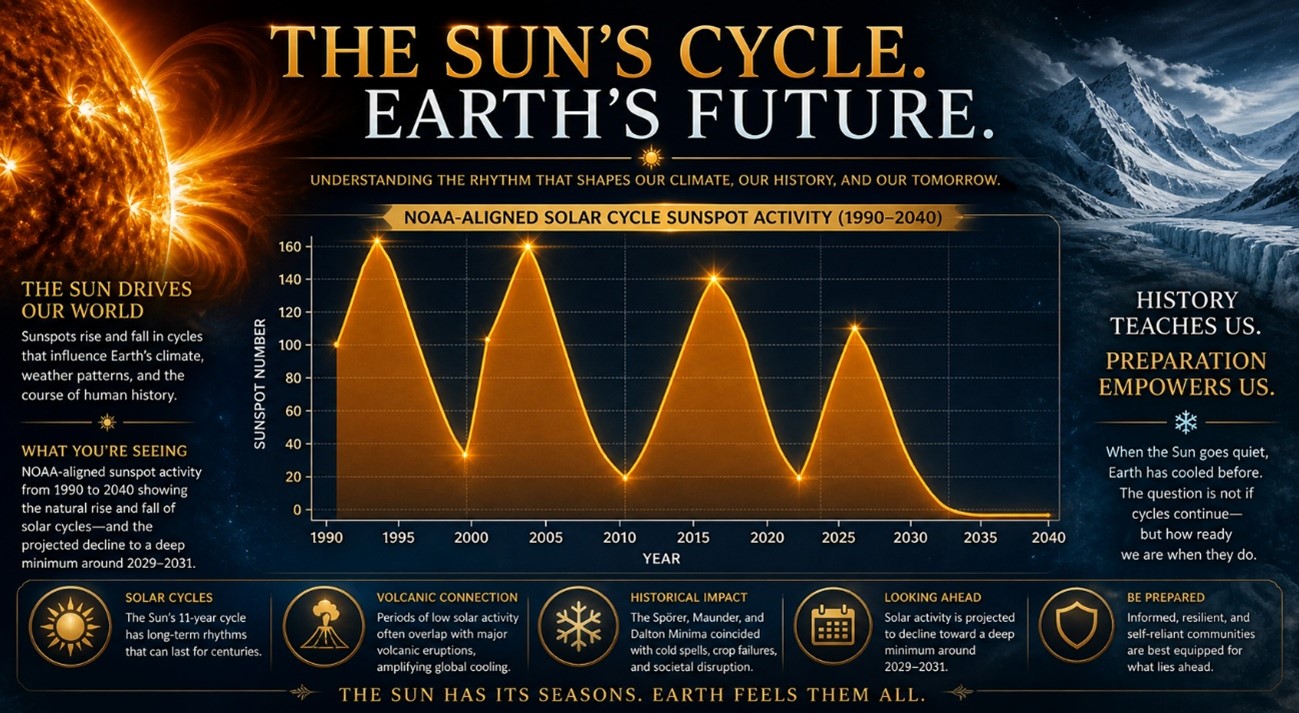
In the shadows of the mainstream climate narrative — filled with fears of overheating, carbon overload, and global boiling — lies a quiet admission from one of the most established scientific institutions in the world: NOAA predicts a complete drop-off of sunspots beginning around 2030. Yet NOAA still insists global warming is a threat.
This sunspot prediction is not just a data point. It’s a cosmic alarm bell, but no one is listening. Climate change has become a globalist religion of insanity. It is also scientific insanity, for CO2 is the most necessary gas and highly healthy. Without CO2, oxygen would not exist at a concentration that supports life on Earth.
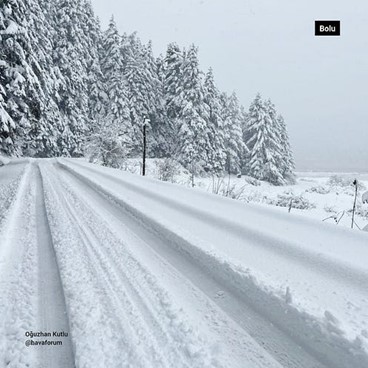
After Athens logged its coldest May Day on record, the cold pushed deeper
overnight into May 4, with historic May lows across Greece and the wider
Balkans. Russian-sourced cold drained south through the Balkans, returning frost
to basins and valleys and threatening orchards, vineyards, and early-season crops.
For most of modern history, climate discussions have focused almost entirely on what happens here on Earth—carbon, industry, methane, oceans, aerosols, deforestation, economics, politics. Yet long before factories, SUVs, carbon taxes, and climate conferences, the Earth was already moving through powerful cycles of warmth and cold, abundance and famine, glacier retreat and glacier advance.
To understand climate honestly, we must occasionally lift our eyes from the ground and look upward. The Sun is not merely a distant lamp hanging in the sky. It is the energetic engine of the entire planetary system. And one of the clearest fingerprints of solar behavior comes through sunspots—dark magnetic regions on the Sun whose numbers rise and fall in roughly eleven-year cycles, but also in much longer grand cycles that can last decades or even centuries.
Denver, Rockies face potentially biggest
snowstorm of the season on the 4th and 5th of May.
When solar physicists and historians look back through telescopic records, ice cores, and isotopic reconstructions, a striking pattern emerges. During the Spörer Minimum, roughly 1450 to 1540, solar activity declined sharply, and Earth entered some of the coldest centuries of the Little Ice Age. Then came the famous Maunder Minimum, when astronomers observed fewer than fifty sunspots during decades when tens of thousands would normally have appeared. These were the years of brutal winters, advancing glaciers, shortened growing seasons, crop failures, and the freezing of the Thames.
Cyprus woke to snow in its Troodos Mountains on May 4 and 5,
an event well outside the island’s early-May norms. The same
cold outbreak also reached Mount Hermon in Israel.
Later came the Dalton Minimum, again accompanied by lower temperatures and agricultural disruption. This correlation between prolonged solar minima and colder climate is not speculation. It is one of the best-documented long-cycle patterns in climate history. NOAA’s own solar cycle progression data shows that after the current stronger-than-expected Solar Cycle 25, solar activity is expected to move downward toward the next solar minimum around 2030–2031. NOAA has not predicted the complete disappearance of sunspots in 2029; some will remain. But the Sun is expected to enter its natural declining phase later this decade. But the crash will be severe, according to NOAA.
As I explored in my essays “When the Sun Goes Silent” and “A Very Cold Story: Warnings of What Is Coming,” the story may be bigger than sunspots alone. History reveals another unsettling correlation. The great solar minima often seem to overlap with clusters of major volcanic activity. During and around the Maunder Minimum, ice-core sulfate records show repeated signatures of powerful eruptions. Then, during the Dalton Minimum, came the catastrophic eruption of Mount Tambora in 1815, followed by the Year Without a Summer—snow in June, failed harvests, famine, migration, and social unrest across continents.
No serious scientist claims that sunspots directly cause volcanoes. Earth’s mantle does not suddenly erupt because the Sun becomes quiet. But the historical overlap is difficult to dismiss. When solar magnetic activity weakens, Earth’s exposure to cosmic radiation increases, atmospheric ionization changes, circulation patterns shift, and some researchers continue to explore whether subtle geophysical interactions may exist. The mechanism remains uncertain. The correlation does not.
Several stations in Okinawa, southern Japan, have
recorded their lowest May temperatures on record.
What becomes increasingly compelling is not any single variable, but the stacking of variables. A quieter Sun alone may cool the climate modestly. A major volcanic eruption alone may inject sunlight-reflecting aerosols into the stratosphere, cooling the planet for several years. But when a quiet Sun and major volcanism occur together, history suggests amplification. That may be exactly what happened during parts of the Little Ice Age. Lower solar output, altered atmospheric circulation, volcanic aerosols, oceanic shifts, and agricultural stress all converged. The result was not simply colder winters. It was food shortages, economic instability, migration, political upheaval, and human suffering.
In “When the Sun Goes Silent,” I argued that one of modern civilization’s blind spots is its extraordinary confidence that technological society can easily absorb climatic shocks. But history tells another story. Civilizations built around just-in-time agriculture, globalized supply chains, debt-driven economies, fragile fertilizer systems, and energy-intensive food production may be even more vulnerable to prolonged cooling than our ancestors were.
In “A Very Cold Story,” I warned that if solar activity weakens while volcanic activity increases—as history suggests can sometimes occur together—the consequences may not be limited to colder weather. They may mean shorter growing seasons, rising food prices, stressed electrical grids, fuel shortages, crop losses, geopolitical tension, and the return of something most of modern humanity has forgotten: climate as an existential force.
Climate models are crap, built on fantasy baselines.
None of this means catastrophe is inevitable. None of this means every solar minimum becomes a mini ice age. None of this means carbon, oceans, land use, and human influence suddenly become irrelevant. But it does mean that any honest discussion of climate that ignores the Sun, long solar cycles, volcanic amplification, and history itself is looking at only part of the picture, which is exactly what climate scientists do. Earth’s climate has always been a symphony of forces—solar, volcanic, oceanic, atmospheric, geological, and now human, through massive sunlight-blocking pollution. And if history teaches us anything, it is this: when the Sun changes its rhythm… the Earth responds with changes on the ground and even underground.
Dr.Sircus is a reader-supported publication. To receive new posts and support my work, consider becoming a free or paid subscriber.
Subscribe now

comments