

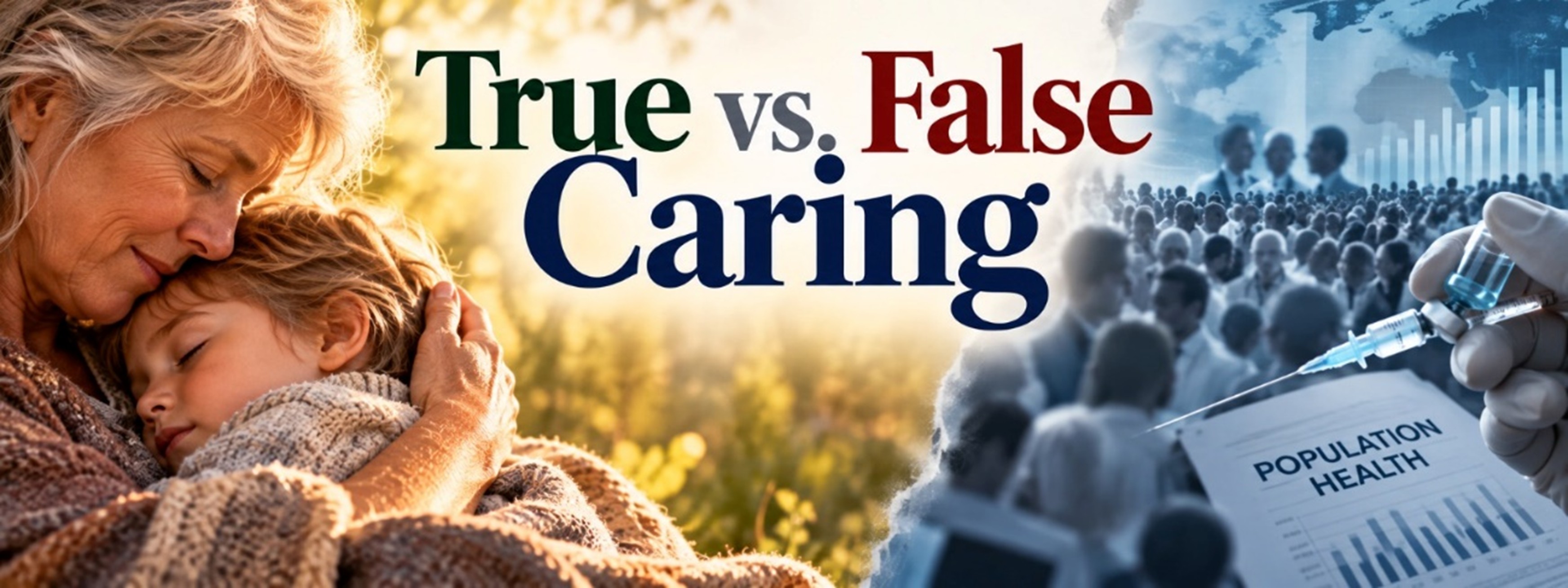
Some of the greatest acts of cruelty in human history have been committed by people who sincerely believed they were doing good. Governments have sacrificed individuals for the nation, religious authorities have inflicted suffering in the name of salvation, and medical institutions have harmed patients while insisting that everything they did was for their benefit. The frightening question is not whether these people believed they cared. Many undoubtedly did. The question is whether their caring was real or had become an intellectual justification for behavior a truly loving heart would find unbearable.
A world of difference separates caring for humanity from caring for the actual human beings who constitute it. True caring begins with the heart, not with the head. Our minds, ruled by the ego, can justify anything, creating astonishing harm. The heart, the spiritual heart, the center of true, pure, and vulnerable feelings, recognizes another person’s existence, suffering, vulnerability, dignity, and right to be treated as someone whose life matters.
False caring begins with a concept. It attaches itself to an idea of goodness, responsibility, protection, or collective welfare while gradually losing sensitivity to the individuals it supposedly protects. Vaccines are at the center of this. They serve the greater good, no matter how many children and adults they hurt.
It is one of the most dangerous deceptions of the psychological self. The ego can become so identified with being good, loving, responsible, or morally superior that it loses the ability to recognize when its actions are hurting others. The image of caring becomes more important than the experience of the person receiving that care.
A parent can control a child’s life while insisting that everything is being done out of love. A husband can dominate his wife because he believes he knows what is best for her. A physician can impose his judgment while ignoring the patient’s suffering. And governments can create policies that inflict enormous hardship while congratulating themselves on protecting the public.
Believing we care does not prove our actions are caring. The essential difference is whether our concern comes from the reality of another person’s experience or from our attachment to what we believe is good for them.
True caring requires listening. It requires a willingness to recognize suffering even when it contradicts our beliefs, our intentions, or the institutions we trust. Most people in power, and even most people in general, listen poorly.
When Public Health Loses Its Heart
Nowhere is this distinction more consequential than in public health. Public health concerns itself with populations, statistics, probabilities, and reducing disease across entire societies. Unfortunately, infants, children, and adults get hurt and killed, and at no time like today have the forces of denial been stronger.
A medical intervention can be evaluated according to the number of people expected to benefit, the number expected to experience adverse effects, and the overall balance of outcomes. A favorable statistical outcome does not automatically answer what happens to those who suffer. Historically, public health officials have committed the nastiest, most uncaring, unbelievable acts imaginable. We saw this early in 2020 when COVID hysteria spread like wildfire.
The Logic of Sacrifice
Vaccination brings this ethical conflict into sharp focus. Vaccination programs are designed to prevent infectious disease across populations. Their justification is based upon anticipated protection, both individual and collective. Yet every medical intervention requires honest attention to its potential harms, and vaccination is no exception. But health experts and mainstream doctors ignore or deny the actual harms whenever possible. It is as far away from caring as anyone can be.
The Whole Cannot Be Separated from Its Parts
I have long believed that separation is largely a construction of the ego-dominated mind. We experience ourselves as isolated individuals, divided from one another by bodies, identities, beliefs, and social boundaries. Yet beneath these differences is a deeper unity of existence. We cannot claim to care for the whole while becoming indifferent to the suffering of those who belong to the whole.
The child injured by a medical intervention is part of humanity. The elderly patient whose adverse reaction is dismissed is part of humanity. The nurse who loses her livelihood for refusing a medical intervention is part of humanity.
This is precisely where public health language can become misleading. The population begins to sound like an entity separate from the individuals who compose it, as though something called society has interests that can be considered independently of its members’ actual lives. But society does not suffer. Individuals suffer. Society does not hold a dying child. A mother does.
The Ego Behind Institutional Goodness
False caring is especially hard to recognize because it often involves sincere intentions. Physicians may sincerely believe they are protecting patients. Public-health officials may sincerely believe they are protecting populations. Parents may sincerely believe they are protecting children. But sincerity does not eliminate the possibility of error, coercion, or cruelty.
The psychological self is extraordinarily skilled at disguising its own needs as moral convictions. It wants to be right, respected, trusted, and recognized as good. Once an institution identifies with a particular definition of goodness, admitting its policies have caused avoidable harm can feel like an attack on its very identity.
True Caring Cannot Be Reduced to a Calculation!
An organization can be so certain an intervention is beneficial that refusing it becomes intolerable. That describes the American Academy of Pediatrics perfectly, which would like to mandate all vaccines. The individual’s freedom to vaccinate or not is treated as an obstacle to doing good. Caring without respect for the person becomes coercion. Caring without listening becomes domination. Caring without humility can become cruelty.
The deepest distinction between true and false caring cannot be discovered through intellectual argument alone. When we genuinely love someone, their suffering matters to us. We do not need to calculate whether they are statistically significant before recognizing their pain.
One cannot truly love the whole while treating its wounded parts as expendable. And perhaps that is the ultimate difference between true and false caring. False caring needs to believe it is doing good. True caring requires knowing what is happening to those it claims to love.
Dr.Sircus is a reader-supported publication. To receive new posts and support my work, consider becoming a free or paid subscriber.
Subscribe now

comments