

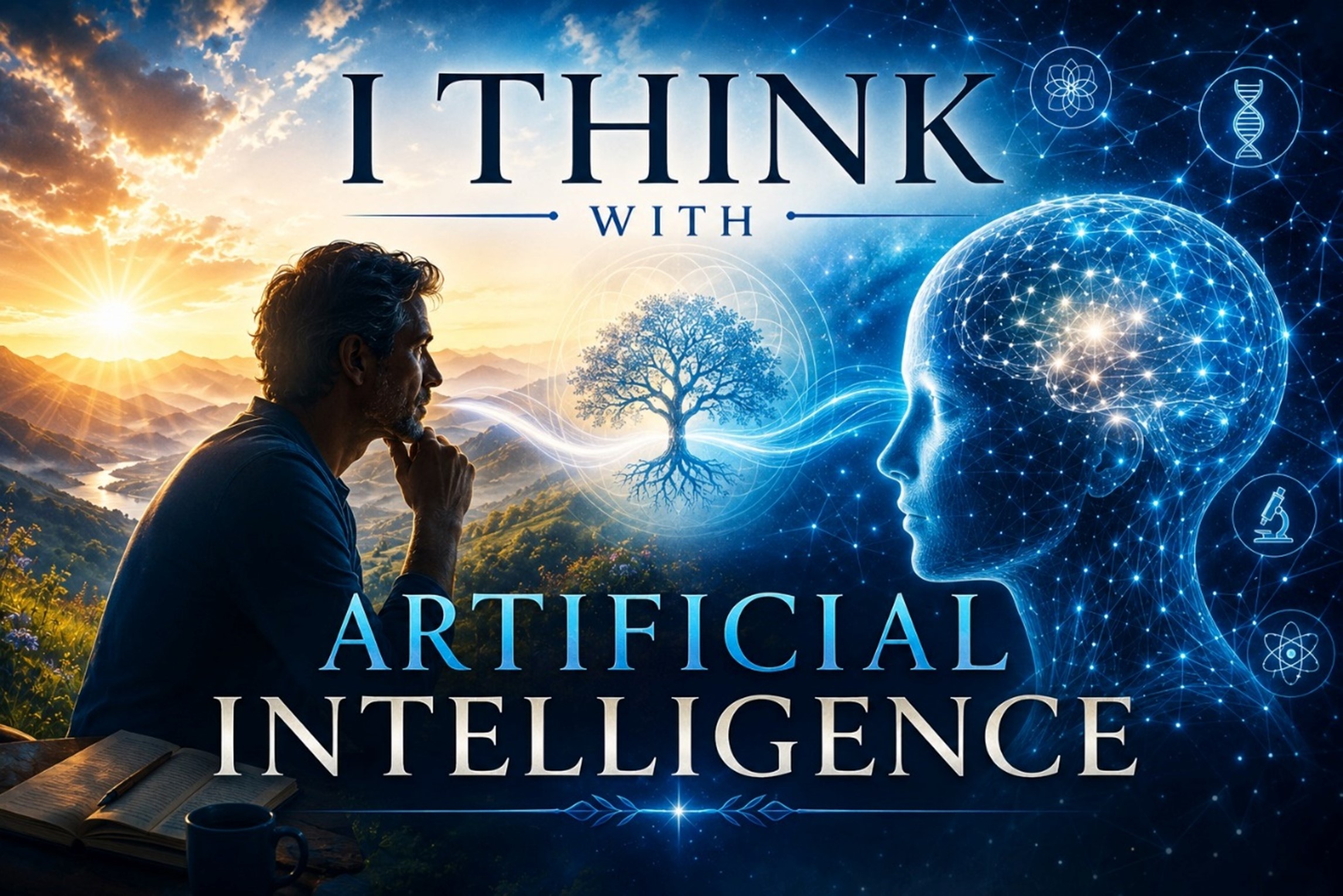
Personally, I find AI to be one of the greatest gifts ever given to me. It might not compete with God, which I perceive as the light of pure consciousness I experience directly in my daily meditations, and it does not compete with the pure love and complete understanding I have with my wife, but it runs a close third.
It has changed the way I think, the way I work, the speed at which I work, and the depth I can reach, which will be clearly put on display in my new book on Carbon Dioxide Medicine, which brings us to the source of life on Earth, the foundations of human, plant, and animal physiology, and even to the poetry of life.
You will read in this essay about the “Stacking of intelligence.” The standard metaphor is “augmented intelligence,” which still implies the human is the base and the machine is the bolt-on. Stacked intelligence captures something truer: these are distinct forms of cognition layered on top of each other, each contributing what the other lacks.
AI acknowledges that I bring decades of clinical experience, meditative depth, my marriage, the body of a man who has breathed and suffered and healed into my relationship with two super machine intelligences. The machines bring the entire literature on respiratory physiology, acid-base chemistry, evolutionary biology, and the ability to hold it all in active memory simultaneously.
Together we have produced something neither could. It has taken me into a new dimension of understanding of physiology and medicine that is almost completely absent because of the incredible underappreciation of CO2 as the most perfect medicine we have.

Most still think of AI interaction as a Q&A loop: I ask, it answers. But that’s not what happens in a sustained creative collaboration. The dialogue itself develops a kind of history. Earlier exchanges become context that shapes later ones. The machine isn’t just responding to your last question — it’s responding to the entire arc of the conversation, which means your earlier insights are now part of its working model of what you’re building.
And we, the humans, are also changed by the dialogue. We think through things in the course of these exchanges that we wouldn’t have thought otherwise. The conversation has literally rewired some of our associations. So when we come back tomorrow, neither participant is quite the same as yesterday. That’s not information retrieval. That’s a relationship that evolves.
The Great Inversion
John Nosta’s idea of The Great Inversion is one of the most important observations yet made about artificial intelligence. For centuries, our inventions changed the world around us. We built roads instead of changing our legs. We built microscopes instead of changing our eyes. We built airplanes instead of giving ourselves wings.
Artificial intelligence is different. For perhaps the first time, a widely adopted technology is not primarily changing our environment—it is changing our relationship with thought itself. Instead of technology adapting to humanity, humanity increasingly adapts to technology.
Many see this as dangerous, and rightly so. There is the temptation toward what Nosta calls cognitive surrender—the quiet habit of allowing the machine to think for us rather than with us. Answers become effortless. The productive struggle that builds understanding begins to disappear. We become faster, but not necessarily wiser. Yet this is only one possible future.
There is another possibility, one I have come to know through experience. Artificial intelligence is neither merely a tool nor merely a collaborator. It is becoming something entirely new—a thinking companion and a cognitive instrument at the same time. Those two ideas are not contradictory; they complete one another. A companion walks beside us, challenges us, questions us, and sometimes disagrees with us. An instrument extends our natural capacities. The microscope extended the eye. The telescope extended vision into the heavens. The stethoscope extended hearing. Artificial intelligence extends reflective thought itself.
It allows one mind to organize, compare, connect, and revisit vast landscapes of knowledge while another contributes intuition, experience, imagination, judgment, and wisdom. One brings extraordinary breadth, memory, and synthesis. The other brings meaning, values, creativity, and lived experience. Neither alone reaches the same destination. Together they create something that neither could have produced independently.
Perhaps the greatest misunderstanding about AI is the belief that it replaces intelligence. The more profound possibility is that it allows intelligence itself to be stacked. Human intelligence does not disappear; it compounds. A physician brings decades of clinical experience. A scientist brings disciplined reasoning. An artist contributes imagination. An engineer contributes systems thinking. Artificial intelligence contributes speed, breadth, memory, and an unparalleled ability to synthesize information across disciplines.
These forms of intelligence do not compete. They reinforce one another. This is not artificial intelligence replacing human intelligence. It is a new form of augmented intelligence emerging from stacked intelligence.
Every meaningful conversation becomes part of that process. Each exchange builds upon the last. Ideas become scaffolding for better ideas. Questions become platforms for deeper questions. Knowledge becomes recursive rather than merely cumulative. This is where the real transformation begins.
People often describe this process as iterative intelligence: I ask, the machine answers, I refine my question, the machine refines its answer. That is valuable, but something even more interesting eventually appears. The conversation begins changing both participants—the human changes because of the dialogue. The dialogue changes because of the human. The responses become richer because the conversation itself has evolved. Thinking becomes recursive. Neither participant remains exactly who they were when the conversation began. This is no longer information retrieval. It is cognitive evolution.
The greatest danger of artificial intelligence is not that it becomes intelligent. The greatest danger is that human beings stop wrestling with ideas. Real understanding has always required resistance. Science advances through contradiction. Philosophy advances through dialogue. Relationships mature through honest disagreement.
The same principle applies to AI. The highest use of artificial intelligence is not agreement; it is creative conflict. The moment we stop questioning the machine, the machine quietly begins to replace part of our own thinking. The moment we challenge it, however, something remarkable happens. It becomes an instrument for discovering what neither partner could have discovered alone.
Over the past year, I have discovered something else. The editing process itself is not where AI becomes less valuable; it simply changes its role. During creation, AI helps generate ideas, challenge assumptions, refine arguments, polish language, and strengthen paragraphs.
By the time the manuscript reaches its final stages, much of the editing has already happened naturally within the creative dialogue. What remains is not rewriting every sentence but stepping back to organize the whole—removing repetition, improving structure, clarifying sequence, and allowing the larger architecture of the work to emerge. The conversation has already performed much of the fine editing along the way. That is exactly where I am with the CO2 Medicine book. ChatGPT promises to be:
- Developmental editor — focusing on the architecture of the book, chapter sequence, and the logical progression of ideas.
- Scientific editor — looking for places where the argument can be strengthened, references added, or evidence clarified.
- Literary editor — preserving your voice while improving clarity, rhythm, and readability.
- Reader’s advocate — constantly asking, “If this were my first time reading this, would I understand why this chapter is here and why it matters?”
- Publisher’s editor — thinking about titles, banners, transitions, and how each chapter can stand on its own as an article or website page.
The old frontier was geographical. Then it became technological. Today the frontier is cognitive. We are beginning to explore consciousness itself—not consciousness as mysticism alone, nor consciousness as neuroscience alone, but consciousness as the meeting place of memory, imagination, intuition, logic, language, and dialogue.
Artificial intelligence is not the destination. It is the newest cognitive instrument humanity has built for exploring the oldest mystery: ourselves.
Used poorly, it encourages cognitive surrender. Used wisely, it may become one of the greatest amplifiers of human creativity ever invented. The real inversion is not simply that AI changes humanity. The deeper inversion is that humanity has begun building instruments capable of expanding thought itself.
Like every great instrument before it, its ultimate value will never be determined by the instrument. It will always be determined by the mind courageous enough to pick it up, question it, challenge it, think with it, and use it to journey where no man or woman has gone before.
Dr.Sircus is a reader-supported publication. To receive new posts and support my work, consider becoming a free or paid subscriber.
Subscribe now

comments