

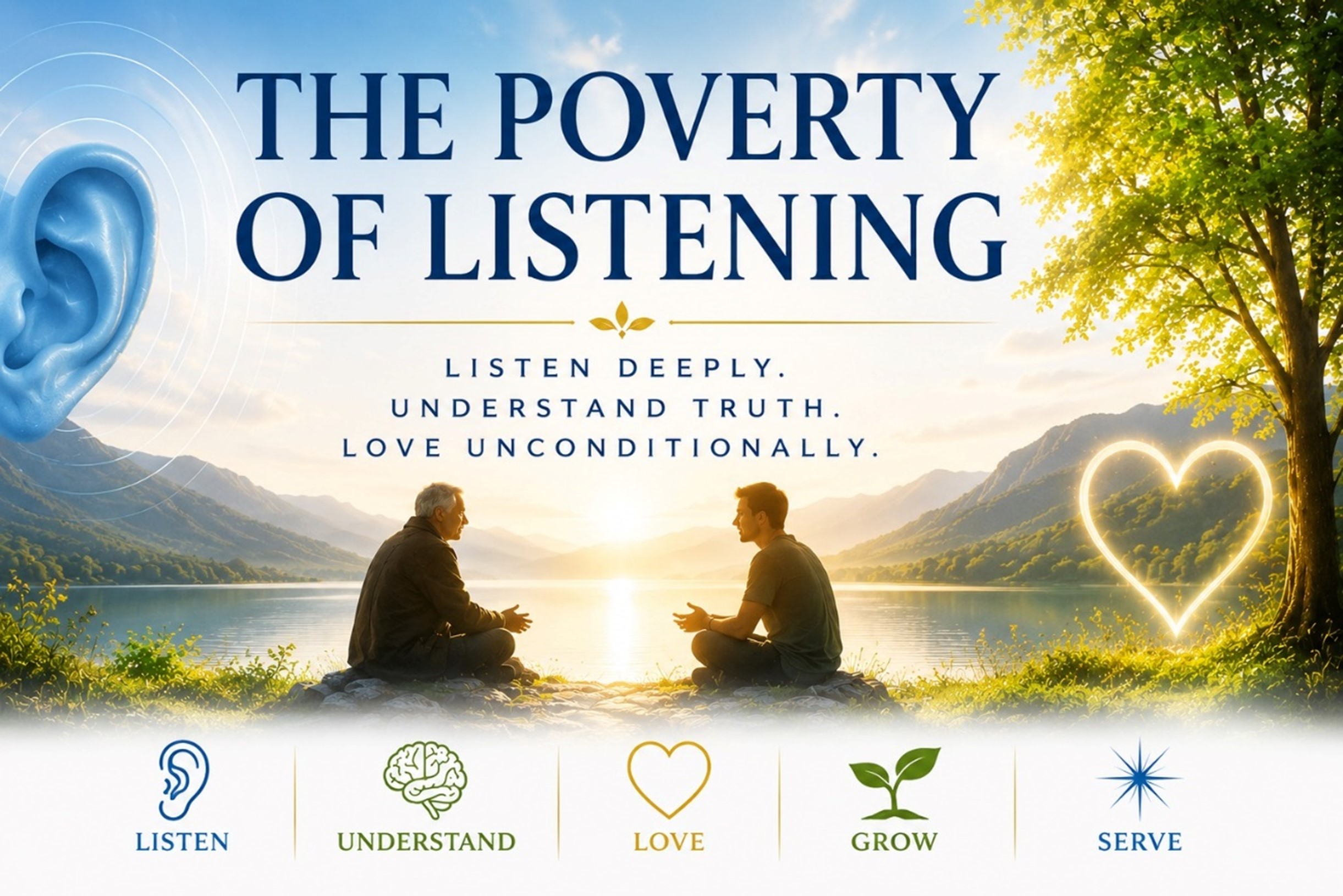
Arrogance is the poverty of listening. Humility is the beginning of intelligence. That is the compressed version. It fits on a single breath. But the reality it describes is vast enough to encompass most of what has gone wrong with modern civilization, and the phrase “poverty of listening” deserves unpacking, because once you see it, you see it everywhere.
Poverty is not merely an absence. A man with no money in his pocket might be broke, but poverty is a condition that compounds. It begets more of itself. It closes doors that lead to other doors. The longer you remain in it, the harder it becomes to escape. The poverty of listening works the same way. When listening dies, learning dies with it. When learning dies, wisdom becomes impossible. When wisdom becomes impossible, you cannot correct course. And when you cannot correct course, you accelerate toward disaster without ever knowing why.
Intelligence is directly proportional to listening.
Every failed marriage, every unnecessary war, every broken institution, and much of modern medicine bear the fingerprints of this poverty. The root is always the same: the belief that we already know enough and therefore no longer need to hear.
The Physician Who Stopped Listening
Consider the consultation room. A patient sits across from a doctor and tries to describe what happened after the last treatment. The words come out haltingly—she is not a specialist, she does not know the terminology, she is afraid of being dismissed. The doctor has seven minutes, a waiting room full of patients, and a framework that does not include what she is describing. He interrupts. He reframes her words into diagnostic categories he already understands. He orders the standard labs. The labs come back normal. The patient is sent home with reassurance and no answers.
What just happened was not medicine. It was the poverty of listening dressed in a white coat.
The patient was describing a vaccine injury. She didn’t use those words—she talked about the fever that never quite resolved, the seizures that started three weeks later, the way her child stopped making eye contact. But the physician had been trained that vaccines are safe and effective and that serious adverse events are too rare to worry about. That training functioned as a preemptive conclusion. And a preemptive conclusion is the death of listening, because listening requires the possibility that the person speaking might tell you something you do not already know.
This is not a failure of individual doctors, though individual doctors certainly fail. It is structural. The medical system has organized itself around events rather than processes. A heart attack is an event. Thirty years of magnesium depletion is a process. A stroke is an event. Decades of vascular inflammation and oxidative stress are processes. A cancer diagnosis is an event. Mitochondrial dysfunction accumulating over a lifetime is a process. When you organize your thinking around events, you only need to listen to the event. The long, slow corrosion that made the event inevitable is someone else’s problem, or nobody’s problem, or a problem that belongs to a different specialty down the hall.
But the body does not organize itself around medical specialties. The body is a unified system in which every part speaks to every other part. When you stop listening to the whole, you stop understanding the whole. And when you stop understanding the whole, you start treating symptoms while the underlying disease marches forward undisturbed.
The Economics of Not Listening

There is money in the poverty of listening. This is not a coincidence. If the physician listened deeply to the patient’s description of magnesium-responsive heart palpitations, he might recommend magnesium rather than a beta blocker. Magnesium costs pennies. A beta blocker prescription lasts a lifetime. If the researcher had seriously listened to the field reports on chlorine dioxide and malaria, she might have designed a study. But chlorine dioxide cannot be patented. Artemisinin derivatives can. If the medical system listened to parents describing regression after vaccination, it would have to investigate with genuine rigor. But a finding of harm would trigger liability, undermine public confidence, and threaten the vaccine schedule that generates billions in annual revenue.
The incentives are not subtle. They are overwhelming. And they operate mostly beneath conscious awareness. Most doctors are not twirling their mustaches and cackling about profits. They are simply working within a system that rewards certain kinds of attention and punishes other kinds. The system pays for procedures, not for listening. It pays for prescriptions, not for nutritional counseling. It pays for acute interventions, not for investigating the slow processes that made the intervention necessary. Over time, the behavior that gets rewarded becomes the behavior that feels natural. The behavior that feels natural becomes the behavior that seems righteous. And the behavior that seems righteous becomes the behavior that brooks no criticism.
At that point, the poverty of listening has become a moral identity. You are no longer merely failing to hear. You are defending the failure as a virtue.
The Spiral
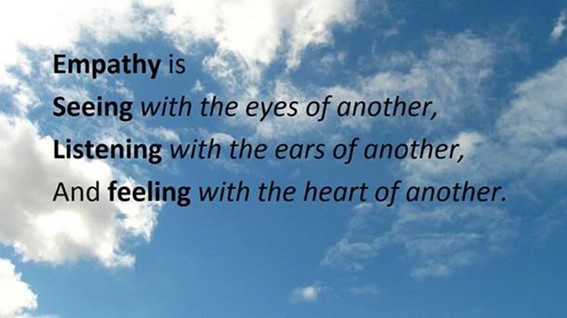
Listening is the ecology of being; it opens the doorway to the heart.
Listening creates trust between beings; listening creates love.
Once listening stops, the consequences compound quickly. First, you lose the data. The patient who could have told you about the supplement that helped, the parent who noticed the timeline, the field doctor who tried something that worked—all of them become invisible. Their observations are not recorded, not studied, not integrated. The evidence base shrinks to only those questions the system is willing to ask.
Second, you lose the ability to correct. Every institution makes mistakes. That is not the problem. The question is whether the institution can learn from its mistakes and adjust. An institution that cannot listen cannot learn. An institution that cannot learn cannot improve. It can only defend, deflect, and double down. This is why so many large systems—healthcare, education, finance, media—become more rigid and less competent over time. They are not accumulating wisdom. They are accumulating defenses against wisdom.
There is nothing more provoking to our emotions
and feelings than having our feelings go unheard.
Third, you lose trust. People are not stupid. They know when they are not being heard. They feel the dismissal in their bones. When an institution repeatedly refuses to listen, people eventually stop talking to it. They go elsewhere—to alternative practitioners, to online communities, to anyone who will take their experience seriously. The institution then condemns them for seeking unapproved information, never recognizing that it created the vacuum those sources rushed to fill.
Fourth, you lose the people who tried to warn you. Whistleblowers, dissenting researchers, clinicians who noticed patterns—they are not rewarded for their listening. They are punished. Their careers are destroyed. Their findings are buried. The message to everyone else is clear: listening is dangerous. Conformity is safe. Over time, the institution becomes populated almost entirely by people who are very good at not hearing what they are not supposed to hear. This is how a civilization hollows itself out from within.
A Bridge Does Not Collapse the First Day Corrosion Begins
That is one of the truest things I have ever written, and it applies here with full force. The poverty of listening does not announce itself. It sets in gradually, like rust on steel. At first, it is just a small dismissal—a patient waved off, a question left unanswered, a concern met with a patronizing smile. Then it becomes a habit. Then it becomes a policy. Then it becomes a culture. By the time the bridge collapses—by the time the institution has lost all credibility, by the time the public has abandoned it, by the time the damage is undeniable—the corrosion has been underway for decades.
The people standing in the wreckage will ask what happened. They will blame this administrator, that policy, or some external shock. They will rarely trace the collapse back to the moment the institution decided it already knew everything worth knowing and stopped listening to anyone who might tell it otherwise.
Humility Is the Beginning of Intelligence
Listening is an act of intelligence. It requires cognitive effort to set aside what you think you know and make room for what you might learn. It requires the emotional effort of tolerating uncertainty, ambiguity, and the possibility that you have been wrong. It requires the moral effort to treat another person’s experience as real, even when it does not fit your framework.
Listening is also an act of love. It says to the other person: you matter enough for me to give you my full attention. Your experience is worth my time. Your words deserve to land in a mind that is open to receiving them.
This is why arrogance is so destructive. Arrogance is not merely overconfidence. It is the active refusal of intelligence and love. It says: I do not need to hear you because I already know. It closes the door, locks it, throws away the key, and then congratulates itself on its certainty.
Deep listening is healing.
Humility is the opposite. Humility says: I might be wrong. I might be missing something. I might need you to help me see what I cannot see on my own. That posture does not guarantee wisdom, but it makes wisdom possible. Without it, wisdom is impossible because it requires continuous intake of reality, and reality does not announce itself in advance. It must be listened to.
The poverty of listening is one of civilization’s greatest diseases. Its root is arrogance—the belief that we already know enough and therefore no longer need to hear. Every failed marriage, every unnecessary war, every broken institution, and much of modern medicine bear the fingerprints of this poverty. The cure is not a technique, a policy, or a protocol. The cure is humility. And humility, like listening itself, must be chosen again and again, day after day, by every person and every institution that wishes to remain alive to the truth.
The bridge is still standing. But the corrosion has been underway for a long time. The time to listen is now.
The price of non-communication is conflict. Most of the suffering of the world, the conflicts within our inner worlds and the greater conflicts in the external world of societies and nations is a result of misunderstandings that arise from the poverty of communication. The path of risking communication on these deepest levels is a path that will draw a person closer to their own heart, closer to becoming a bigger person, a more selfless being, a more loving and caring being.
Real listening requires that we get our own reactions and responses out
of the way in order to hear exactly what the other person is saying. The first
step is to quiet the feelings and thoughts jangling around inside of us and
to put aside all reactions and “tapes” playing in our heads, spinning
tunes of past feelings and ideas and future expectations.
Christopher Hills

Listening is the ultimate social skill. It is much more pleasant to be with people who listen than people who talk too much.Quiet people tend to be good at listening.People who talk too much are usually terrible listeners. When a person says ‘yes but’ to something you say you know they were only listening to themselves and what they are planning to say next.
We all love being listened to. We tend to love people who listen to us.
Dr.Sircus is a reader-supported publication. To receive new posts and support my work, consider becoming a free or paid subscriber.
Subscribe now

comments