

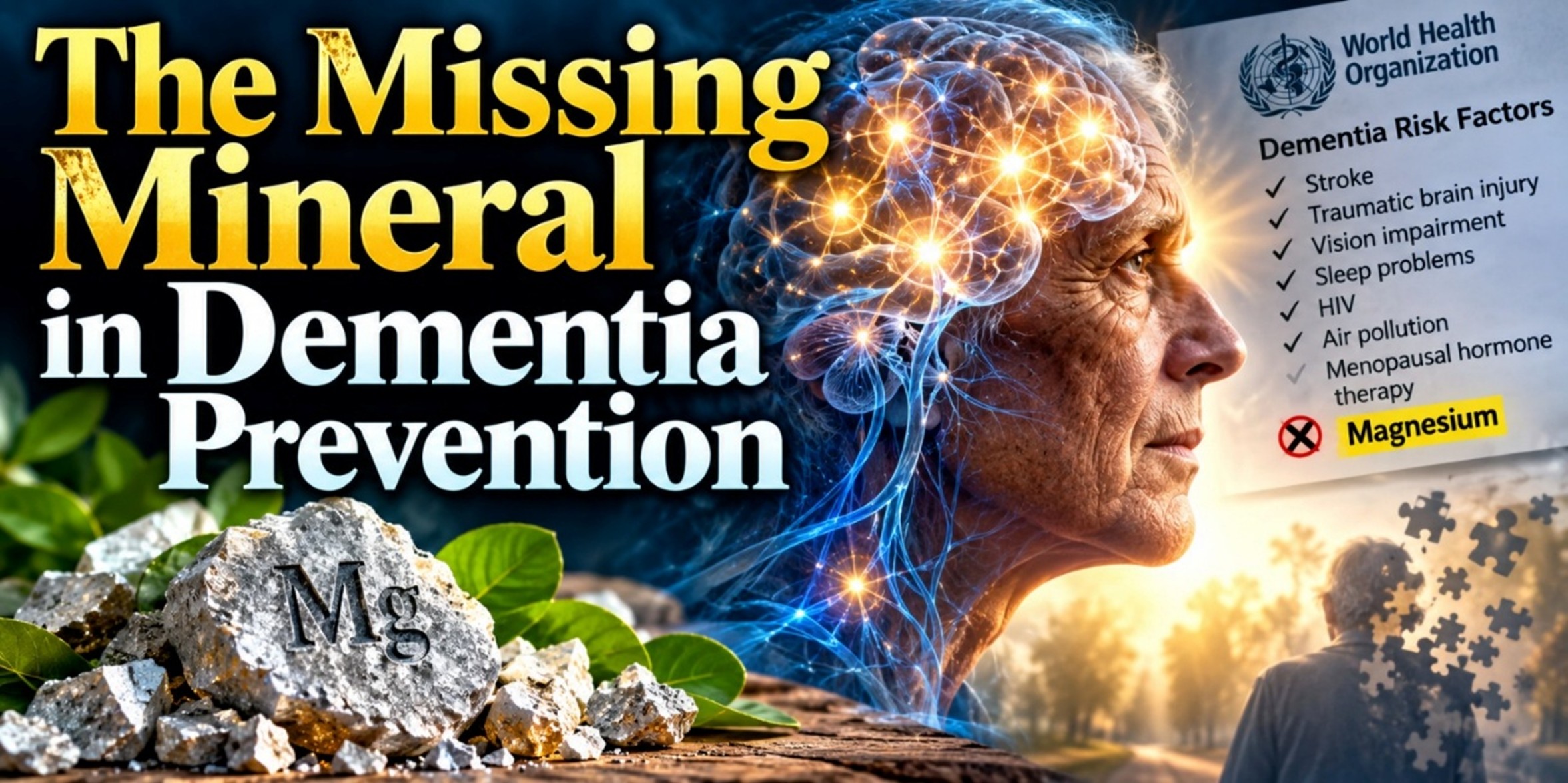
That is a good question and mirrors one of the biggest problems and blind spots in modern medicine. Another major dementia report has appeared, and once again, magnesium is missing from the conversation. The World Health Organization has updated its recommendations for reducing dementia risk, and a September 1, 2026, article published by Fox News and Yahoo Health announced seven additional risk factors: stroke, traumatic brain injury, vision impairment, sleep problems, HIV, air pollution, and menopausal hormone therapy. The existing recommendations include diabetes, hypertension, obesity, unhealthy nutrition, and physical inactivity. But the article never mentions magnesium. Not once.
How can we have a serious conversation about preventing dementia without discussing the mineral essential to neuronal function, cellular energy, vascular regulation, and protection against excessive calcium activity in the brain? The answer is: we can’t.
This is not some obscure nutritional substance with a questionable role in human biology. Magnesium is fundamental to life. It participates in hundreds of enzyme reactions, supports mitochondrial energy production, regulates calcium movement, and helps maintain normal electrical activity in the nervous system. It also helps regulate NMDA receptors, which are involved in learning, memory, and potentially damaging overstimulation of neurons. Research reviews have examined magnesium’s possible roles in maintaining the blood–brain barrier, regulating neuroinflammation, and protecting against excitotoxic injury.
The Research They Ignore
In 2023, researchers examining 6,001 participants in the UK Biobank reported that higher dietary magnesium intake was associated with larger brain volumes, including greater hippocampal volume. The hippocampus is particularly important because it supports learning and memory. The researchers also identified associations between magnesium intake patterns and white matter lesions, with notable differences between men and women. The findings were observational, but they offered another reason to examine magnesium in preventing age-related cognitive decline. UK Biobank
A 2024 systematic review and meta-analysis published in Advances in Nutrition followed. Researchers examined three randomized clinical trials and twelve cohort studies involving magnesium and cognitive health. Compared with a serum magnesium concentration of 0.85 mmol/L, concentrations below 0.75 mmol/L were associated with a 43 percent higher hazard of dementia or cognitive impairment.
Now, in 2026, researchers in Japan added another piece to the puzzle. An eight-year study followed 13,032 adults aged 40–74. Among men, those in the lowest quartile of dietary magnesium intake had a 73 percent higher observed dementia hazard than those in the highest quartile.
Ignoring magnesium in medicine is like ignoring a truck hitting you. Not giving a severely magnesium-deficient patient magnesium is exactly like telling a man dying of thirst in the desert that water is not indicated. You’ll find these words in my essay Medical Insanity, The Disease Doctors Don’t Know They Have.
The Brain Cannot Be Separated from the Cardiovascular System

One of the central arguments in my book Unclogging Your Arteries is that you can’t understand cardiovascular health by looking at cholesterol and blood pressure alone. Artery health depends on a complex relationship involving inflammation, insulin resistance, calcium metabolism, mitochondrial function, and the availability of essential nutrients.
The brain is no exception. A brain weighing approximately three pounds depends on an extraordinary supply of oxygen, glucose, and other nutrients. Its neurons require continuous energy production to maintain their electrical activity and communication.
Blood vessels must keep delivering what the brain needs. Mitochondria must produce energy, but they won’t if they don’t have enough magnesium. Neurons must regulate calcium and other electrolytes to maintain normal signaling. Magnesium participates in all these processes, so ignoring it is medically hollow.
The brain cannot function without magnesium, so deficiencies are very problematic for neurological health. We do not need to claim that magnesium cures Alzheimer’s disease to recognize that its relationship with neuronal activity, inflammation, vascular health, and cognitive decline deserves a laser focus on this mineral drug.
Why must readers search scientific journals to discover that magnesium has been investigated in connection with hippocampal volume, dementia risk, neuronal excitability, and neuroinflammation? Because doctors are blind and would rather poison you with pharmaceuticals? Certainly, cardiologists will dish out statin drugs, which could compromise the brain, which is highly dependent on healthy levels of cholesterol, rather than prescribe magnesium as an essential medicine for neurological vulnerabilities.
Sad Conclusion
The tragedy of dementia is not merely that people lose their memories. It is that they gradually lose their independence, their ability to communicate, and sometimes their capacity to recognize the people they love. Families watch the slow disappearance of someone who is still physically present. Few medical conditions place such a profound emotional burden on spouses, children, and caregivers.
That suffering demands intellectual seriousness from everyone involved in dementia research and public health, but patients don’t get it from their doctors. Magnesium is not the whole answer to dementia. But a dementia-prevention conversation that overlooks magnesium is missing the crucial piece of the puzzle. You can also consider DMSO, chlorine dioxide, bicarbonates, iodine, and selenium as support, because it always makes sense to cover the basics of physiology.
When millions of people are facing the prospect of cognitive decline, we cannot afford to leave essential aspects of human physiology out of the conversation. The brain needs oxygen. It needs circulation. It needs energy. And it needs magnesium. And, would you believe, it even needs healthy levels of carbon dioxide.
Dr.Sircus is a reader-supported publication. To receive new posts and support my work, consider becoming a free or paid subscriber.
Subscribe now

comments